Health guide
Inversion Table Negative Side Effects: What the Research Actually Shows

Inversion table negative side effects fall into two groups: what happens inside your body while you are upside down, and what happens when something goes wrong with you or the table. We are not doctors and we have not tested these tables on people, so we give you the numbers from the studies and recall notices together with their limits.
Inversion Table Negative Side Effects, Ranked by Evidence
Not every warning about inversion rests on the same kind of proof. It helps to sort them before going through each one.
Measured in Studies
Three effects have been measured directly in inverted people. Blood pressure goes up (Haskvitz, 1986). Eye pressure roughly doubles after five minutes fully upside down (Weinreb, 1984). And a 2019 ultrasound study on an actual inversion table recorded significant changes in blood flow to the brain and in a marker of pressure inside the skull (Kondrashova, 2019).
All three studies were small, and none followed people over months. They tell you what happens during a session, not what happens after years of use.
Documented in Case Reports and Recalls
Falls are the risk with the most serious consequences on record. A 2021 case report describes three cervical spinal cord injuries from inversion table falls (Jung, 2021), and the U.S. Consumer Product Safety Commission recalled about 33,000 inversion benches in 2010 after ankle clamps released and straps broke (CPSC, 2010). None of this gives you a rate. It proves the failure is real.
Claimed but Not Found
Some claims circulate widely with nothing behind them. We found no study giving a percentage of users who get dizzy or develop vertigo, even though a figure of about one in five appears on many pages. We found no study showing inversion relieves headaches, improves circulation or sharpens thinking. And we found no peer-reviewed study linking inversion tables to cortisol or stress hormones; that claim comes from wellness marketing, and we deal with it on our page about what inversion tables can and can’t do.
Blood Pressure Goes Up When You Invert
Blood pressure is the side effect with the longest research history, and the one most doctors mention first.
What the 1986 Trial Measured
Researchers randomized 60 women aged 20 to 30 and put some of them upside down for two minutes, comparing them with women standing upright. “Both systolic and diastolic blood pressures increased significantly,” they wrote, and they warned that this “indicates a need for caution when using inversion traction as a treatment technique for low back pain” (Haskvitz, 1986). Their final line was that “hypertensive individuals may need to avoid its use.”
What It Did Not Measure
The trial’s abstract does not report how many mmHg the pressure rose. If you see a site quoting a precise number from this study, that number is not in the abstract.
The sample was also young, healthy and entirely female. Nobody in it had high blood pressure, heart disease or a history of stroke, which are exactly the people for whom the rise would matter most. So the result tells you the direction of the effect, clearly, and nothing about its size in older or less healthy users.
The Numbers From a 1983 Gravity Boots Study
For a size, the figures come from an older and more extreme setup. In a 1983 letter reporting two small studies, Klatz and colleagues hung 20 healthy volunteers fully head-down in gravity boots for three minutes. Blood pressure went from 119/74 mmHg seated to 157/93 mmHg inverted, and eye pressure from an average of 19 to 35 mmHg (Klatz et al., 1983). In a follow-up of 12 subjects, hard exercise did not significantly raise eye pressure, while inversion did.
Read those numbers for what they are: boots at full vertical, not a table at a partial angle, in young, healthy people, for three minutes, with no control group. They show how large the rise can be at the far end of inversion. They do not tell you what a table set to 20 or 40 degrees does, and nobody should transfer them to one without saying so.
Why This Is a Side Effect for Everyone
A rise in blood pressure is not only a problem for people who already have hypertension. It happens alongside the other effects on this page, the pressure in your eyes and the change in blood flow to your head, and it is the reason manufacturers ask about heart and circulatory conditions.
If your pressure is normal, a short session is unlikely to be a problem on its own. If it is already high, you start closer to the limit. The condition side of that question lives on our page about who should avoid inversion.
Eye Pressure Roughly Doubles
Eye pressure is where the measured numbers are largest, and they come from several separate research teams.
Five Minutes Fully Upside Down
In a clinical study published in 1984, eye pressure was measured after five minutes of full inversion. In normal eyes it went from 16.8 to 32.9 mmHg. In eyes with glaucoma it went from 21.3 to 37.6 mmHg (Weinreb, 1984).
That is close to double in both groups. The authors recommended that anyone with ocular hypertension or glaucoma “refrain from this activity.”
Partial Head-Down Positions Do It Too
A shallower angle is not a clean fix. In a 2015 yoga study of 10 people with glaucoma and 10 without, Downward Dog held for two minutes raised eye pressure from about 17 to 28 mmHg in the glaucoma group and from about 17 to 29 mmHg in the others (Jasien, 2015). In a headstand study of 75 experienced yoga practitioners, pressure showed “a uniform 2-fold increase” that held for as long as the pose did, measured at five minutes (Baskaran, 2006).
Neither study used an inversion table. They are supporting evidence: if a partly head-down pose does this within two minutes, full inversion on a table is unlikely to do less.
A Spike, Not Measured Damage
The honest caveat matters here. In the 1984 study, visual fields did not change after inversion (Weinreb, 1984), and in the yoga study pressure returned to baseline within two minutes of coming out of the pose (Jasien, 2015). What the research documents is a temporary spike.
For healthy eyes, that is a side effect you will not feel. For eyes that already struggle with pressure, the spike is the concern, which is why eye researchers and manufacturers both tell glaucoma patients to stay off.
One ophthalmologist’s account adds a detail about what happens during the session itself. In a 1985 letter, Thomas Friberg of the University of Texas wrote that his group had measured weaker visual signals travelling from the eyes to the brain, and defects in the visual field, in normal subjects while they were inverted (Friberg, 1985). Those changes disappeared once the subjects were upright again. Friberg himself wrote that it remained uncertain whether healthy people using inversion daily for years would suffer any permanent damage, so this is a temporary effect on vision, not evidence of lasting harm.
Headaches, Dizziness and the Stroke Question
This is the section most people are looking for, and it is where the internet is least careful.
What Inversion Does to Blood Flow in Your Head
The most direct study on this was done on an inversion table, not a yoga mat. In 2019, researchers used ultrasound to measure people lying flat, after three minutes inverted, and after returning flat. The diameter of the optic nerve sheath, a marker of intracranial pressure, “changed significantly” across those positions.
Blood flow in the internal carotid and middle cerebral arteries also changed significantly in velocity, resistance and pulsatility (Kondrashova, 2019). The authors concluded that “inversion therapy should be used with caution,” especially in anyone with a previous history of raised intracranial pressure.
Two limits apply. We have read only the abstract, which gives statistical significance but no absolute values, so we cannot tell you how big the changes were. And the abstract does not report how many people took part or how old they were. What the study does settle is direction: inversion measurably changes what happens in the head, and the researchers read that as a reason for caution, not as a benefit.
Headaches and Dizziness: The Mechanism, Not a Number
No study we found reports how often inversion table users get headaches or feel dizzy. What the evidence gives you is the mechanism.
Blood pressure rises (Haskvitz, 1986), pressure inside the skull shifts, and blood flow to the brain changes (Kondrashova, 2019). A headache or a head rush during or after a session fits that picture. So does lightheadedness when you come back upright.
Teeter, the best-known maker, treats these symptoms as warning signs rather than normal adjustment. Its contraindication list names severe headaches, lightheadedness, dizziness and disorientation among the conditions that call for a physician’s approval before inverting (Teeter). That is a manufacturer’s caution, not a trial finding, but it is a useful rule.
Can an Inversion Table Cause a Stroke?
We found no study showing that an inversion table caused a stroke. What has been measured is the rise in blood pressure and the change in brain blood flow described above. Those findings are the reason for caution in people who are already at risk, which is how Teeter frames it: its list includes a history or risk of TIA or stroke, a history of intracranial bleeding, and anticoagulant use, including high doses of aspirin (Teeter). The accurate answer is that the stroke risk from inversion has not been measured in anyone, and people who already carry that risk are the ones told to get clearance first.
Falls: The Most Serious Documented Risk
If you only remember one section of this page, make it this one. The physiological effects above are temporary. A bad fall is not.
How an Inversion Table Fall Happens
A 2021 report from South Korea describes three people who suffered cervical spinal cord injuries after falling from inversion tables, with tetraplegia among the outcomes. The authors compare the mechanism to a shallow-water diving injury: “once the ankle power is lost or it slips, the user will land on top of their head.” They add a warning that runs against intuition: “falls from 1 or 2 feet high are by no means negligible” (Jung, 2021). When you are fully inverted, your head is only a short distance above the floor, and that is exactly the problem, because you land on the top of it.
This is a three-case report. It cannot tell you how often these falls happen, and we will not call them common or rare. What it shows is how a fall happens and why the ankles are the weak point. If you are weighing a device that doesn’t lock your ankles into a tilting frame, our pages on sitting in an inversion chair and a trapeze hung from a joist or stand cover what changes and what doesn’t. For how the body reacts the longer you stay head-down, see how long you can hang upside down.
Four Recalls, Two Failure Points
The ankle system has failed badly enough, in real products, to trigger recalls. The first CPSC recall came earlier than most people realize. In December 2007, Icon Health & Fitness recalled about 22,000 NordicTrack and Reebok inversion benches, sold from September 2006 to January 2007, because “the ankle clamp mechanism can release unexpectedly.” Icon had received five reports of injuries, “including contusions, lacerations and back pain” (CPSC, 2007).
A month later, in January 2008, Stamina Products recalled about 2,000 of its Inversion Therapy Table and Pro Inversion System units, sold from October 2005 to October 2007. This time the problem was the frame, not the ankles: “A weld in the center of the inversion table can fail when the table is in an inverted position.” Stamina had three reports of weld failures and said no injuries had been reported (CPSC, 2008).
In April 2010, the U.S. Consumer Product Safety Commission announced a recall of about 33,000 NordicTrack, Gold’s Gym and Weider Club inversion benches. The hazard: “The ankle clamp can release unexpectedly or the strap used to limit rotation can break.” The maker had received 75 incident reports, “including 23 injuries, some of which were to the head and neck” (CPSC, 2010).
In January 2015, DICK’S Sporting Goods voluntarily recalled its Fitness Gear Inversion Table, sold from 2011 to 2014. Its notice said the manual “clearly stresses the importance of ensuring the ankle locking systems are engaged,” yet “some customers have fallen and sustained injuries” (DICK'S, 2015). That notice came from the retailer, not the CPSC, and gave no injury count.
Keep these recalls in proportion. They cover specific models sold between 2005 and 2014, each with its own defect, and the older ones were discontinued nearly two decades ago. They do not give an injury rate for inversion tables in general, and they say nothing about the Teeter or Innova models on this site or about what those brands sell today.
What they do prove is a pattern. Three of the four involved the ankle system, the same failure point the case report describes, across different brands and years. The fourth was the frame itself giving way while the user hung from it.
Those are the two things to inspect on any table: the ankle lock and the structure that carries your weight. If the ankle lock or strap on your own table is worn, our guide to ordering a replacement ankle system or tether explains how to get the right part from Teeter or Innova.
What the FDA’s Injury Reports Contain
A 2023 article in Disability and Rehabilitation reviewed how inversion tables are regulated. It notes that the FDA’s Medical Device Reporting database lists serious injuries from inversion table therapy, “including spinal cord injury, fractures, lacerations, and death” (Kassay, 2023). The article gives no count or rate for any of these.
It also explains why the picture is incomplete: the FDA only regulates the tables whose makers claim a medical use, and most makers do not, so most inversion tables sit outside FDA regulation. Put plainly, deaths have been reported, and no public source we found says how many or under what circumstances.
Does Back Pain Get Worse Afterward?
Most people who buy an inversion table buy it for back pain, so a back that feels worse afterward is the side effect that surprises them most. The evidence on it is better than on most of the others.
Seven of 32 Trials Reported Adverse Effects
A Cochrane review published in 2013 pooled 32 trials of traction for low-back pain, with or without sciatica. Adverse effects were reported in seven of them, and they “included increased pain, aggravation of neurological signs and subsequent surgery” (Wegner, 2013). Four trials said explicitly that there were none.
The review covers traction in general, manual and mechanical, not inversion tables specifically. But inversion is a form of traction, so it is the best evidence available on the question.
Tighter Back Muscles, Not Looser
Relaxing the back muscles is one of the most repeated promises made for inversion, and one study measured the opposite. In 2016, researchers recorded lower back muscle activity in 60 healthy men before and after six minutes of inversion. Activity was significantly higher afterward, and the authors concluded that inversion is more likely to increase muscle tension and prevent relaxation (Kim, 2016). Other small studies found the reverse, and our benefits page sets them side by side. Everyone in this one was healthy, so it cannot say whether the extra tension makes back pain worse.
The Benefit Side Is Small
The same review found that traction, alone or with other treatment, “has little or no impact on pain intensity, functional status, global improvement and return to work” (Wegner, 2013). That matters when you weigh side effects.
A risk is easier to accept when the benefit is large and proven. For traction in general it is neither. The smaller studies that looked at inversion specifically are covered on our benefits page.
When Pain Is a Signal to Stop
The review does not separate mild soreness from real harm, so it helps to know which signs match its wording. The ones to take seriously are new or spreading numbness, tingling or weakness in the legs, or pain that is clearly worse than before you started. “Aggravation of neurological signs” is the Cochrane wording for exactly that. If it happens, stop inverting and have it checked before you try again.
What Owners Report
The Complaints in Three Forum Threads
Studies are small, so we also read what owners say. In three long forum threads, on Mayo Clinic Connect, AnandTech and the Polk Audio forum, 19 people described their own results with an inversion table (Mayo Clinic Connect) (AnandTech Forums) (Polk Audio Forum). Six of them got worse or could not tolerate it, and some who did get relief ran into trouble later. The complaints across the threads: blood rushing to the head, dizziness or vertigo, motion sickness, relief that faded once they were upright again (“absolutely no permanent improvement,” one user wrote), pain that got worse with a lateral disc herniation, and one case of inguinal hernias after months of use.
Why Six of 19 Is Not a Rate
These are self-selected stories from people who chose to post about their table, usually without a confirmed diagnosis. Six of 19 is not a frequency of side effects: people with a bad experience may be more likely to post, or less. What the reports do show is which problems real owners run into, and they line up with the measured effects above: pressure in the head, dizziness, and a back that did not always respond.
So, Are Inversion Tables Dangerous?
That depends on who you are and on the table under you. The honest answer has three parts.
For Healthy Users
For a healthy adult, the measured effects happen during the session. Blood pressure and eye pressure rise while you are upside down, and brain blood flow changes. In the yoga study, eye pressure was back to baseline within two minutes, and the 1984 eye study found no change in visual fields.
None of the studies we read followed healthy users long enough to look for lasting harm, and none reported any. The risk that does not reverse is a fall, and that depends on your ankles, your grip, your balance and the table’s ankle system.
For People With Certain Conditions
For people with high blood pressure, glaucoma, a history of stroke or raised intracranial pressure, the same temporary rises land on a system that is already under strain. That is where the researchers’ warnings point. We do not repeat the whole list here: our page on who should not use an inversion table goes through each condition with its evidence.
What Nobody Has Measured
No study we found tracks inversion table users over years. None gives a national injury rate. None measures how often headaches or dizziness happen.
How to Reduce the Risk
You cannot remove the physiological effects; they are what inversion is. You can do a lot about the fall risk, which is the one with permanent consequences.
Look at the Ankle System First
Three of the four recalls and the case report point at the same place: the ankles. When you compare tables, the ankle system matters more than any other spec. Here is how two popular models describe theirs, from the manufacturers’ own published specifications:
| Spec |  Teeter FitSpine X3Premium, price tier 3 of 3Maker source Teeter FitSpine X3Premium, price tier 3 of 3Maker source |  Innova ITX9600Budget, price tier 1 of 3Maker source Innova ITX9600Budget, price tier 1 of 3Maker source |
|---|---|---|
| Ankle system | Deluxe EZ-Reach ankle lock, extra-long handle, micro-adjusting closure | Reversible ankle holders (foam rollers and U-shaped holders can trade places) |
| Angle control | EZ-Angle tether marked at 20°, 40° and 60°; full inversion with secure lockout | Pin with protective cover; the manual labels the settings 15°, 30°, 45°, 60° and 85° (the product page calls it a six-position pin) |
| Weight capacity | 300 lb | 300 lb |
| User height | 4'8" to 6'6" | 4'10" to 6'6" |
| Warranty | 5 years (extension to 10 sold separately)Highest here | 1 year limited |
| FDA | 510(k) cleared (K162702), Class I device | Not stated |
| Assembly and setup | 85% pre-assembled, BILT app instructions (brand-wide claim) | Not stated |
| Buy | See today's price: Teeter FitSpine X3 on Amazon (opens in a new tab) | Not linked |
Teeter FitSpine X3Maker source- Ankle system
- Deluxe EZ-Reach ankle lock, extra-long handle, micro-adjusting closure
- Angle control
- EZ-Angle tether marked at 20°, 40° and 60°; full inversion with secure lockout
- Weight capacity
- 300 lb
- User height
- 4'8" to 6'6"
- Warranty
- 5 years (extension to 10 sold separately)Highest here
- FDA
- 510(k) cleared (K162702), Class I device
- Assembly and setup
- 85% pre-assembled, BILT app instructions (brand-wide claim)
Innova ITX9600Maker source- Ankle system
- Reversible ankle holders (foam rollers and U-shaped holders can trade places)
- Angle control
- Pin with protective cover; the manual labels the settings 15°, 30°, 45°, 60° and 85° (the product page calls it a six-position pin)
- Weight capacity
- 300 lb
- User height
- 4'10" to 6'6"
- Warranty
- 1 year limited
- FDA
- Not stated
- Assembly and setup
- Not stated
Maker source from the maker's own page or manual, not independently testedListing only retail listing, no maker spec sheetNot stated the maker publishes nothing
A published spec tells you how a system is designed, not how it holds up after years of use. Whatever table you use, check that the ankle lock is fully engaged every single time before you tilt back, and replace worn parts rather than working around them. Our inversion table buying guide compares ankle systems and frames across more models.
Set the Angle Before You Get On, and Keep It Short
A table that limits rotation lets you decide how far you go before you are upside down. The Teeter X3 marks 20, 40 and 60 degrees on its tether; the Innova ITX9600 uses a pin whose settings its manual labels 15°, 30°, 45°, 60° and 85°, although the product page gives no degrees, so check the manual before your first session. Remember that even partial head-down positions raise eye pressure (Jasien, 2015), so a shallow angle limits the fall height and the strain, but it does not make the pressure rise disappear.
The authors of the 2021 case series recommend keeping sessions “less than 1 min” to reduce fall risk (Jung, 2021). That is their recommendation, not a clinical consensus, but it is the only published guidance on session length we found tied to injury. For what the makers publish about low angles, see our beginner inversion exercises.
Put Something Under Your Head
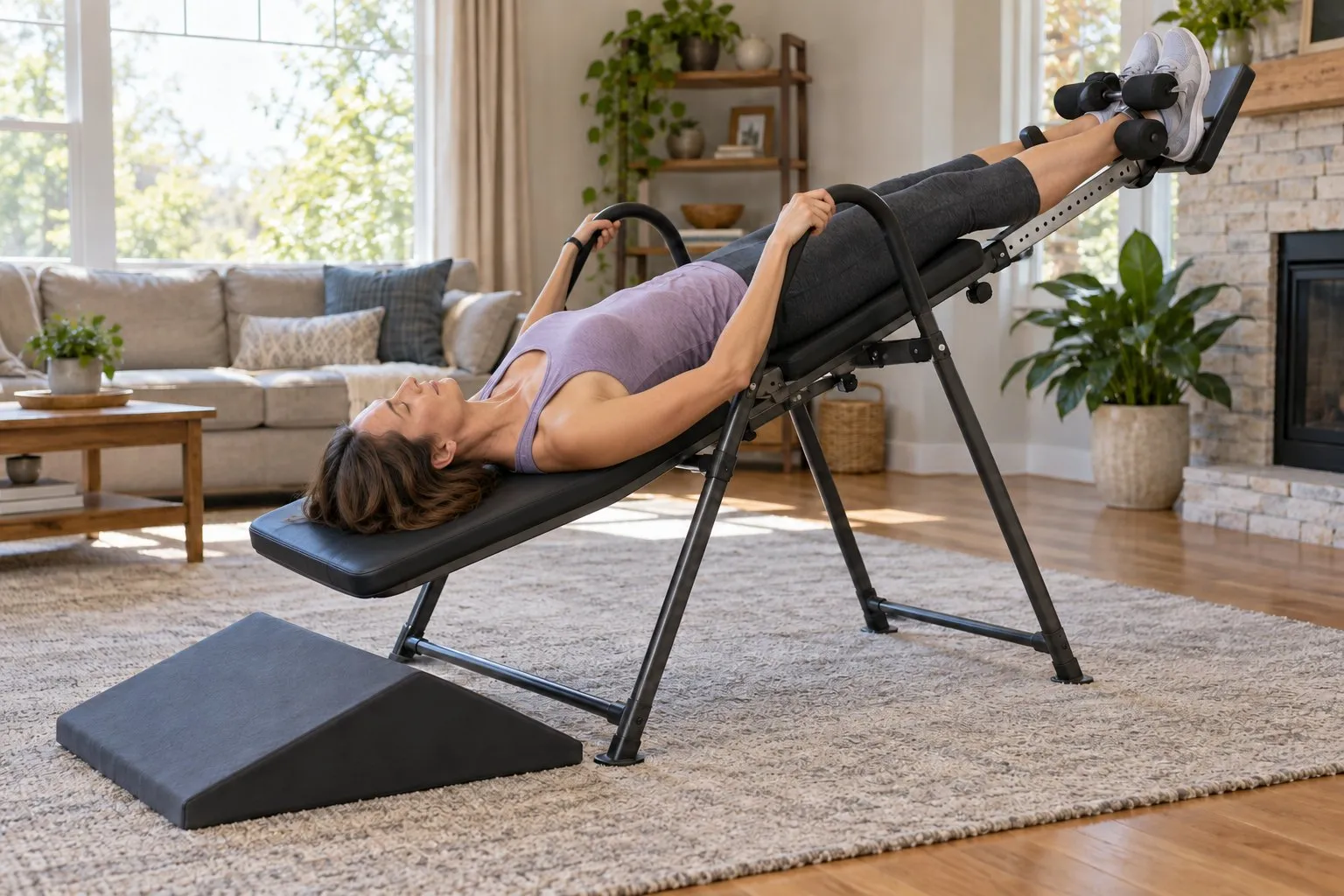
That advice targets the exact mechanism of the injuries they report. They also single out older and heavier users with weaker ankle strength as needing extra care. Our own suggestion, not a study finding: for your first sessions, have someone else in the room who can help you back upright.
Stop at the First Warning Sign
A headache, dizziness, blurred vision, a pounding feeling in your head, or new tingling in your legs are all reasons to come back upright and end the session. None of the studies here tell you which of these is dangerous and which is harmless, and that uncertainty is itself the reason to stop and ask your doctor rather than try again the next day.
Your questions, answered
Frequently Asked Questions
What are the negative side effects of inversion tables?
The measured ones are a rise in blood pressure, eye pressure that roughly doubles when fully inverted, and significant changes in a marker of pressure inside the skull and in blood flow to the brain. The most serious documented harm is a fall onto the head, which has caused spinal cord injuries. Headaches and dizziness are plausible, but no study gives a frequency.
Is there a risk of stroke when using an inversion table?
No published study we found shows an inversion table causing a stroke. What has been measured is a rise in blood pressure and significant shifts in brain blood flow and in a marker of intracranial pressure. That is why the researchers urge caution, and why Teeter tells anyone with a history or risk of stroke or TIA to get a physician's approval first.
Does inversion increase blood flow to the brain?
It changes it, but more is not the same as better. A 2019 ultrasound study on an inversion table found significant changes in velocity, resistance and pulsatility in two arteries that feed the brain, plus a rise in an intracranial pressure marker. Its authors concluded that inversion should be used with caution. No study we found shows a cognitive or circulatory benefit.
Do inversion tables help with headaches?
There is no evidence that they do. We looked for the study often quoted online about inversion relieving migraines and tension headaches and could not find it. The one study that measured the head during inversion found changes in blood flow and in an intracranial pressure marker, and Teeter lists severe headaches as a reason to get a doctor's approval first.
What happens if you stay on an inversion table too long?
The longer you stay, the longer your blood pressure and eye pressure stay raised, and the more time your ankles have to tire. Eye pressure in a headstand study stayed doubled for as long as the pose lasted. The authors of a 2021 case series on falls advise sessions under one minute, because tired ankles are how the injuries they describe started.
Why is my back pain worse after using an inversion table?
Traction does not agree with every back. A Cochrane analysis of 32 traction trials found adverse effects reported in seven, including more pain and worsening nerve signs, and some people went on to surgery. It covered traction broadly, not only tables. New tingling, numbness or weakness after a session is a signal to stop and see a clinician.
19 sources used for this guide
Each linked to the original. Citations in the text jump here.
View sources
Haskvitz EM, Hanten WP. Blood pressure response to inversion traction. Physical Therapy 1986;66(9):1361-1364.
Klatz RM, Goldman RM, Tarr RS, Pinchuk BG. Gravity inversion therapy. The Western Journal of Medicine 1983;139(4):538-540.
Weinreb RN, Cook J, Friberg TR. Effect of inverted body position on intraocular pressure. American Journal of Ophthalmology 1984;98(6):784-787.
Friberg TR. Ocular effects of gravity inversion. The Western Journal of Medicine 1985;143(4):530-531.
Kondrashova T, Makar M, Proctor C, Bridgmon KA, Pazdernik V. Dynamic assessment of cerebral blood flow and intracranial pressure during inversion table tilt using ultrasonography. Journal of the Neurological Sciences 2019;404:150-156.
Jung SH, Hwang JM, Kim CH. Inversion Table Fall Injury, the Phantom Menace: Three Case Reports on Cervical Spinal Cord Injury. Healthcare (Basel) 2021;9(5):492.
CPSC. ICON Health & Fitness Recalls Inversion Benches Due to Fall Hazard. U.S. Consumer Product Safety Commission, cpsc.gov, recall 10-210, April 28, 2010.
Jasien JV, Jonas JB, de Moraes CG, Ritch R. Intraocular Pressure Rise in Subjects with and without Glaucoma during Four Common Yoga Positions. PLoS One 2015.
Baskaran M, Raman K, Ramani KK, Roy J, Vijaya L, Badrinath SS. Intraocular pressure changes and ocular biometry during Sirsasana (headstand posture) in yoga practitioners. Ophthalmology 2006;113(8):1327-1332.
Teeter. Are there health issues that would prevent me from inverting?. teeter.com, Support Center (the same list appears in the owner's manual).
CPSC. Icon Health & Fitness Recalls Inversion Benches Due to Fall Hazard. U.S. Consumer Product Safety Commission, recall 08109, December 5, 2007.
CPSC. Inversion Therapy Tables Recalled by Stamina Products Due to Fall Hazard. U.S. Consumer Product Safety Commission, recall 08538, January 16, 2008.
DICK'S Sporting Goods. DICK'S Sporting Goods Voluntarily Recalls Fitness Gear Inversion Table. company recall notice via PR Newswire, January 8, 2015.
Kassay A, Soliman MAR, Jhawar BS. Recommendations for inversion table therapy. Disability and Rehabilitation 2023;45(22):3779-3782.
Wegner I, Widyahening IS, van Tulder MW et al. Traction for low-back pain with or without sciatica. Cochrane Database of Systematic Reviews 2013, CD003010.
Kim CY, Kang JH. Analysis of electromyographic activities of the lumbar erector spinae caused by inversion traction. Journal of Physical Therapy Science 2016;28(4):1238-1240.
Mayo Clinic Connect members. What are people's experience with Inversion tables?. Mayo Clinic Connect discussion thread, 2021-2023.
AnandTech Forums members. Just got an inversion table. AnandTech Forums discussion thread, 2011.
Polk Audio Forum members. Inversion table experience-knowledge anyone?. Polk Audio Forum discussion thread, 2010.