Buying guide
Inversion Table for a Herniated or Bulging Disc: Does It Help?
By the IntoInversion teamUpdated
- 2 picks
- 22 sources
- 15 min read
We earn from qualifying purchases made through our links.
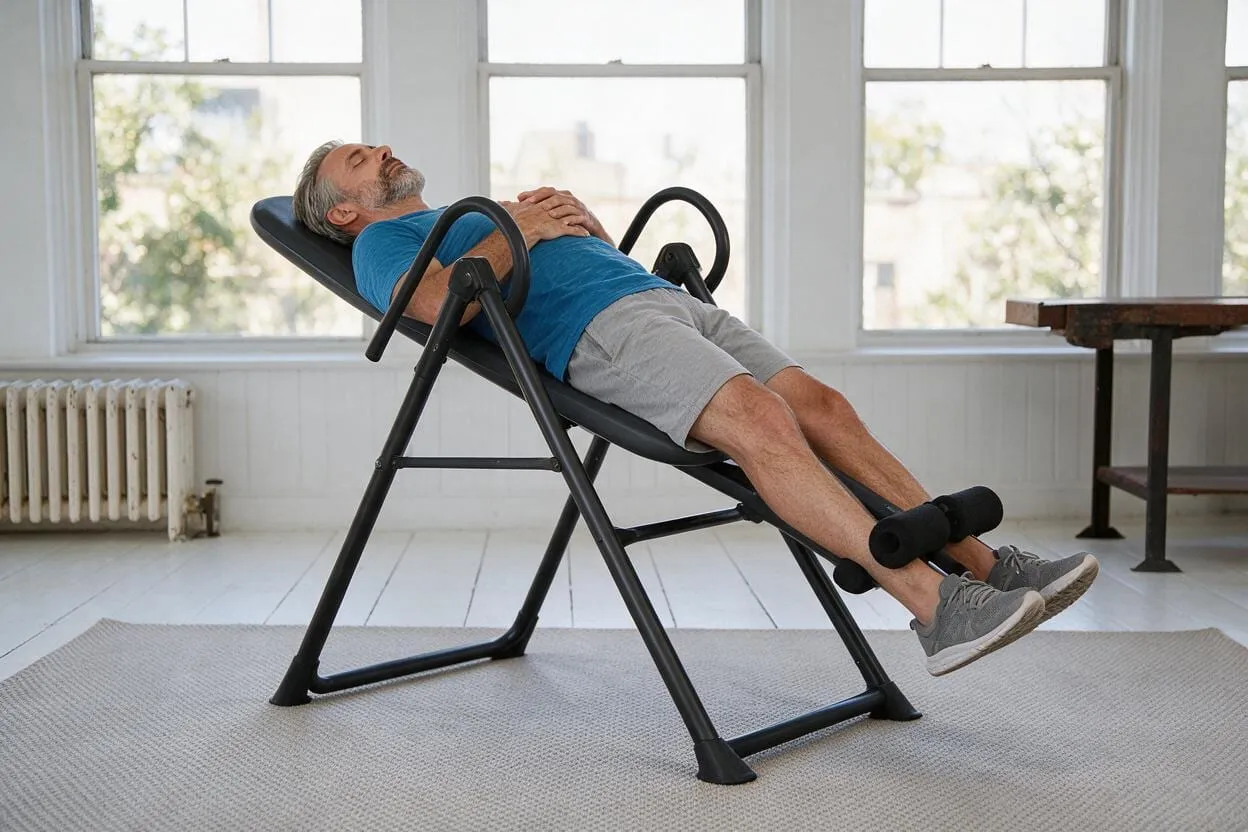
If you are looking at an inversion table for herniated disc pain, you have probably read two stories: that hanging upside down “takes the pressure off” the disc, or that it is a gimmick. We did not test these tables: what we offer is a close reading of the record, and a short list of tables that suit a careful trial if your doctor agrees.
Herniated Disc vs Bulging Disc: What’s the Difference?
Many people searching for a table have an MRI report that says “bulging disc,” not “herniated disc.” Others were told they have a “slipped disc.” Those words are not interchangeable to a radiologist, so it is worth being exact before looking at the studies.
What a Bulging Disc Is
The standard vocabulary comes from a joint consensus of the North American Spine Society, the American Society of Spine Radiology and the American Society of Neuroradiology, published by Fardon and Milette in 2001. It defines a bulge by how much of the disc’s rim is involved: “Presence of disc tissue ‘circumferentially’ (50-100%) beyond the edges of the ring apophyses may be called ‘bulging’ and is not considered a form of herniation.” And then, plainly: “Bulging, by definition, is not a herniation” (Fardon, 2001).
In everyday terms, a bulging disc spreads a little beyond its normal edge all the way around, or most of the way.
What a Herniated Disc Is
A herniation, in the same document, is a localized displacement: disc material pushed beyond its normal limits over less than 50% of the disc’s circumference (Fardon, 2001). In plain terms, a bulge involves half or more of the disc’s edge, and a herniation involves less than half, concentrated to one side or in one spot.
What People Mean by a Slipped Disc
“Slipped disc” is the everyday phrase, and it is not one of the terms in the Fardon and Milette classification (Fardon, 2001). It can be used for a bulge or a herniation, so it tells a doctor little. Your MRI report is more exact: look for “bulge” (50% to 100% of the rim) or “herniation” (less than 50%). If a slipped disc comes with leg weakness, numbness or trouble controlling your bladder, talk to your clinician before you invert.
One limit on this definition: the Fardon and Milette paper is a naming standard for imaging reports. It says nothing about inversion tables, and nothing about whether a bulge and a herniation respond differently to any treatment (Fardon, 2001).
Why the Inversion Studies Don’t Separate the Two
The two inversion studies below never report a group with bulges apart from a group with herniations. What the 2021 paper does say is who got in: adults “within 6 months of a current attack of pain with a single level unilateral disc as shown on MRI and surgery was indicated” (Mendelow, 2021). The authors describe their patients as having an “MRI-proven disc protrusion with sciatica.”
A one-sided disc at one level, bad enough for surgery, matches the localized picture above better than a diffuse bulge. So if your scan shows a bulging disc and you have back pain without leg symptoms, these studies say even less about you.
That doesn’t mean a table can’t help a bulge. It means nobody has tested it, and this page should not pretend otherwise. For back pain without a clear disc diagnosis, our page on inversion tables for back pain is the better fit.
What an Inversion Table Is Supposed to Do to a Disc
The case for an inversion table for herniated disc problems rests on one idea: take weight off the disc and it may shrink back or stop pressing on the nerve. Here is how far the evidence for that idea goes.
Gravity as Traction
Inversion tables are a form of spinal traction. A 2023 paper in Disability and Rehabilitation describes inversion table therapy as traction “which is thought to have a role in relieving low back pain due to the gravity-facilitated traction of the spine which distracts the lumbar vertebrae” (Kassay, 2023). When you tip back, the weight of your upper body pulls the lower vertebrae slightly apart. Note “is thought to”: it is a proposed mechanism in an opinion and regulatory article, not a trial result.
What Nosse 1978 Actually Measured
The oldest direct measurement of what an inversion table does to the spine is a 1978 study by Nosse. Twenty healthy men were tipped upside down on a motorized tilt table for one minute. Their spinal length, measured with a tape, was significantly greater while inverted than while sitting, and electrical activity in the superficial muscles of the lower back dropped compared with lying flat (Nosse, 1978). The author concluded that short periods of inversion “significantly increased spinal length and reduced emg activity of the superficial lumbar area musculature of normal males.”
That is a real finding, and it is often cited loosely. Read it for what it is: longer spine, quieter back muscles, in healthy young men with no disc problem.
What Nobody Has Measured: Pressure Inside the Disc
The Nosse study did not measure the pressure inside a disc, and it did not image the discs. A tape measure on the back tells you the whole spine got longer. It can’t tell you which gaps opened, by how much, or whether a herniated fragment moved. We searched the medical literature for a study that measured intradiscal pressure or disc height on imaging during inversion or gravity traction, and could not find one.
Does a Longer Spine Mean a Decompressed Disc?
Not necessarily, and not permanently. Even if inversion separates the vertebrae for a minute, nobody has shown how long any change lasts once you stand up and load your spine again. The Newcastle team’s pilot trial, covered next, is the one that looked: it compared MRI results after six weeks and found no significant difference between the inversion group and the physiotherapy-only group (Prasad, 2012).
The Evidence for an Inversion Table for Herniated Disc Patients
Two studies from one neurosurgical team in Newcastle, England, tested inversion in people with a disc problem. That evidence is narrower and more interesting than either the “takes the pressure off” story or the gimmick story. It is also more specific here than for any other back problem, because the only trials of inversion in patients were done in people with a disc problem.
Our sciatica page walks through both in detail and covers the guidelines at length; here we keep to what matters for the disc itself.
The 2012 Pilot: Fewer Operations, Same Pain
The team took 24 patients with single-level lumbar disc disease who were already listed for surgery. Thirteen added inversion to physiotherapy and eleven had physiotherapy alone. In the inversion group, 10 of 13 avoided the operation; in the control group, two patients did (Prasad, 2012). Pain scores, disability scores and MRI appearance did not differ significantly between the groups (Prasad, 2012).
For a disc, that combination is telling.
The trial was a pilot, too small to settle anything, and the authors called for a larger one.
The 2021 Registry: 21% Against 39%
The same team later followed 85 people with a single-level disc problem who used inversion. Their two-year surgery rate was 21%, against 39% in a matched group of neurosurgery patients (Mendelow, 2021). It was not randomized, so people who chose inversion may have differed from the comparison group in ways that also shape surgery decisions. The authors say so: “The main limitation of the study is that patients were not randomised” (Mendelow, 2021).
The Pain Numbers You See in Ads
Within that registry, 74% of those followed up (49 of 66) reported a lower pain score, and the median score fell from 6 to 3 (Mendelow, 2021). There was no comparison group for those figures, and pain from a herniated disc often eases with time on its own, so they can’t separate inversion from recovery.
Teeter’s FitSpine page turns this study into “50% Less Likely to Need Surgery” and “74% Pain Reduction,” among other claims (Teeter). The 74% is in the paper, without a control; the “50%” rounds 21% against 39%. The 2021 registry used Teeter tables, and Teeter supplied them and funded the study’s administrator; the authors state the analysis was independent (Mendelow, 2021).
What the Guidelines Say About Traction for a Disc
The North American Spine Society has a guideline written for exactly this diagnosis, lumbar disc herniation with radiculopathy (nerve pain from the disc). Its verdict: “There is insufficient evidence to make a recommendation for or against the use of traction,” graded I for insufficient evidence (NASS, 2012). That means not enough good evidence to say either way, not proof that it fails.
The UK’s NICE is firmer: “Do not offer traction for managing low back pain with or without sciatica” (NICE, 2016). And a Cochrane review published in 2013, pooling 32 trials with 2,762 people, found traction had “little or no impact” on pain, function or return to work (Wegner, 2013). Both cover traction in general, not inversion tables specifically, but an inversion table sits inside the category they judge.
What the Manufacturers Warn People With a Disc Problem About
Every inversion table manual carries a list of conditions that need a doctor’s approval first. With a disc diagnosis, three items on those lists deserve a closer look.
Innova Lists “Spinal Injury”
Innova’s ITX9600 manual says “DO NOT USE THIS INVERSION TABLE WITHOUT A LICENSED PHYSICIAN’S APPROVAL,” and its list of 21 conditions includes “Spinal injury,” an entry Teeter’s list does not have (Innova). The manual doesn’t define it, and it says the list “is for reference only and it is not a complete listing.” Whether your herniation counts is a question for your doctor, which is exactly what the manual asks you to do.
Teeter Lists Recent Surgery and Implants
Teeter tells users not to invert until a licensed physician approves if they have, among other things, “recent surgery” or “surgically implanted orthopedic supports” and “medullary pins” (Teeter). If you have had a discectomy or microdiscectomy, the table waits for your surgeon’s go-ahead. If you have had a fusion with rods or screws, that is an implant on Teeter’s list. Innova’s manual lists surgically implanted orthopedic supports too (Innova).
Teeter’s list also names “hiatal or other hernia.” That item sits under digestive conditions (Teeter). It refers to abdominal hernias, not a herniated disc, so it doesn’t answer the disc question either way.
Neither list names a herniated disc as a contraindication, and neither exempts one. Our page on who should not use an inversion table walks through every item on both lists.
What “Indicated for Herniated Disc” in Teeter’s Manual Means
Teeter’s assembly manual says its tables “are FDA-Registered as 510(k) medical devices” and lists ten conditions they are “indicated for,” including “Herniated disc” and “Degenerative disc disease” (Teeter, 2023). The FDA did clear Teeter’s manual inversion table through the 510(k) process, as “substantially equivalent” to devices already on the market (FDA, 2016). Substantial equivalence is a comparison with existing devices, not a trial showing the table treats a herniated disc. The indication list is Teeter’s claim under that clearance.
Symptoms That Rule Out a Home Experiment
The 2021 registry excluded people with cauda equina syndrome, “symptoms or signs of bladder impairment,” or “a progressive neurological deficit” (Mendelow, 2021). Those are not situations anyone tested a table in. Numbness in the groin, new trouble controlling your bladder or bowels, or a leg that is getting weaker belong with a doctor, the same day, not on a table.
If Your Doctor Agrees: How to Try It With a Disc Problem
Nothing here replaces an examination. If your doctor has seen your scan and agrees a trial of inversion is reasonable, this is what the manufacturers and the injury reports say about doing it carefully.
What the Makers Publish About Angle
Teeter tells new users: “When starting out, limit your angle to somewhere between 20-45 degrees, then gradually increase that angle over time” (Teeter, 2020). Its user guide lists 20 degrees as a starting angle (Teeter, 2023). On the Teeter X3 and LX9, the tether has three published marks, so you can see the limit before you tip back:
These are product settings, not a recommended progression. Follow the current manual and any restrictions given by your clinician.
Innova’s FAQ says to start at a low inversion position and to have a spotter with you (Innova). Nobody has shown that a steeper angle helps a disc more. With a disc problem, the angle and duration are for your doctor to set.
What the Makers Publish About Session Length
Teeter’s guide publishes one to two minute sessions as a starting point, with three to five minutes mentioned later (Teeter, 2023). The doctors who reported three spinal cord injuries from inversion table falls recommend keeping sessions under one minute, to reduce the chance of ankle strength giving out (Jung, 2021). The first is a usage suggestion; the second is a safety recommendation. Neither was tested in disc patients.
Come Back Up Slowly
For anyone with a disc problem, the return matters as much as the tilt. Teeter’s instructions say to “STOP and rest at just short of horizontal,” which “allows your body to ‘re-compress’ gently and helps avoid sudden compression to any injured areas” (Teeter, 2020). Pause there before you sit up, and step out of the ankle locks with care.
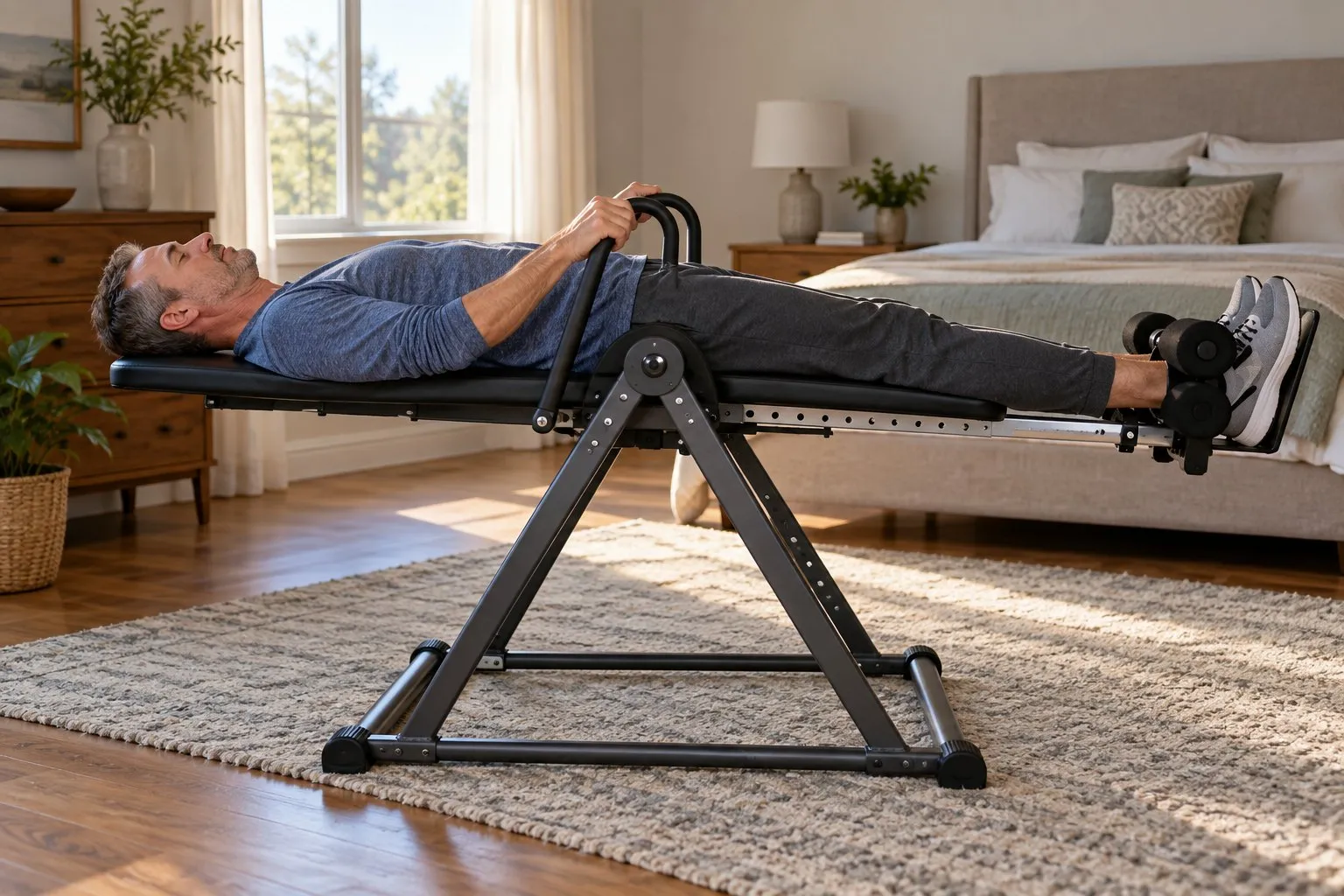
The worst documented injuries from these tables come from falling, not from traction. The 2021 case reports compare the mechanism to a shallow-water diving injury: if the ankles slip, the user lands on the top of the head, and falls of one or two feet “are by no means negligible” (Jung, 2021). With a disc problem, the risky moments are stepping on, bending to lock your ankles, and pushing back upright. Have someone with you for the first sessions.
Know When to Stop
The Cochrane review lists the harms reported with traction: “increased pain, aggravation of neurological signs and subsequent surgery” (Wegner, 2013).
Our page on inversion table side effects covers the rest, from headaches to eye pressure.
Best Inversion Tables for a Herniated or Bulging Disc
If you have a bulging disc, no table has been shown to treat it, and the same is true of a herniated disc. The Newcastle work tested inversion in a narrow group of patients, not one table against another. So these are not the tables that heal a disc. They are the ones that make the careful approach above easiest: a shallow, repeatable angle, short sessions, and a safe way on and off.
We chose from the tables verified for our best inversion tables guide, using the specs each maker publishes. If you buy through our links, we may earn a commission; it never decides the pick.

Our pick for a cautious trial
Teeter FitSpine X3
The easiest table here to hold to a shallow angle, because you can see the limit on the strap before you tip back.
- Tether marked at 20, 40 and 60 degrees, set while you stand upright
- You go back to exactly the same angle every session
- Five-year warranty, against Innova's one year
- Weight limit
- 300 lb
- User height
- 4'8" to 6'6"
- Warranty
- 5 years
- Price range
- Premium
Maker sourceSpecs from the maker's own product page
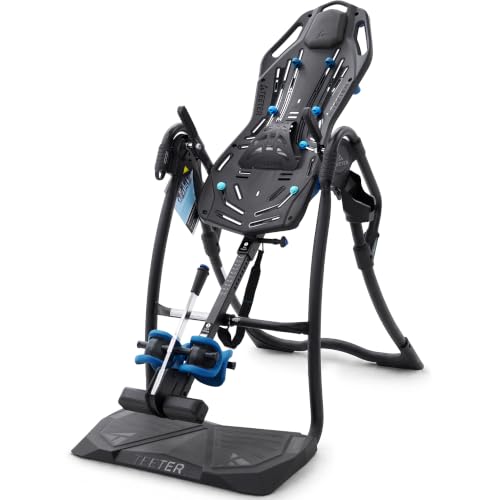
Best if bending down is the hard part
Choose it if bending down to lock your ankles is what hurts your back, or what makes you unsteady. Skip it if getting on is easy for you: the X3 gives you the same angle control for less.

Best low-cost first trial
Choose it if you want to find out whether inversion does anything for your back before spending premium money. Skip it if you want a marked tether you can glance at: the angles are pin settings labeled in the manual.
| Spec | Editor's choiceTeeter FitSpine X3Premium, price tier 3 of 3Maker source | Teeter FitSpine LX9Premium, price tier 3 of 3Maker source | Innova ITX9600Budget, price tier 1 of 3Maker source |
|---|---|---|---|
| Angle control | EZ-Angle tether marked at 20°, 40° and 60°; full inversion with secure lockout | EZ-Angle tether marked at 20°, 40° and 60°; full inversion with secure lockout | Pin with protective cover; the manual labels the settings 15°, 30°, 45°, 60° and 85° (the product page calls it a six-position pin) |
| Weight capacity | 300 lb | 300 lb | 300 lb |
| User height | 4'8" to 6'6" | 4'8" to 6'6" | 4'10" to 6'6" |
| Ankle system | Deluxe EZ-Reach ankle lock, extra-long handle, micro-adjusting closure | Deluxe EZ-Reach ankle lock with Ankle Comfort Dial | Reversible ankle holders (foam rollers and U-shaped holders can trade places) |
| Warranty | 5 years (extension to 10 sold separately)Highest here | 5 years (extension to 10 sold separately)Highest here | 1 year limited |
| FDA | 510(k) cleared (K162702), Class I device | 510(k) cleared (K162702), Class I device | Not stated |
| Heat and massage | None | None | None |
| Assembly and setup | 85% pre-assembled, BILT app instructions (brand-wide claim) | 85% pre-assembled, BILT app instructions (brand-wide claim) | Not stated |
| Buy | See today's price: Teeter FitSpine X3 on Amazon (opens in a new tab) | See today's price: Teeter FitSpine LX9 on Amazon (opens in a new tab) | Not linked |
Editor's choiceTeeter FitSpine X3Maker source- Angle control
- EZ-Angle tether marked at 20°, 40° and 60°; full inversion with secure lockout
- Weight capacity
- 300 lb
- User height
- 4'8" to 6'6"
- Ankle system
- Deluxe EZ-Reach ankle lock, extra-long handle, micro-adjusting closure
- Warranty
- 5 years (extension to 10 sold separately)Highest here
- FDA
- 510(k) cleared (K162702), Class I device
- Heat and massage
- None
- Assembly and setup
- 85% pre-assembled, BILT app instructions (brand-wide claim)
Teeter FitSpine LX9Maker source- Angle control
- EZ-Angle tether marked at 20°, 40° and 60°; full inversion with secure lockout
- Weight capacity
- 300 lb
- User height
- 4'8" to 6'6"
- Ankle system
- Deluxe EZ-Reach ankle lock with Ankle Comfort Dial
- Warranty
- 5 years (extension to 10 sold separately)Highest here
- FDA
- 510(k) cleared (K162702), Class I device
- Heat and massage
- None
- Assembly and setup
- 85% pre-assembled, BILT app instructions (brand-wide claim)
Innova ITX9600Maker source- Angle control
- Pin with protective cover; the manual labels the settings 15°, 30°, 45°, 60° and 85° (the product page calls it a six-position pin)
- Weight capacity
- 300 lb
- User height
- 4'10" to 6'6"
- Ankle system
- Reversible ankle holders (foam rollers and U-shaped holders can trade places)
- Warranty
- 1 year limited
- FDA
- Not stated
- Heat and massage
- None
- Assembly and setup
- Not stated
Maker source from the maker's own page or manual, not independently testedListing only retail listing, no maker spec sheetNot stated the maker publishes nothing
Teeter FitSpine X3: The Angle You Can See
The X3’s tether is marked at 20, 40 and 60 degrees. For a disc, that is the reason to choose it: you set the limit standing upright, you can see it on the strap, and you go back to exactly the same angle every session. If your doctor says “keep it shallow,” this is the easiest table to hold to that. It sits in the premium tier, with a five-year warranty and the FDA 510(k) status Teeter claims, with the limits described above.
Long ankle-lock handle, 5-year warrantyMaker source
by TEETER
Best for disc patients whose doctor says to keep the angle shallow.
Skip it if bending down to lock your ankles is what hurts or unsteadies you: the LX9 is built for getting on and off.
What the premium over a cheaper table buys is the longer ankle-lock handle, the 5-year warranty against Innova's 1 year, and a tether marked at 20°, 40° and 60°. The Innova ITX9600 also lets you set a limit with a pin whose degrees are listed in its manual, so a marked angle is not exclusive to Teeter.
- Weight limit
- 300 lb
- User height
- 4'8" to 6'6"
- Warranty
- 5 years
- Price range
- Premium
What we like
- Tether marked at 20°, 40° and 60°, set before you get on
- Five-year full warranty, against Innova's one year
- Teeter's tables are FDA 510(k) cleared under K162702
- EZ-Reach ankle lock with an extra-long handle
Keep in mind
- No heat or massage
- No raised boarding platform, unlike the LX9
- Rated to 300 lb, max height 6 ft 6 in
Full specs
- Price range
- Premium
- Weight capacity
- 300 lb
- User height
- 4'8" to 6'6"
- Angle control
- EZ-Angle tether marked at 20°, 40° and 60°; full inversion with secure lockout
- Ankle system
- Deluxe EZ-Reach ankle lock, extra-long handle, micro-adjusting closure
- Heat and massage
- None
- Warranty
- 5 years (extension to 10 sold separately)
- FDA
- 510(k) cleared (K162702), Class I device
Maker sourceFrom the maker's product page. Not stated means the maker publishes nothing.
We may earn a commission. It never changes which table we pick, or the order they appear in.
Teeter FitSpine LX9: Easier Getting On and Off
The LX9 has the same marked tether as the X3. According to Teeter’s product page, it adds an arched frame “for effortless entry and exit” and a “Raised Boarding Platform” (Teeter). If bending down to lock your ankles is what hurts your back, or what makes you unsteady, that is worth paying for. If getting on is easy for you, the X3 gives you the same angle control for less.
Raised boarding platformMaker source
by TEETER
Best for people who find bending down to lock their ankles painful or unsteadying.
Skip it if getting on is easy for you: the X3 gives you the same angle control for less.
Same angle system as the X3, plus a boarding platform with an arched frame. Worth the step up only if getting on and off the table is the hard part for you.
- Weight limit
- 300 lb
- User height
- 4'8" to 6'6"
- Warranty
- 5 years
- Price range
- Premium
What we like
- Raised boarding platform and arched frame for getting on and off
- Same 20°, 40° and 60° marked tether as the X3
- Five-year full warranty, with a five-year extension sold separately
- Ships with a Storage Caddy and traction handles on the hinges
Keep in mind
- Otherwise identical to the X3, so you pay for the platform
- Roller hinge setting must match your body weight, per the manual
- No heat or massage
- Rated to 300 lb, max height 6 ft 6 in
Full specs
- Price range
- Premium
- Weight capacity
- 300 lb
- User height
- 4'8" to 6'6"
- Angle control
- EZ-Angle tether marked at 20°, 40° and 60°; full inversion with secure lockout
- Ankle system
- Deluxe EZ-Reach ankle lock with Ankle Comfort Dial
- Heat and massage
- None
- Warranty
- 5 years (extension to 10 sold separately)
- FDA
- 510(k) cleared (K162702), Class I device
Maker sourceFrom the maker's product page. Not stated means the maker publishes nothing.
We may earn a commission. It never changes which table we pick, or the order they appear in.
Innova ITX9600: A Low-Cost Trial
If you want to find out whether inversion does anything for your back before spending premium money, the ITX9600 is the budget table we would point to. Given that Cochrane found little or no average effect from traction, a small outlay for a first trial makes sense. The angle is set with a pin: the owner’s manual labels the settings 15, 30, 45, 60 and 85 degrees, and the pin goes in the 15-degree hole at assembly (Innova). The trade-offs are a one-year warranty, no marked tether you can glance at, and no FDA status stated for this model.
Reversible ankle holdersMaker source
by Innova
Best for people who want a low-cost first trial of inversion.
Skip it if you want a marked tether you can glance at: the angles are pin settings labeled in the manual.
It is the only entry table here with reversible ankle holders, so the foam roller can move to the front once inverting stops feeling new. One of its listing bullets says 350 lb; the maker's page says 300 lb, and 300 is what we publish.
- Weight limit
- 300 lb
- User height
- 4'10" to 6'6"
- Warranty
- 1 year
- Price range
- Budget
What we like
- Ankle holders reverse, so the foam roller can move to the front
- Manual labels the pin angles, from 15° up to 85°
- Pin with a protective cover, left at 15° after assembly
- Rated to 300 lb in both the manual and on the maker's page
Keep in mind
- One-year limited warranty, non-transferable
- No heat or massage
- Manual shows five pin angles, the product page says six
- Needs 2 ft clear at each side and 3 ft front and back
We are not linking to this model at the moment. The specs below still hold. See the alternatives we would pick instead.
Full specs
- Price range
- Budget
- Weight capacity
- 300 lb
- User height
- 4'10" to 6'6"
- Angle control
- Pin with protective cover; the manual labels the settings 15°, 30°, 45°, 60° and 85° (the product page calls it a six-position pin)
- Ankle system
- Reversible ankle holders (foam rollers and U-shaped holders can trade places)
- Heat and massage
- None
- Warranty
- 1 year limited
- FDA
- Not stated
Maker sourceFrom the maker's product page. Not stated means the maker publishes nothing.
See the tables we left out, and why
Decompression Tables and What We Left Out
Motorized spinal decompression tables, the kind used in clinics where you lie flat and a machine pulls, are a different product, and we don’t recommend one here. The Newcastle studies did not use them, so nothing above applies to them; the next section sets out what does. We also left out the YOLEO table from our general list: it publishes no manufacturer spec sheet and a lower weight recommendation than Teeter and Innova, and heavier users are the group the fall reports single out for extra care (Jung, 2021). Heat and massage tables are a comfort feature; we found no source tying them to disc relief.
Inversion Table vs Decompression Table
Both machines are sold as “spinal decompression,” and they work in different ways. An inversion table has no motor: you tip yourself back and your own body weight does the pulling, at whatever angle you set. On a motorized decompression table you stay lying down, strapped into a pelvic harness, while a computer program moves one part of the table to stretch the spine.
According to one maker of these tables, the difference is the technology: its tables “include sensors that indicate whether a patient’s muscles are resisting the stretch being applied by the table. As the muscles resist, the table reduces the poundage of the pull until the muscles relax, then begins to pull again” (Hill). The same maker describes a course of at least 12 sessions of about 30 minutes each (Hill). That is one seller describing its own product and protocol, not a clinical standard.
The FDA also puts the two in different classes. Non-powered traction apparatus, the category that covers inversion tables, is Class I, the lowest-risk class (FDA). Powered traction equipment, the category that covers motorized decompression tables, is Class II under 21 CFR 890.5900 (FDA).
That is a classification of device categories, not a verdict on any one machine. It means the motorized category is subject to more regulatory control. It does not mean either one is safer or works better. The smaller devices sold for home use, from inflatable belts to lumbar traction frames, are compared in our guide to the best back decompression device.
Whether the sensors make a difference to your disc is the question that matters, and one trial has tested it head to head. In a small single-blind randomized trial published in 2018, Koçak and colleagues treated 48 people with low back pain from a lumbar disc herniation: 24 with conventional motorized traction and 24 with “non-surgical spinal decompression” on a DRX9000, over 20 sessions in six weeks. Both groups improved in pain, function and mood, but the authors concluded that decompression “is not superior to” conventional traction “in terms of pain, functionality, depression and quality of life” (Kocak, 2018).
Two limits apply. The trial was small, and it had no untreated group, so it cannot show that either treatment beats doing nothing. What it does show is that, in this trial, the extra technology did not beat plain traction. And plain traction, in the Cochrane review above, made little or no difference to low back pain (Wegner, 2013).
Your questions, answered
Frequently Asked Questions
Do inversion tables work for herniated discs?
They have not been proven to. The North American Spine Society rates the evidence for traction in a herniated lumbar disc with nerve pain as insufficient to recommend for or against. One English team found fewer operations among patients who inverted, but its trial had 24 people and found no difference in pain, and its later registry was not randomized.
Does hanging upside down help a bulging disc?
Nobody has tested that directly. Radiologists define a bulge as disc tissue extending around 50% to 100% of the disc's edge, and they do not count it as a herniation. The inversion studies enrolled people with a one-sided disc protrusion and sciatica, so they say even less about a bulge found on a scan without leg symptoms.
How long should I use an inversion table for a herniated disc?
There is no tested session length for a herniated disc. Teeter's guide tells beginners to start with one to two minutes, while doctors who reported spinal cord injuries from table falls advise staying under one minute to cut the risk of slipping. Starting with the shorter limit costs nothing. If your doctor sets a limit, use theirs.
Are inversion tables bad for herniated discs?
They can be for some people. In the Cochrane analysis of traction, seven of 32 trials recorded harm: more pain, worse nerve signs, and surgery afterwards. That was traction in general rather than inversion alone. If numbness, weakness or leg pain grows after a session, the table is not helping you, and a doctor should look at your back.
Is a decompression table good for a herniated disc?
A decompression table is a different machine from an inversion table: it is motorized, you lie flat, and it is usually run in a clinic. The inversion studies on this page do not apply to it, and in a small 2018 trial with 48 disc patients, a branded decompression device did no better than ordinary motorized traction. Ask whoever offers the treatment which trials support that specific device for your diagnosis.
22 sources used for this guide
Each linked to the original. Citations in the text jump here.
View sources
Fardon DF, Milette PC. Nomenclature and Classification of Lumbar Disc Pathology. Spine 2001;26(5):E93-E113. Recommendations of the Combined Task Forces of the North American Spine Society (NASS), American Society of Spine Radiology (ASSR), and American Society of Neuroradiology (ASNR).
Mendelow AD, Gregson BA, Mitchell P et al. Lumbar disc disease: the effect of inversion on clinical symptoms and a comparison of the rate of surgery after inversion therapy with the rate of surgery in neurosurgery controls. Journal of Physical Therapy Science 2021;33(11):801-808.
Kassay A, Soliman MAR, Jhawar BS. Recommendations for inversion table therapy. Disability and Rehabilitation 2023;45(22):3779-3782.
Nosse LJ. Inverted spinal traction. Archives of Physical Medicine and Rehabilitation 1978;59(8):367-370.
Teeter. FitSpine LX9 Inversion Table: User Guide, rev. LX1030 0123-4. teeter.com/wp-content/uploads/2023/02/FitSpine-LX-Series_LX6-LX7-LX8-LX9_OM_LX1030_0123-4.pdf.
Prasad KS, Gregson BA, Hargreaves G, Byrnes T, Winburn P, Mendelow AD. Inversion therapy in patients with pure single level lumbar discogenic disease: a pilot randomized trial. Disability and Rehabilitation 2012;34(17):1473-1480.
Teeter. FitSpine Inversion Tables. teeter.com/fitspine/.
North American Spine Society (NASS), Lumbar Disc Herniation with Radiculopathy Work Group. Lumbar Disc Herniation with Radiculopathy: An Evidence-Based Clinical Guideline. NASS Evidence-Based Clinical Guidelines, 2012.
National Institute for Health and Care Excellence (NICE). Low back pain and sciatica in over 16s: assessment and management, Recommendations. NICE guideline NG59, published 30 November 2016, last updated 29 July 2026.
Wegner I, Widyahening IS, van Tulder MW et al. Traction for low-back pain with or without sciatica. Cochrane Database of Systematic Reviews 2013, CD003010.
Innova. ITX9600 Heavy Duty Deluxe Inversion Therapy Table, Owner's Manual (version 1709AJJ). Innova Products Inc., owner's manual.
Teeter. Are there health issues that would prevent me from inverting?. teeter.com, Support Center (the same list appears in the owner's manual).
Teeter. Assemble Your FitSpine LX Inversion Table: Assembly Instructions (models LX4 to LX9), rev. LX1040B 0123-0. teeter.com/wp-content/uploads/2023/03/FitSpine-LX-Series_Assembly-Instructions_LX4-thru-LX9_LX1040B_0123-0.pdf.
FDA. 510(k) Premarket Notification K162702: Teeter Manual Inversion Table. U.S. Food and Drug Administration, 510(k) database, decision date December 30, 2016.
Teeter. How to Use an Inversion Table. teeter.com blog, 2020 (updated 2022).
Innova. Frequently Asked Questions. innovaproductsinc.com/faq/.
Jung SH, Hwang JM, Kim CH. Inversion Table Fall Injury, the Phantom Menace: Three Case Reports on Cervical Spinal Cord Injury. Healthcare (Basel) 2021;9(5):492.
Teeter. FitSpine LX9 Inversion Table. teeter.com, product page.
Hill DT Solutions LLC. What Is a Spinal Decompression Table?. hilldtsolutions.com/spinal-decompression-table-info.
FDA. Device classification, product code HST: Apparatus, Traction, Non-Powered. U.S. Food and Drug Administration, device classification database (openFDA), 21 CFR 888.5850.
FDA. Device classification, product code ITH: Equipment, Traction, Powered. U.S. Food and Drug Administration, device classification database (openFDA), 21 CFR 890.5900.
Kocak FA, Tunc H, Tomruk Sutbeyaz S, Akkus S, Koseoglu BF, Yilmaz E. Comparison of the short-term effects of the conventional motorized traction with non-surgical spinal decompression performed with a DRX9000 device on pain, functionality, depression, and quality of life in patients with low back pain associated with lumbar disc herniation: A single-blind randomized-controlled trial. Turkish Journal of Physical Medicine and Rehabilitation 2018;64(1):17-27.