Health guide
Inversion Table for Scoliosis: Does It Help, and Is It Safe?
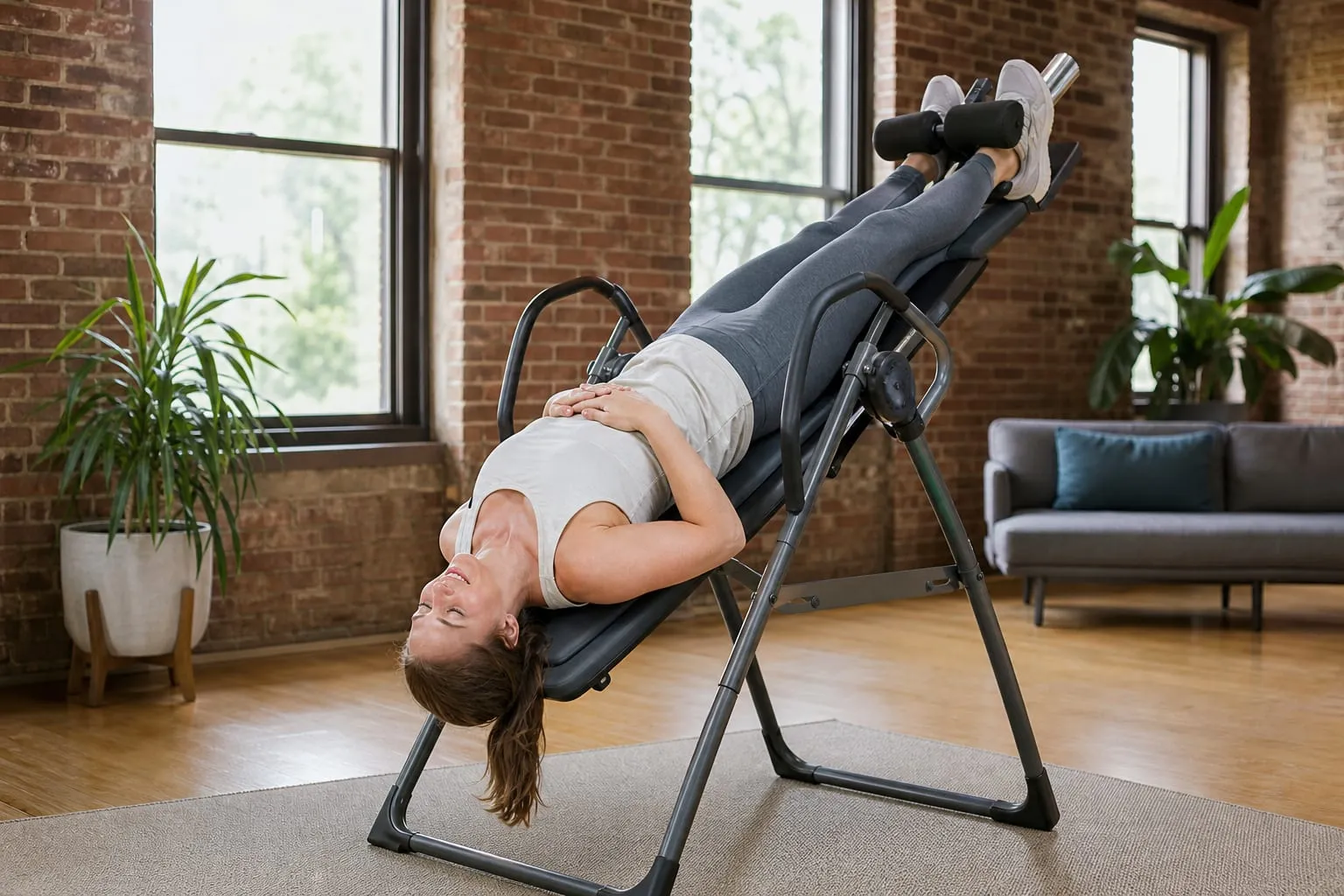
If you searched for an inversion table for scoliosis, you most likely want one answer: will it help, or could it hurt? We are not doctors, and we have not tested these tables on anyone; what we did was read the manufacturers’ warnings in full, search the medical literature, and read the main scoliosis treatment guidelines from start to finish.
What the Manufacturers Say About Spinal Curvature
Start here, because this is the part most “inversion table for scoliosis” pages leave out.
Teeter Names “Significant Spinal Curvature”
Teeter’s contraindication list, which the company says is also printed in the owner’s manual, opens with a blanket instruction: “DO NOT use until approved by a licensed physician.” It applies to “any medical or health condition that may be made more severe by an elevation of blood pressure, intracranial pressure or mechanical stress of the inverted position” (Teeter).
The list is grouped by body system. Under bone and spine, Teeter names significant spinal curvature, acutely swollen joints, osteoporosis, fractures, dislocations, medullary pins and surgically implanted orthopedic supports (Teeter). Scoliosis is a spinal curvature. If yours is significant, the maker of the table is telling you not to use it without a doctor’s go-ahead.
Innova’s ITX9600 List Does Not Name It, and That Is Not a Green Light
Innova’s ITX9600 owner’s manual carries its own list of 21 conditions that need a licensed physician’s approval. We searched the whole manual for any mention of curvature or scoliosis and found none. The closest item is “spinal injury,” which is a different category from a curve (Innova). The table itself is covered in our Innova ITX9600 review.
Do not read that as Innova approving inversion for scoliosis. The manual itself says: “This list is for reference only and it is not a complete listing” (Innova). The accurate way to put it is that Innova’s list does not name spinal curvature the way Teeter’s does. Innova has not said scoliosis is fine.
Here is how the two lists compare on the spine:
| Condition | Teeter (support center and owner’s manual) | Innova ITX9600 (owner’s manual) |
|---|---|---|
| Spinal curvature or scoliosis | Named: “significant spinal curvature” | Not mentioned |
| Spinal injury | Not named as such | Named |
| Osteoporosis | Named | Named (“bone weakness”) |
| Fractures | Named | Named (“recent or unhealed fractures”) |
| Surgical implants, medullary pins | Named | Named |
| List described as complete? | Not stated | No: “for reference only” |
What “Significant” Means Is Up to Your Doctor
Teeter does not define “significant.” It gives no degree threshold, no curve type and no age group. That leaves the call where it belongs: with the doctor who has your X-rays and knows whether your curve is stable, growing, or has hardware in it.
The rest of the manufacturers’ lists (blood pressure, eyes, pregnancy, hernias and more) is covered on our page about who should not use an inversion table. We won’t repeat it here.
What the Research Says About Inversion Tables for Scoliosis
The short version: there is almost nothing, and what exists does not test an inversion table.
No Study of an Inversion Table in Scoliosis Was Found
We searched EuropePMC, a database that indexes PubMed and more, for inversion tables and scoliosis, for inversion therapy and scoliosis, and for gravity traction in adolescent idiopathic scoliosis. We found no clinical study of a gravity inversion table in people with scoliosis, at any age.
The Nearest Result: One Patient and a Different Device
The closest paper was a case report published in 2026 about one 12-year-old girl with low back pain and a 40° thoracolumbar curve. She was treated with a program that combined postural correction training, muscle balance training, “three-dimensional spinal traction” and spinal manipulation. After 50 sessions over 32 weeks, her Cobb angle, the standard X-ray measure of a scoliosis curve, fell by 7° in the thoracic region and 17° in the lumbosacral region, and her back pain was much reduced (Mao, 2026).
Three limits make this useless as evidence for an inversion table:
- It is one patient, with no comparison group, so it cannot tell you how often this result happens.
- Four treatments were given at once, so nobody can say how much, if any, of the change came from the traction.
- The device was not an inversion table. Three-dimensional spinal traction is a clinical, multi-axis device. Hanging by your ankles at home is something else.
We include it only to show where the search ended.
A Large Review of Scoliosis Treatments Does Not List Traction
A network meta-analysis published in 2025 pooled 54 randomized trials with 3,984 participants on conservative treatment for adolescent idiopathic scoliosis. Three combinations showed short-term improvement in Cobb angle, with moderate certainty: a brace plus scoliosis-specific exercise, manual therapy plus scoliosis-specific exercise, and manual therapy plus mind-body exercise (Ren, 2025). Bracing alone could help prevent progression. Traction does not appear among the treatments found effective in the abstract.
A limit on our side: we read the abstract, not the full paper. We can’t tell you whether any of the 54 trials tested traction and it simply showed no effect, or whether none tested it at all. What we can say is that traction is not on the list of what worked.
The Scoliosis Guidelines Do Not Mention Inversion
SOSORT, the international society focused on conservative scoliosis treatment, published guidelines in 2016 (in print in 2018) with 68 recommendations on bracing, exercise, other treatments, breathing, sport and assessment in growing children (Negrini, 2018). We read the full text. The word “inversion” does not appear once.
“Traction” appears twice. One mention is a cited trial in which every patient, in both groups, received “electrical stimulation on the lateral surface of the body, traction, and postural training,” while only the experimental group added scoliosis-specific exercises (Negrini, 2018). The difference between the groups came from the exercise, not the traction. The other mention is the title of a 1978 paper in the reference list, with no discussion in the text.
So SOSORT neither recommends inversion tables nor warns against them. It has no published position.
The Scoliosis Research Society Mentions Only Surgical Traction
The Scoliosis Research Society’s position statements mention traction only in a surgical context: as halo gravity traction, a surgical-setting treatment for severe spinal deformity in young children discussed alongside casting and surgery, and as a traction X-ray taken before an operation. In the society’s own words, when treatment is delayed, larger curves may need riskier surgery “or prolonged treatments such as halo gravity traction. Thus, we know young children with severe spinal deformity benefit from early treatment with casting and surgery” (SRS, 2026). Inversion does not appear on the society’s index of informational and position statements at all, and none of the statements listed there addresses inversion tables or traction at home.
That is a statement about what the society has listed on that page, not proof that the SRS has never commented on inversion anywhere. But halo gravity traction belongs to the specialist care of children with severe deformity, and it tells you nothing about hanging from your ankles at home. Neither SOSORT nor the SRS has put its name to inversion.
Pain Relief Is Not the Same as Correcting the Curve
Many people with scoliosis also have back pain, and the two questions get blurred. They should not be.
What Traction Is Thought to Do
Inversion table therapy is a form of spinal traction. The proposed reason it might ease low back pain is that gravity-assisted traction “distracts the lumbar vertebrae,” meaning it separates them slightly (Kassay, 2023). That is a proposed mechanism, written with the words “is thought to,” and it is about pulling vertebrae apart along the length of the spine. It says nothing about untwisting or straightening a sideways, rotated curve, and we found no source that proposes such a mechanism for inversion.
Traction for Back Pain in General
Even for ordinary low back pain, the track record of traction is weak. A Cochrane review published in 2013 pooled 32 trials with 2,762 people and found that traction, “either alone or in combination with other treatments, has little or no impact on pain intensity, functional status, global improvement and return to work” (Wegner, 2013). That review covers traction in general, manual and mechanical, in people with back pain and sciatica, not people with scoliosis and not inversion tables specifically. It is background, not a scoliosis result.
The same review found that seven of its 32 trials reported adverse effects of traction, including “increased pain, aggravation of neurological signs and subsequent surgery” (Wegner, 2013). For what inversion can and cannot do for back pain in general, see our page on inversion table benefits.
Why This Matters for Scoliosis Specifically
The curve is still there when you stand up, and nothing we found suggests otherwise. Buying a table in the hope that it will change your X-ray has no support in the literature we read.
Safety Risks That Apply With or Without Scoliosis
A curve is not the only thing to weigh. Some risks apply to every user.
Falls Land You on Your Head
A 2021 report described three people with cervical spinal cord injuries after falling from inversion tables. The authors compare the mechanism to a shallow-water diving injury: “once the ankle power is lost or it slips, the user will land on top of their head,” and “falls from 1 or 2 feet high are by no means negligible” (Jung, 2021). It is a three-case report, so it can’t tell you how often this happens. It does tell you what a fall looks like, which is a good reason to think hard about a spine you already need to protect.
Blood Pressure Goes Up
In a 1986 trial of 60 healthy women aged 20 to 30, two minutes of inversion raised both systolic and diastolic blood pressure significantly compared with standing, and the authors wrote that “hypertensive individuals may need to avoid its use” (Haskvitz, 1986). The sample was young and healthy, and the abstract gives no mmHg figure. The rest of the short-term effects, from headaches to dizziness, are on our page about inversion table side effects.
Most Tables Are Not Medical Devices
The FDA’s device reporting database includes serious injuries from inversion table therapy, among them spinal cord injury, fractures and death. But the FDA only regulates the tables whose makers claim a medical use, and most makers do not (Kassay, 2023). A table sold for general fitness has not been reviewed for use in any spinal condition, scoliosis included.
If Your Doctor Clears You
If your doctor knows your curve and still says an inversion table is fine, for back pain or for anything else, these are the things worth controlling.
Questions to Bring to the Appointment
- Does my curve count as “significant spinal curvature” in Teeter’s sense?
- Is my curve still progressing, and does that change the answer?
- I have (or don’t have) a fusion or other hardware. Does that rule inversion out?
- How far back should I go, and for how long?
Choose a Table With Angle Control
Being able to set a partial angle before you get on is more useful than any other feature. Here is how two common tables handle it, from the manufacturers’ own specifications:
| Spec |  Teeter FitSpine X3Premium, price tier 3 of 3Verified Teeter FitSpine X3Premium, price tier 3 of 3Verified |  Innova ITX9600Budget, price tier 1 of 3Verified Innova ITX9600Budget, price tier 1 of 3Verified |
|---|---|---|
| Angle control | EZ-Angle tether marked at 20°, 40° and 60°; full inversion with secure lockout | Pin with protective cover; the manual labels the settings 15°, 30°, 45°, 60° and 85° (the product page calls it a six-position pin) |
| Weight capacity | 300 lb | 300 lb |
| User height | 4'8" to 6'6" | 4'10" to 6'6" |
| Ankle system | Deluxe EZ-Reach ankle lock, extra-long handle, micro-adjusting closure | Reversible ankle holders (foam rollers and U-shaped holders can trade places) |
| Warranty | 5 years (extension to 10 sold separately)Highest here | 1 year limited |
| FDA | 510(k) cleared (K162702), Class I device | Not stated |
| Assembly and setup | 85% pre-assembled, BILT app instructions (brand-wide claim) | Not stated |
| Buy | See today's price: Teeter FitSpine X3 on Amazon (opens in a new tab) | See today's price: Innova ITX9600 on Amazon (opens in a new tab) |
Teeter FitSpine X3- Angle control
- EZ-Angle tether marked at 20°, 40° and 60°; full inversion with secure lockout
- Weight capacity
- 300 lb
- User height
- 4'8" to 6'6"
- Ankle system
- Deluxe EZ-Reach ankle lock, extra-long handle, micro-adjusting closure
- Warranty
- 5 years (extension to 10 sold separately)Highest here
- FDA
- 510(k) cleared (K162702), Class I device
- Assembly and setup
- 85% pre-assembled, BILT app instructions (brand-wide claim)
Innova ITX9600- Angle control
- Pin with protective cover; the manual labels the settings 15°, 30°, 45°, 60° and 85° (the product page calls it a six-position pin)
- Weight capacity
- 300 lb
- User height
- 4'10" to 6'6"
- Ankle system
- Reversible ankle holders (foam rollers and U-shaped holders can trade places)
- Warranty
- 1 year limited
- FDA
- Not stated
- Assembly and setup
- Not stated
Verified from the maker's own page or manualClaimed retail listing onlyNot stated the maker publishes nothing
The Teeter marks 20°, 40° and 60° on its tether. The Innova uses a pin, and its manual labels the settings from 15° to 85°. Both publish a 300 lb user limit.
Neither maker markets either table as a scoliosis treatment, and neither spec sheet makes one safer for a curve than the other. The angle marks give you control and repeatability, nothing more. For the full comparison of models, see our guide to the best inversion tables.
Keep Sessions Short and Plan for a Fall
That is their recommendation, not clinical consensus, but it targets the exact mechanism of the injuries they describe.
If Back Pain Is the Real Reason
If what you want is relief from ordinary back pain rather than a change in your curve, our page on inversion tables for back pain goes through that evidence on its own terms. Bring it to your doctor alongside Teeter’s line about spinal curvature, and let them decide which applies to you.
Your questions, answered
Frequently Asked Questions
Would an inversion table help with scoliosis?
Not as a way to straighten the curve, as far as anything published goes. We found no clinical study of an inversion table in anyone with scoliosis, and Teeter's own manual names significant spinal curvature as a reason to get a physician's approval before inverting. Some people hope for short-term pain relief, but that has not been tested in scoliosis either.
Who should avoid inversion tables?
Anyone with a condition that gets worse under higher blood pressure, higher eye pressure or the strain of hanging by the ankles, and anyone whose balance or grip is unreliable. On the spine side, Teeter names significant spinal curvature, osteoporosis, fractures and implants, while Innova's ITX9600 manual adds spinal injury and weak ankles. Our contraindications page goes through each item with its evidence.
Who should not use inversion therapy?
People with high blood pressure, heart disease, glaucoma, a past retinal detachment, a hernia, a pregnancy or recent surgery should not start without a doctor's approval, according to Teeter's manual. For scoliosis, the relevant line in that manual is significant spinal curvature. Teeter does not say what counts as significant, so the cut-off belongs to the doctor who follows your curve.
10 sources used for this guide
Each linked to the original. Citations in the text jump here.
View sources
Teeter. Are there health issues that would prevent me from inverting?. teeter.com, Support Center (the same list appears in the owner's manual).
Innova. ITX9600 Heavy Duty Deluxe Inversion Therapy Table, Owner's Manual (version 1709AJJ). Innova Products Inc., owner's manual.
Mao Z, Li C, Chen S, Zhao Z. Integration of three-dimensional spinal traction and conventional rehabilitation for structural correction in adolescent idiopathic scoliosis: a case report. Frontiers in Sports and Active Living 2026;8:1794187.
Ren J, Wang S, Li M, Zhou X, Wen Y, Wen Z, Lin J, Kong L, Fang M. Comparative efficacy of conservative interventions for adolescent idiopathic scoliosis: a systematic review and network meta-analysis of randomized controlled trials. Systematic Reviews 2025;14(1):156.
Negrini S, Donzelli S, Aulisa AG, Czaprowski D, Schreiber S, de Mauroy JC, et al. 2016 SOSORT guidelines: orthopaedic and rehabilitation treatment of idiopathic scoliosis during growth. Scoliosis and Spinal Disorders 2018;13:3 (published online 2018, dataset year 2016).
Scoliosis Research Society. Informational & Position Statements. srs.org, March 17, 2026.
Kassay A, Soliman MAR, Jhawar BS. Recommendations for inversion table therapy. Disability and Rehabilitation 2023;45(22):3779-3782.
Wegner I, Widyahening IS, van Tulder MW et al. Traction for low-back pain with or without sciatica. Cochrane Database of Systematic Reviews 2013, CD003010.
Jung SH, Hwang JM, Kim CH. Inversion Table Fall Injury, the Phantom Menace: Three Case Reports on Cervical Spinal Cord Injury. Healthcare (Basel) 2021;9(5):492.
Haskvitz EM, Hanten WP. Blood pressure response to inversion traction. Physical Therapy 1986;66(9):1361-1364.