Health guide
Hanging Leg Raises: How to Do Them, Starting With the Hanging Knee Raise
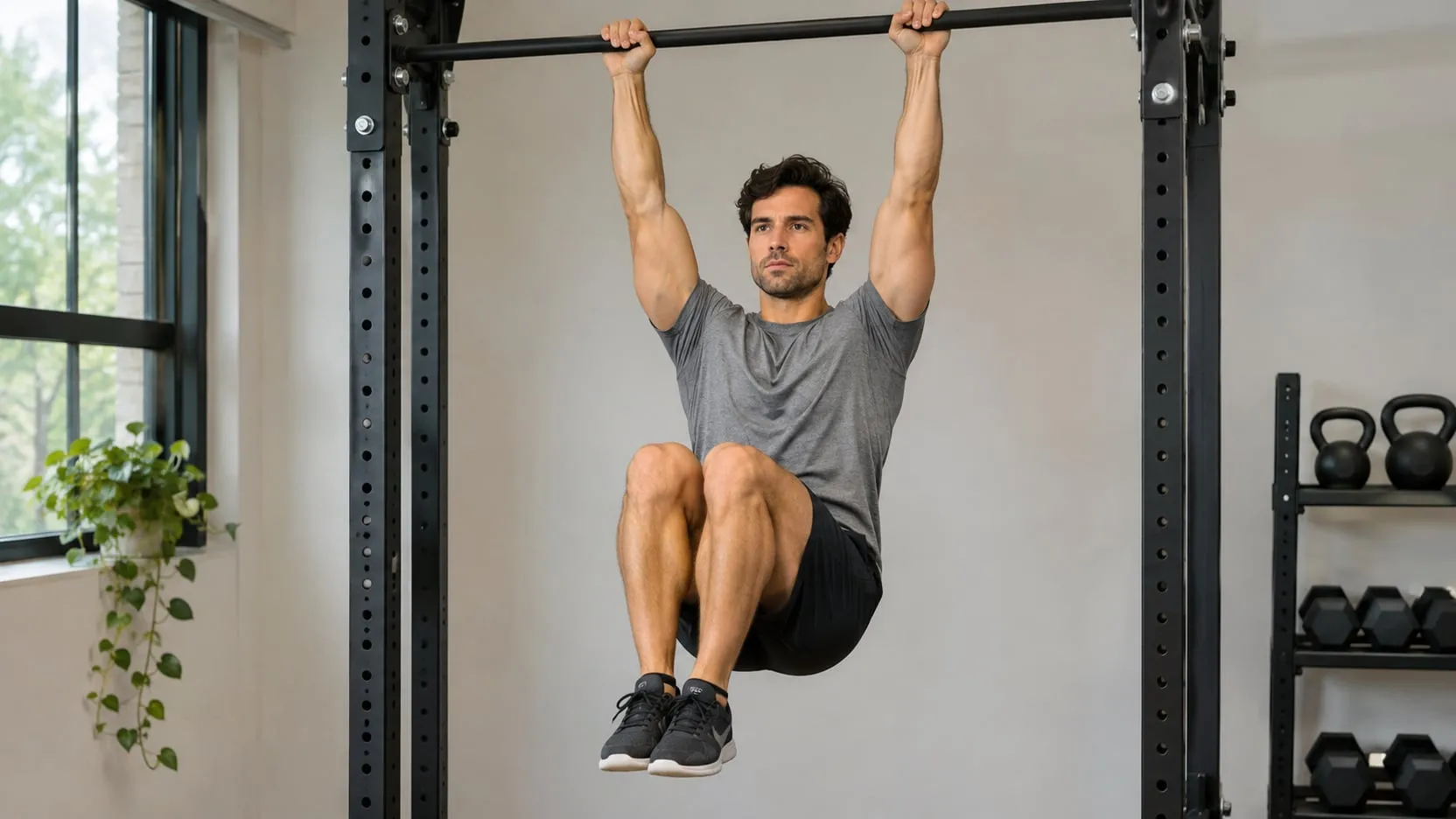
Hanging leg raises look simple on video and feel brutal on the bar. The reason is not just your abs. Your grip, your shoulders and your control all have to hold while your legs swing out in front of you like a long lever. This guide shows how to do hanging leg raises with clean form, the hanging knee raise steps that get you there, how many to do, which equipment helps, and when to be careful with your back and shoulders. We did not test anyone; every claim about muscles or safety names its source.
How to Do Hanging Leg Raises With Good Form
The setup decides whether the abs or the momentum does the work. Get these four parts right and the rest is volume.
Grip and Shoulders
Take an overhand grip about shoulder width apart with your thumbs wrapped around the bar. Before you lift anything, pull your shoulders gently down and back so they are not shrugged up to your ears. The American Council on Exercise gives the same cue for pulling exercises: “depress and retract your scapulae (pull shoulders back and down)” and hold that position (American). If you cannot hold that shoulder position yet, our scapular pull-up guide is the drill that builds it.
Brace Before You Lift
Tighten your stomach as if you were about to be poked in the ribs. ACE tells people to stiffen (“brace”) the abdominal muscles to stabilize the spine before a pull (American). In a leg raise the brace keeps your lower back from arching as the legs start to move.
Lift by Curling the Pelvis
The common mistake is to flick the legs up from the hips while the lower back stays arched. The better version tilts the pelvis backward at the top, so your tailbone curls toward the front. Think of rolling your hips up rather than kicking your feet up. Raise your legs to hip height at least; higher is fine if the pelvis keeps curling.
Lower Slowly and Kill the Swing
Take two to three seconds to lower. A fast drop starts a pendulum, and the next rep then rides the swing instead of the muscle. If you start swinging, pause in a still hang before the next rep. A light touch of your feet on a box at the bottom also stops the swing while you learn.
Start With the Hanging Knee Raise
The hanging knee raise is the same movement with bent legs. Bending the knees shortens the lever, so the load on your abs and grip drops and you can practice the pelvic curl.
How to Do a Hanging Knee Raise
- Hang from the bar with a full grip and your shoulders set.
- Brace your stomach and keep your legs together.
- Bend your knees and lift them until your thighs are level with your hips.
- Curl your pelvis slightly at the top, pause for a second.
- Lower over two to three seconds and stop the swing before the next rep.
What the Research Measured
The best-known lab data on this movement come from a 2006 study of 21 healthy adults aged 23 to 43. Using surface EMG, the researchers found the hanging knee-up with straps among the exercises with the highest upper and lower rectus abdominis, internal oblique and external oblique activity, alongside the Power Wheel and an inclined reverse crunch (Escamilla, 2006). EMG shows how hard a muscle is working during the movement; it does not prove the exercise builds more strength than another, and the participants used straps rather than a bare bar.
Knee Raise Versus Leg Raise
| Feature | Hanging knee raise | Hanging leg raise |
|---|---|---|
| Legs | Bent | Straight |
| Lever length | Short | Long |
| Grip demand | Moderate | High |
| Best for | Beginners, people with a sensitive back | Once you can do clean knee raises for 3 sets of 10 or more |
| Main fault | Rushing the lowering | Swinging and an arched lower back |
A Hanging Leg Raise Progression
Each step below is harder than the last. Stay on a step until you can do about three clean sets of 8 to 12 reps.
Step 1: The Still Hang
Hang for 20 to 30 seconds with your shoulders set and no swing. If grip is the limit, our dead hang grip guide covers how to build it.
Step 2: Knee Raises to Hip Height
The movement above, slow and controlled.
Step 3: Knees to Chest
Bring the knees higher and finish with a clear pelvic curl. This is where most people first feel the lower abs working.
Step 4: Single Leg Extended
Raise both knees, then straighten one leg at the top and lower. Alternate legs each rep.
Step 5: Straight-Leg Raises to Hip Height
Keep the legs straight and lift them to hip height, then lower slowly.
Step 6: Toes Toward the Bar
The advanced version. Only try it once straight-leg raises to hip height feel easy and controlled.
Common Hanging Leg Raise Mistakes
Most stalled progress on hanging leg raises comes from one of four habits. Each one moves the work away from your abs.
Swinging
The swing is the biggest cheat. Once your body moves like a pendulum, the legs ride the momentum up and your abs only steer. A two to three second lowering and a pause in a still hang between reps fix most of it.
Lifting Only From the Hips
If your legs rise but your pelvis never curls, the hip flexors are doing nearly all the work. Think about bringing your belt buckle toward your chest at the top of each rep, not your feet toward the bar.
Hanging From Shrugged Shoulders
Letting your shoulders ride up to your ears makes the hang feel unstable and loads the shoulder in its least supported position. Set the shoulders down before the first rep and keep them there.
Chasing Straight Legs Too Soon
Straight legs look impressive, but three clean sets of knee raises beat a handful of swung straight-leg reps. Earn each step of the progression before you move on.
Sets, Reps and How Often
What We Know About Dose
No study we found has tested the best number of sets or reps for hanging leg raises. The guidance that does exist is general. The American College of Sports Medicine’s 2026 position stand found that strength improved with training at least two days a week, and muscle growth with at least 10 sets per muscle group per week (Currier, 2026).
A Practical Starting Plan
| Level | Exercise | Sets x reps | Sessions a week |
|---|---|---|---|
| New | Hanging knee raise | 3 x as many clean reps as you can | 2 |
| Building | Knees to chest | 3 x 8 to 12 | 2 to 3 |
| Strong | Straight-leg raise | 3 x 6 to 10 | 2 to 3 |
This is our suggestion built on the ACSM frequency finding, not a tested program. End each set when the swing appears.
Equipment: Bar, Straps or Power Tower
A Pull-Up Bar
A doorway or wall-mounted bar works for hanging leg raises if it lets you hang with straight arms and your feet clear of the floor. The catch is the swing: a doorway bar under a swinging body is the setup most likely to shift. In 2011 the CPSC announced a recall of about 7,000 Perfect Pullup doorway bars after handles cracked (CPSC, 2011). Our guides to doorway pull-up bars and wall-mounted pull-up bars cover fit and mounting.
Arm Straps
Ab straps loop over the bar and hold your upper arms, so you hang from your elbows instead of your hands. That is the setup of the study above (Escamilla, 2006). They are a good fix when grip gives out long before your abs. Our guide to the best ab straps for hanging leg raises compares four pairs by padding, hook and fit.
A Power Tower
A power tower adds a back pad and padded armrests, the station often called a captain’s chair. Your forearms carry your body weight, the back pad stops the swing, and you can do knee raises and leg raises without a hang at all. Our guide to the best power towers compares the ones we would choose.
Back and Shoulder Safety
The Lower Back
In the same 2006 study, lumbar paraspinal activity was low across every exercise tested. The authors also warn that exercises with high rectus femoris (hip flexor) activity, which in their data were the Power Wheel pike and knee-up, the inclined reverse crunch and the bent-knee sit-up, may be a problem for some people with low back problems (Escamilla, 2006). The hanging knee-up was not on that list, but a straight-leg raise with an arched back leans heavily on the hip flexors. If you have a sensitive back, keep your knees bent, keep the pelvic curl, and stop if the lift brings on back pain. The upside-down version of this ab work, hanging from gravity boots, is covered in our guide to inverted sit-ups.
The Shoulders
Hanging puts your arms overhead, which narrows the space in the shoulder. A study of 11 people tracking the shoulder blade during pull-ups found that high arm elevation reduces the sub-acromial space, and linked wide and reverse grips with patterns of higher impingement risk (Prinold, 2016). That was a small study of pull-ups, not leg raises, but the arm position is similar. A shoulder-width grip, set shoulders and arm straps or armrests are kinder to a sore shoulder.
When to Stop
Stop and get advice for sharp pain in the back or shoulder, pain that runs down the arm or leg, or a bulge in the abdomen during the lift. If you have had recent surgery, a back condition or a shoulder injury, ask a clinician before you start.
Bringing It Together
Begin with the hanging knee raise, two sessions a week, a few clean sets each. Hang with set shoulders, brace, curl the pelvis, lower slowly. Use straps or a power tower if grip is the limit. Move one progression step at a time, and only when the current step is clean. Hanging leg raises are a long-term exercise: the people who get good at them are the ones who refuse to swing.
Your questions, answered
Frequently Asked Questions
How do I perform a hanging leg raise as a beginner?
Start with bent knees, not straight legs. Hang with a full grip and your shoulders pulled gently down, brace your stomach, then lift your knees to hip height and lower them slowly without swinging. Arm straps or a power tower's armrests take your grip out of the equation while you learn the movement.
How to work up to doing hanging leg raises?
Build in steps: a steady hang, then knee raises to hip height, then knees to chest with a pelvic tilt, then one leg straight, then both legs straight. Move to the next step only when you can do about three clean sets of 8 to 12 of the current one without swinging or a rushed descent.
How many hanging leg raises should I do?
No study has set a number for this exercise. A practical start is three sets of as many clean reps as you can manage, stopping when the swing or a dropped descent appears. General strength guidance from the ACSM supports training a muscle group at least twice a week, so two or three ab sessions is plenty.
Do hanging leg raises work better with knees bent or straight?
Straight legs are harder because the weight sits further from your hips, but harder is not automatically better. The one lab study we found that measured strong abdominal activity used bent-knee raises in straps. Bend your knees until you can control the lift and lowering, then straighten them gradually.
What can I substitute for hanging knee raises?
If you have nothing to hang from, a reverse crunch on the floor or an incline bench works the same hip-curl pattern, and in one EMG study the inclined reverse crunch scored among the highest for abdominal activity. A captain's chair on a power tower keeps the movement while your forearms carry your weight.
Why is it so hard to do hanging leg raises?
Because three things have to hold at once: your grip, your shoulders and your abdominal muscles, while your legs act as a long lever. Most people fail at the grip or start swinging long before their abs give out. Straps, a power tower and bent knees remove those limits one at a time.
5 sources used for this guide
Each linked to the original. Citations in the text jump here.
View sources
Escamilla RF, Babb E, DeWitt R, Jew P, Kelleher P, Burnham T, Busch J, D'Anna K, Mowbray R, Imamura RT. Electromyographic analysis of traditional and nontraditional abdominal exercises: implications for rehabilitation and training. Physical Therapy 2006;86(5):656-671.
American Council on Exercise. Chin-ups (Exercise Library). acefitness.org, exercise library entry 190.
Prinold JA, Bull AM. Scapula kinematics of pull-up techniques: Avoiding impingement risk with training changes. Journal of Science and Medicine in Sport 2016;19(8):629-635.
Currier BS, D'Souza AC, Singh MAF, et al. American College of Sports Medicine Position Stand. Resistance Training Prescription for Muscle Function, Hypertrophy, and Physical Performance in Healthy Adults: An Overview of Reviews. Medicine & Science in Sports & Exercise 2026;58(4):851-872.
CPSC. Perfect Pullup Recalled by Perfect Fitness Due to Fall Injury Hazard. U.S. Consumer Product Safety Commission, cpsc.gov, release 11-136, February 17, 2011.