Review
Teeter FitSpine X3 Review: What the Premium Over a Cheaper Table Buys
By the IntoInversion teamUpdated
- 20 sources
- 11 min read
We earn from qualifying purchases made through our links.

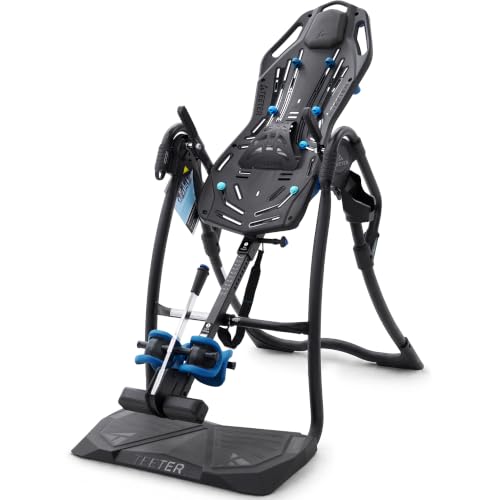
Our pick if you will use it for years
Teeter FitSpine X3
Choose the Innova ITX9600 if lower upfront cost matters most. Choose the X3 if you expect to use a table for years and will pay for the longer ankle-lock handle, the five-year warranty and Teeter’s full package. A marked tether is not exclusive to Teeter, and equal 300 lb ratings do not mean equal strength. Neither choice shows better pain relief or fewer injuries.
- Deluxe EZ-Reach ankle lock with an extra-long handle
- Five-year full warranty and FDA 510(k) clearance
- Tether marked at 20°, 40° and 60°, set before you lie back
- Weight limit
- 300 lb
- User height
- 4'8" to 6'6"
- Warranty
- 5 years
- Price range
- Premium
Maker sourceSpecs from the maker's own product page
Better if getting on is hard
Choose it if bending to your ankles or balancing on one foot while you lock in is difficult: the LX9 adds a raised boarding platform and an arched frame. Skip it if mounting is easy for you: the LX9 inverts you exactly as the X3 does.
This Teeter FitSpine X3 review is built from Teeter’s product page, its spec table and its published answers to buyers, compared line by line with the other three tables Teeter sells. We did not test the X3 ourselves, and we may earn a commission if you buy through links on this page. That does not decide which table we recommend.
Why the Teeter FitSpine X3 Is Our Default Pick
Teeter sells four inversion tables today: the FitSpine X1, X3 and LX9, and the EP-560 (Teeter). All four share a 300 lb rating, a five-year warranty and the same FDA clearance. So the question is not which one is stronger. It is which controls and entry features better fit your requirements. If the unmarked strap does not bother you, our Teeter FitSpine X1 review covers the entry model.
The Marked Angles
The X3’s EZ-Angle tether has embroidered markings with preset rotational control at 20, 40 and 60 degrees (Teeter). You set the strap before you lie back, and the table stops at that angle. The ITX9600 also lets you set a limit before reclining, with a pin whose degrees are listed in its manual; the difference is how the limit is selected and labeled.
The three marks are settings the equipment offers, not a recommended progression. For how to start and how long to stay, follow Teeter’s current manual and any limit your own clinician gives you; Teeter’s own beginner advice is one to two minutes per session, advancing “only as you feel comfortable” (Teeter, 2014).
These are product settings, not a recommended progression. Follow the current manual and any restrictions given by your clinician.
The Ankle Lock
The X3 uses Teeter’s Deluxe EZ-Reach ankle system, with an extra-long handle and a micro-adjusting closure that Teeter says “reduces the need to bend forward when securing ankles,” plus a secondary gravity-activated lock (Teeter). The ankle cups are the same Ergo-Embrace supports with a soft foam liner used across the range.
Every inversion table hangs you by the ankles, so this is the part that holds you for the whole session. Teeter publishes no failure data for any of its locks, so we can’t call one safer. What the long handle does is let you close it standing more upright, which helps anyone stiff in the hips or lower back, which is most people buying a table for back pain.
Teeter FitSpine X3 Specifications
Here is what Teeter publishes for the X3, against the two tables people most often weigh it against.
| Spec | Editor's choiceTeeter FitSpine X3Premium, price tier 3 of 3Maker source |  Teeter FitSpine X1Premium, price tier 3 of 3Maker source | Teeter FitSpine LX9Premium, price tier 3 of 3Maker source |
|---|---|---|---|
| Weight capacity | 300 lb | 300 lb | 300 lb |
| User height | 4'8" to 6'6" | 4'8" to 6'6" | 4'8" to 6'6" |
| Angle control | EZ-Angle tether marked at 20°, 40° and 60°; full inversion with secure lockout | Angle tether, no degree marks; full inversion with secure lockout | EZ-Angle tether marked at 20°, 40° and 60°; full inversion with secure lockout |
| Ankle system | Deluxe EZ-Reach ankle lock, extra-long handle, micro-adjusting closure | Ergo-Embrace ankle supports, spring-loaded closure, Ankle Comfort Dial | Deluxe EZ-Reach ankle lock with Ankle Comfort Dial |
| Warranty | 5 years (extension to 10 sold separately) | 5 years (extension to 10 sold separately) | 5 years (extension to 10 sold separately) |
| Heat and massage | None | None | None |
| FDA | 510(k) cleared (K162702), Class I device | 510(k) cleared (K162702), Class I device | 510(k) cleared (K162702), Class I device |
| Assembly and setup | 85% pre-assembled, BILT app instructions (brand-wide claim) | 85% pre-assembled, BILT app instructions (brand-wide claim) | 85% pre-assembled, BILT app instructions (brand-wide claim) |
| Buy | See today's price: Teeter FitSpine X3 on Amazon (opens in a new tab) | See today's price: Teeter FitSpine X1 on Amazon (opens in a new tab) | See today's price: Teeter FitSpine LX9 on Amazon (opens in a new tab) |
Editor's choiceTeeter FitSpine X3Maker source- Weight capacity
- 300 lb
- User height
- 4'8" to 6'6"
- Angle control
- EZ-Angle tether marked at 20°, 40° and 60°; full inversion with secure lockout
- Ankle system
- Deluxe EZ-Reach ankle lock, extra-long handle, micro-adjusting closure
- Warranty
- 5 years (extension to 10 sold separately)
- Heat and massage
- None
- FDA
- 510(k) cleared (K162702), Class I device
- Assembly and setup
- 85% pre-assembled, BILT app instructions (brand-wide claim)
Teeter FitSpine X1Maker source- Weight capacity
- 300 lb
- User height
- 4'8" to 6'6"
- Angle control
- Angle tether, no degree marks; full inversion with secure lockout
- Ankle system
- Ergo-Embrace ankle supports, spring-loaded closure, Ankle Comfort Dial
- Warranty
- 5 years (extension to 10 sold separately)
- Heat and massage
- None
- FDA
- 510(k) cleared (K162702), Class I device
- Assembly and setup
- 85% pre-assembled, BILT app instructions (brand-wide claim)
Teeter FitSpine LX9Maker source- Weight capacity
- 300 lb
- User height
- 4'8" to 6'6"
- Angle control
- EZ-Angle tether marked at 20°, 40° and 60°; full inversion with secure lockout
- Ankle system
- Deluxe EZ-Reach ankle lock with Ankle Comfort Dial
- Warranty
- 5 years (extension to 10 sold separately)
- Heat and massage
- None
- FDA
- 510(k) cleared (K162702), Class I device
- Assembly and setup
- 85% pre-assembled, BILT app instructions (brand-wide claim)
Maker source from the maker's own page or manual, not independently testedListing only retail listing, no maker spec sheetNot stated the maker publishes nothing
Capacity, Height and Weight
The X3 is item X3A. Teeter lists it for users from 4 ft 8 in to 6 ft 6 in (142 to 198 cm) and up to 300 lb (136 kg), and the table weighs 65.8 lb (29.9 kg) (Teeter). Answering a buyer on the same page, a Teeter product expert confirms the 300 lb capacity.
Dimensions, Folded and in Use
Teeter publishes these dimensions for the X3 (length x width x height) (Teeter):
| Dimension | FitSpine X3 |
|---|---|
| In use, at full inversion | 81.0 x 28.8 x 86.5 in |
| Upright, not in use | 58.0 x 28.8 x 60.5 in |
| Folded for storage | 20.0 x 28.8 x 66.0 in |
| In the shipping box | 49.2 x 29.9 x 8.3 in |
Bed, Handles and What’s in the Box
The X3 has Teeter’s FlexTech backrest, which sits on an 8-point Floating Suspension that lifts it off the frame. It comes with Stretch Max Handles, EZ-Stretch Traction Handles for added decompression at lesser angles, a Lumbar Bridge, Acupressure Nodes and a headrest pillow, plus printed instructions, a full-color user guide, 3D assembly in the BILT app and the Teeter Move app (Teeter). A product expert on the same page gives the width between the two traction handles as 18 inches.
Teeter’s FitSpine page says its tables arrive 85% pre-assembled, with the rest guided in the BILT app (Teeter).
Warranty, Returns and FDA Status
The X3 carries a five-year full warranty, with an extension of another five years sold separately (Teeter). Bought from Teeter, it can be returned within 90 days of delivery for a full refund in original condition; used or damaged returns get up to 50% (Teeter). On Amazon, Amazon’s policy applies.
Teeter’s inversion tables are cleared under FDA 510(k) number K162702 (FDA, 2016). The record names the “Teeter Manual Inversion Table,” not the X3 by model, and the device type sits in Class I, the FDA’s lowest-risk class (FDA). That is an equivalence review and a risk category, not a trial showing the X3 relieves pain.
X3 vs X1 vs LX9: Which Teeter to Buy
The three FitSpine tables share a frame family, a bed and a rating. The differences are all about how you set the angle and how you get in.
X3 vs X1
The X1 has the same FlexTech bed and 300 lb rating, but its angle tether is not marked in degrees, and its ankle system is the Ergo-Embrace support with a spring-loaded closure and T-shaped grip (Teeter). You set the angle by feel and reach lower to lock in.
If you already know how far you like to invert, the X1 does the job for less. If this is your first table, the marked strap and the longer ankle handle are the two upgrades we would pay for.
X3 vs LX9
The LX9 adds three things to the X3: an arched LX Ergonomic Frame, a Raised Boarding Platform that Teeter says makes stepping into the ankle lock easier, and a Storage Caddy (Teeter). Angle strap, ankle lock, capacity, warranty and clearance are the same. Our full Teeter LX9 breakdown goes through it line by line.
Buy the LX9 if balancing on one foot or bending to your ankles is genuinely hard. Otherwise the X3 does everything the LX9 does during the session itself.
X3 vs EP-560
The EP-560 is Teeter’s older ComforTrak table, with an unmarked strap and the T-pin ankle closure, and it is the only current Teeter sold with a heat and vibration cushion in the box (Teeter). If heat is what you want, read our page on the Teeter EP-560 inversion table. If not, the X3 is the better table.
Long ankle-lock handle, 5-year warrantyMaker source
by TEETER
Best for buyers who want a marked tether and an ankle lock they can close without bending far.
Skip it if you weigh over 300 lb, or you want heat built in from the first session.
What the premium over a cheaper table buys is the longer ankle-lock handle, the 5-year warranty against Innova's 1 year, and a tether marked at 20°, 40° and 60°. The Innova ITX9600 also lets you set a limit with a pin whose degrees are listed in its manual, so a marked angle is not exclusive to Teeter.
- Weight limit
- 300 lb
- User height
- 4'8" to 6'6"
- Warranty
- 5 years
- Price range
- Premium
What we like
- Tether marked at 20°, 40° and 60°, set before you get on
- Five-year full warranty, against Innova's one year
- Teeter's tables are FDA 510(k) cleared under K162702
- EZ-Reach ankle lock with an extra-long handle
Keep in mind
- No heat or massage
- No raised boarding platform, unlike the LX9
- Rated to 300 lb, max height 6 ft 6 in
Full specs
- Price range
- Premium
- Weight capacity
- 300 lb
- User height
- 4'8" to 6'6"
- Angle control
- EZ-Angle tether marked at 20°, 40° and 60°; full inversion with secure lockout
- Ankle system
- Deluxe EZ-Reach ankle lock, extra-long handle, micro-adjusting closure
- Heat and massage
- None
- Warranty
- 5 years (extension to 10 sold separately)
- FDA
- 510(k) cleared (K162702), Class I device
Maker sourceFrom the maker's product page. Not stated means the maker publishes nothing.
We may earn a commission. It never changes which table we pick, or the order they appear in.
Raised boarding platformMaker source
by TEETER
Best for people who find bending to their ankles or balancing on one foot hard.
Skip it if you can step in and close the ankle lock without strain: the X3 does the same job.
Same angle system as the X3, plus a boarding platform with an arched frame. Worth the step up only if getting on and off the table is the hard part for you.
- Weight limit
- 300 lb
- User height
- 4'8" to 6'6"
- Warranty
- 5 years
- Price range
- Premium
What we like
- Raised boarding platform and arched frame for getting on and off
- Same 20°, 40° and 60° marked tether as the X3
- Five-year full warranty, with a five-year extension sold separately
- Ships with a Storage Caddy and traction handles on the hinges
Keep in mind
- Otherwise identical to the X3, so you pay for the platform
- Roller hinge setting must match your body weight, per the manual
- No heat or massage
- Rated to 300 lb, max height 6 ft 6 in
Full specs
- Price range
- Premium
- Weight capacity
- 300 lb
- User height
- 4'8" to 6'6"
- Angle control
- EZ-Angle tether marked at 20°, 40° and 60°; full inversion with secure lockout
- Ankle system
- Deluxe EZ-Reach ankle lock with Ankle Comfort Dial
- Heat and massage
- None
- Warranty
- 5 years (extension to 10 sold separately)
- FDA
- 510(k) cleared (K162702), Class I device
Maker sourceFrom the maker's product page. Not stated means the maker publishes nothing.
We may earn a commission. It never changes which table we pick, or the order they appear in.
X3 vs Innova ITX9600: Is the Premium Worth It?
The table most X3 shoppers also look at is Innova’s ITX9600, the common first table in the budget tier. Both makers publish enough to compare them line by line.
| Spec | Editor's choiceTeeter FitSpine X3Premium, price tier 3 of 3Maker source |  Innova ITX9600Budget, price tier 1 of 3Maker source |
|---|---|---|
| Weight capacity | 300 lb | 300 lb |
| User height | 4'8" to 6'6" | 4'10" to 6'6" |
| Angle control | EZ-Angle tether marked at 20°, 40° and 60°; full inversion with secure lockout | Pin with protective cover; the manual labels the settings 15°, 30°, 45°, 60° and 85° (the product page calls it a six-position pin) |
| Ankle system | Deluxe EZ-Reach ankle lock, extra-long handle, micro-adjusting closure | Reversible ankle holders (foam rollers and U-shaped holders can trade places) |
| Warranty | 5 years (extension to 10 sold separately)Highest here | 1 year limited |
| FDA | 510(k) cleared (K162702), Class I device | Not stated |
| Assembly and setup | 85% pre-assembled, BILT app instructions (brand-wide claim) | Not stated |
| Buy | See today's price: Teeter FitSpine X3 on Amazon (opens in a new tab) | Not linked |
Editor's choiceTeeter FitSpine X3Maker source- Weight capacity
- 300 lb
- User height
- 4'8" to 6'6"
- Angle control
- EZ-Angle tether marked at 20°, 40° and 60°; full inversion with secure lockout
- Ankle system
- Deluxe EZ-Reach ankle lock, extra-long handle, micro-adjusting closure
- Warranty
- 5 years (extension to 10 sold separately)Highest here
- FDA
- 510(k) cleared (K162702), Class I device
- Assembly and setup
- 85% pre-assembled, BILT app instructions (brand-wide claim)
Innova ITX9600Maker source- Weight capacity
- 300 lb
- User height
- 4'10" to 6'6"
- Angle control
- Pin with protective cover; the manual labels the settings 15°, 30°, 45°, 60° and 85° (the product page calls it a six-position pin)
- Ankle system
- Reversible ankle holders (foam rollers and U-shaped holders can trade places)
- Warranty
- 1 year limited
- FDA
- Not stated
- Assembly and setup
- Not stated
Maker source from the maker's own page or manual, not independently testedListing only retail listing, no maker spec sheetNot stated the maker publishes nothing
Angle Control
Both tables let you limit the angle, in different ways. The X3 uses a strap marked at 20°, 40° and 60° (Teeter). The ITX9600 uses a pin, and its owner’s manual gives five marked angles with degrees: 15°, 30°, 45°, 60° and 85°. The manual also has installers screw the pin into the 15° hole during assembly, so the table starts at its shallowest setting (Innova). On angle control alone, the cheaper table is not behind; it starts even shallower.
Warranty
This is where the price gap shows. The X3 carries a five-year full warranty (Teeter). Innova’s warranty runs one year from purchase, covers only the original purchaser buying from an authorized retailer for household use, and is non-transferable (Innova).
Weight, Size and Space
The ITX9600 manual gives an assembled size of 52 x 28 x 59 inches and a weight of 54 lb, against 65.8 lb for the X3. It explains how to fold the table but publishes no folded dimensions, while Teeter lists the X3 at 20.0 x 28.8 x 66.0 inches folded. Innova’s manual also sets a clearance that is worth applying to any table: at least 2 feet on the left and right and 3 feet at the front and back (Innova).
Who Should Not Use Either
Innova’s manual asks for a physician’s approval first and lists 21 conditions. Four of them are not on Teeter’s list at all: weak ankles or feet, cerebral sclerosis, conjunctivitis and spinal injury (Innova). Reading both lists before you buy costs nothing, and if anything on either applies to you, it applies whichever table you choose.
What the FDA File Behind the X3 Actually Says
Teeter’s marketing leans on its FDA status. The summary Teeter filed for clearance K162702 is public, and it is more modest than the badge suggests.
A Family of Devices, One Clearance
The 510(k) covers a family of Teeter decompression devices, including the inversion table, gravity boots and a portable device, for over-the-counter home use by adults. The indications filed for the whole family are back pain, muscle tension, degenerative disc disease, spinal degenerative joint disease, spinal stenosis, herniated disc, spinal curvature due to tight muscles, sciatica, muscle spasm and facet syndrome (FDA 510(k) K162702 summary).
What Was Tested
The performance data in the summary are safety evaluations of the inversion table and gravity boots and a risk analysis. No clinical trial was submitted, and the clearance rests on substantial equivalence to an earlier device, the Lo-Bak TRAX (FDA 510(k) K162702 summary). The FDA’s decision letter records the outcome as “Substantially Equivalent” (FDA, 2016).
How to Read It
So the clearance tells you the table went through a safety evaluation and an equivalence review, and that Teeter may market it for those conditions. It does not tell you the X3 relieves any of them. For that question, the trials discussed further down are the evidence, and they are mixed.
Adding Heat to the X3
The X3 has no heat or massage as standard. That is the one feature people most often ask about when they compare it with Innova’s heated tables.
The FitSpine Cushion
Teeter sells a Heat & Vibration Comfort Cushion in a FitSpine version that it lists as compatible with the X1, X2, X3, LX7 and LX9. It has six vibration motors with two intensity levels, separately controlled heat that shuts off after 20 minutes, and a control panel on the cushion (Teeter).
The Warranty Catch
The cushion carries its own one-year full warranty (Teeter), against five years on the table. If you add it, register it separately and keep the receipt.
Using the X3 Safely
Set It Up for Your Body
Before the first session, set the main shaft to your height and choose one of the three roller hinge settings (Teeter). When an owner of an EP-560 asked why their table would not rotate back far enough, Teeter’s customer service pointed to exactly these two adjustments: shorten the shaft by one to two inches, or change the hinge setting (Teeter). Do the first fitting with someone nearby.
Start Short and Shallow
Teeter’s guidance is to begin with one to two minutes per session, and it says that inverting more often matters more than inverting for longer (Teeter, 2014). Independent advice goes further. The authors of a 2021 case series describe three patients who fell from inversion tables and suffered cervical spinal cord injuries, and they recommend sessions under one minute (Jung, 2021). Three cases can’t tell you how often this happens, only that it does.
Who Should Not Use It
Teeter tells users not to invert until a licensed physician approves if they have high blood pressure, heart or circulatory conditions, glaucoma, a history of retinal detachment, osteoporosis, fractures or orthopedic implants, hernias, severe acid reflux, pregnancy or recent surgery, among other conditions (Teeter).
Some of that list is backed by measurements. In a study of 60 healthy women, two minutes of inversion raised both systolic and diastolic blood pressure significantly (Haskvitz, 1986). After five minutes fully inverted, eye pressure roughly doubled, from 16.8 to 32.9 mmHg in healthy eyes and from 21.3 to 37.6 mmHg in eyes with glaucoma (Weinreb, 1984). Those rises are temporary, but they are why hypertension and glaucoma lead the list. For pregnancy we found no study at all, which is a reason to wait, not to experiment. Our page on who should not use an inversion table sorts the full list.
What the X3 Can and Can’t Do for Back Pain
The Evidence on Traction
A Cochrane review of 32 trials with 2,762 people found traction of any kind makes little or no difference to pain, function or return to work in low-back pain (Wegner, 2013). That covers traction in general, not inversion or the X3 specifically.
The Evidence on Inversion
The numbers Teeter advertises come from a 2021 registry in which 74% of patients (49 of 66) reported less pain at follow-up and the median pain score fell from 6 to 3 (Mendelow, 2021). Patients were compared with their own earlier scores, without a control group, and Teeter supplied the tables and funded the study’s administrator; the authors state the analysis was independent. We go through both studies in what inversion tables are shown to do, and the negative side effects page covers the other side. If back pain is why you are looking, our guide to inversion tables for back pain sets out what the guidelines and trials say.
When the X3 Isn’t the Right Choice
If You Weigh More Than 300 lb
Every current Teeter, the X3 included, is rated to 300 lb. Innova publishes a 350 lb capacity for its ITX1200 (Innova). Our guide to tables for big, tall and heavier users covers that range.
If Budget Comes First
The X3 sits in the premium tier. If price decides it, our best inversion tables guide includes a budget pick, and our Innova inversion table guide covers the cheaper heated tables.
The Verdict on the Teeter FitSpine X3
The Teeter FitSpine X3 is the table we point to if you expect to use one for years and will pay more than an Innova ITX9600 costs. It shares its 300 lb rating, five-year warranty and FDA clearance with every Teeter, and adds an angle strap marked in degrees and an ankle lock you can close without folding in half. If lower upfront cost matters most, the ITX9600 does the basic job for less.
Skip it for the LX9 only if getting on is hard, for the X1 only if you already know your angle, and for the EP-560 only if you want heat in the box. Whichever you choose, follow the manual’s starting setting, keep sessions short, and get a doctor’s approval first if anything on Teeter’s own list applies to you.
Your questions, answered
Frequently Asked Questions
Do teeter inversion tables really work?
As machines, yes: a Teeter holds you at the angle you choose so your own weight pulls along the spine. As a back pain treatment, the evidence is thinner. Pooled traction trials found little or no benefit, and the best known inversion registry had no control group. Expect a stretch that some people find relieving, not a cure.
How long should you be on a Teeter inversion table?
Teeter's answer for beginners is one to two minutes per session, advancing only as you feel comfortable, and it values frequent short sessions over long ones. Surgeons who reported three fall injuries in 2021 suggested staying under a minute to spare your ankles. Use the shorter limit while you learn the table, and ask your doctor if you have a condition.
Do inversion tables actually decompress spine?
Briefly, and by a small amount. Studies of inversion and hanging have measured the spine lengthening by a few millimeters while the load is off, but most of that gain was gone within about half an hour of standing again. So decompression on a table is real but temporary, which is why any relief tends to come from repeated sessions, not one.
How to do inversion without a table?
The usual options are gravity boots on a doorway or rack bar, an inversion chair that tips you from a seated position, a yoga trapeze, or simply a dead hang from a pull-up bar, which loads the spine without turning you upside down. Each one has its own safety limits, and none of them makes inversion safe for people with glaucoma or high blood pressure.
20 sources used for this guide
Each linked to the original. Citations in the text jump here.
View sources
Teeter. FitSpine X3 Inversion Table. teeter.com, product page.
Teeter. Product sitemap. teeter.com/product-sitemap.xml.
Teeter. FitSpine X1 Inversion Table. teeter.com, product page.
Teeter. FitSpine LX9 Inversion Table. teeter.com, product page.
Teeter. FitSpine Inversion Tables. teeter.com/fitspine/.
Teeter. EP-560 Inversion Table. teeter.com, product page.
Teeter. Heat & Vibration Comfort Cushion. teeter.com, product page.
FDA. 510(k) Premarket Notification K162702: Teeter Manual Inversion Table. U.S. Food and Drug Administration, 510(k) database, decision date December 30, 2016.
FDA. Device classification, product code HST: Apparatus, Traction, Non-Powered. U.S. Food and Drug Administration, device classification database (openFDA), 21 CFR 888.5850.
Teeter. Return Policy. teeter.com, Return Policy.
Teeter. FAQ: Invert How Long And How Often?. teeter.com blog, 2014 (updated 2025).
Jung SH, Hwang JM, Kim CH. Inversion Table Fall Injury, the Phantom Menace: Three Case Reports on Cervical Spinal Cord Injury. Healthcare (Basel) 2021;9(5):492.
Teeter. Are there health issues that would prevent me from inverting?. teeter.com, Support Center (the same list appears in the owner's manual).
Haskvitz EM, Hanten WP. Blood pressure response to inversion traction. Physical Therapy 1986;66(9):1361-1364.
Weinreb RN, Cook J, Friberg TR. Effect of inverted body position on intraocular pressure. American Journal of Ophthalmology 1984;98(6):784-787.
Wegner I, Widyahening IS, van Tulder MW et al. Traction for low-back pain with or without sciatica. Cochrane Database of Systematic Reviews 2013, CD003010.
Mendelow AD, Gregson BA, Mitchell P et al. Lumbar disc disease: the effect of inversion on clinical symptoms and a comparison of the rate of surgery after inversion therapy with the rate of surgery in neurosurgery controls. Journal of Physical Therapy Science 2021;33(11):801-808.
Innova. ITX1200 Inversion Table. innovaproductsinc.com, product page.
Innova. ITX9600 Heavy Duty Deluxe Inversion Therapy Table, Owner's Manual (version 1709AJJ). Innova Products Inc., owner's manual.
FDA; STL International, Inc. 510(k) Summary and Indications for Use, K162702: Teeter Decompression Devices. U.S. Food and Drug Administration, clearance letter of December 30, 2016, with the 510(k) summary.