Review
Teeter FitSpine X1 Inversion Table Review: What the Cheapest FitSpine Gives You
By the IntoInversion teamUpdated
- 18 sources
- 11 min read
We earn from qualifying purchases made through our links.

Our pick if budget is the constraint
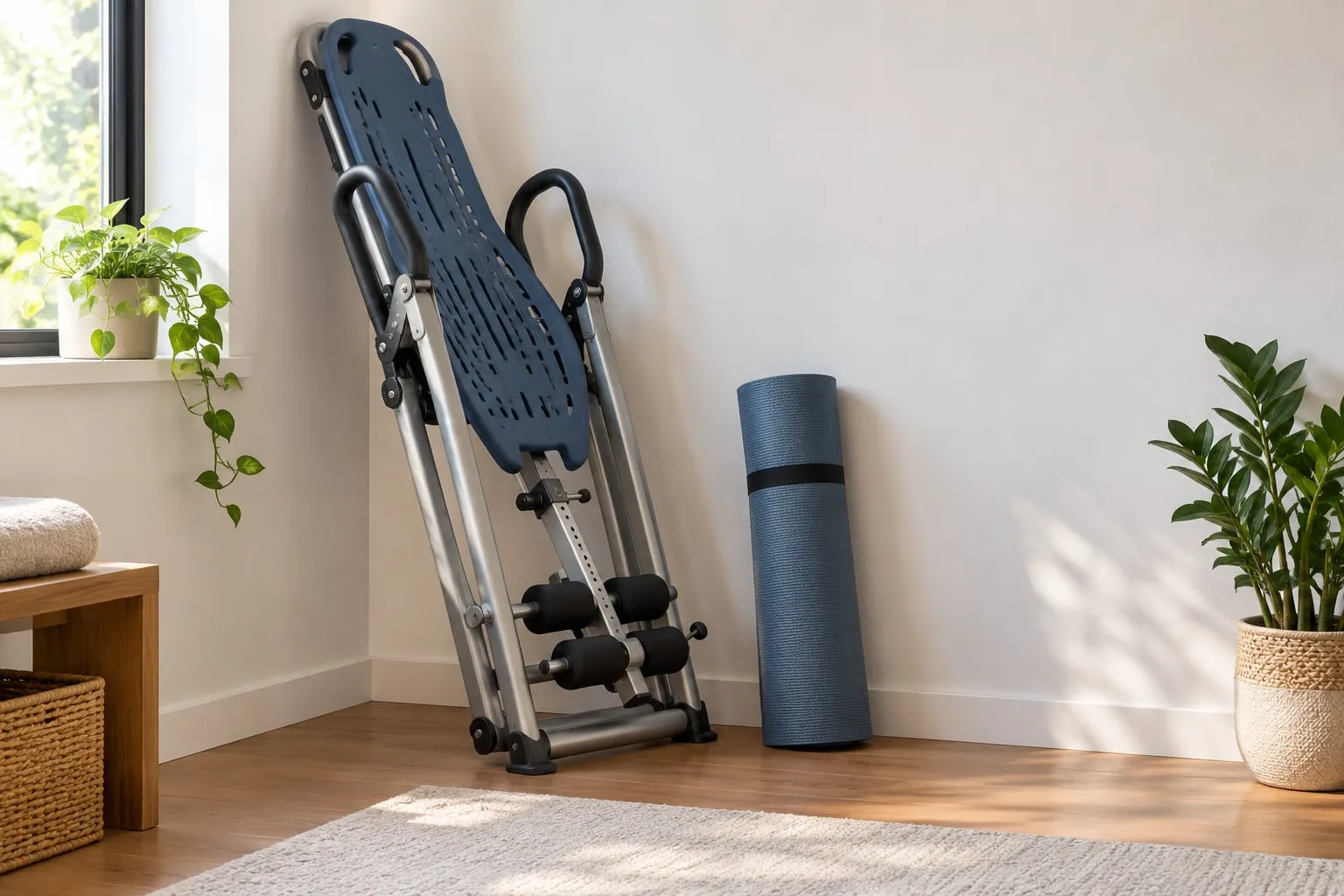
Teeter FitSpine X1
Choose the Teeter FitSpine X1 if you want Teeter’s frame, warranty and ankle supports without paying for a marked angle strap or the longer ankle-lock handle. Its angle tether has no degree marks and its ankle closure needs more reach. Neither table shows better pain relief than the other.
- Five-year full warranty, the same as the dearer FitSpines
- FDA 510(k) clearance shared across Teeter's inversion tables
- Ergo-Embrace ankle supports with an Ankle Comfort Dial
- Weight limit
- 300 lb
- User height
- 4'8" to 6'6"
- Warranty
- 5 years
- Price range
- Premium
Maker sourceSpecs from the maker's own product page

Better if you want a marked tether
Choose it if you are new to inversion and want to set 20, 40 or 60 degrees by a mark on the strap, and you want a longer handle on the ankle lock. Skip it if you already know the angle you want and the lower reach of the X1 lock is no problem.
This Teeter FitSpine X1 review is built from Teeter’s product page for the X1, set beside Teeter’s pages for the X3 and LX9 and the safety evidence we have read. We did not test the X1 ourselves, and we may earn a commission if you buy through links on this page. That does not decide which table we recommend.
Teeter FitSpine X1 Inversion Table Specs
Teeter sells four inversion tables today: the FitSpine X1, X3, LX9 and the EP-560 (Teeter). The Teeter FitSpine X1 inversion table is the one with the fewest extras. On Amazon it lists below the X3 and LX9 in price, and what you give up is mostly in how you set the angle and how you close the ankle lock.
| Spec | Teeter FitSpine X1Premium, price tier 3 of 3Maker source | Teeter FitSpine X3Premium, price tier 3 of 3Maker source | 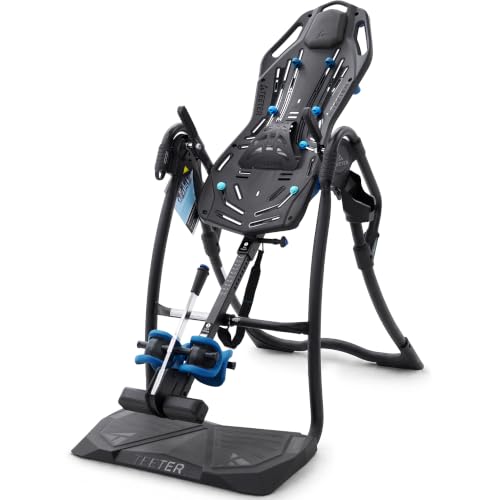 Teeter FitSpine LX9Premium, price tier 3 of 3Maker source |
|---|---|---|---|
| Weight capacity | 300 lb | 300 lb | 300 lb |
| User height | 4'8" to 6'6" | 4'8" to 6'6" | 4'8" to 6'6" |
| Angle control | Angle tether, no degree marks; full inversion with secure lockout | EZ-Angle tether marked at 20°, 40° and 60°; full inversion with secure lockout | EZ-Angle tether marked at 20°, 40° and 60°; full inversion with secure lockout |
| Ankle system | Ergo-Embrace ankle supports, spring-loaded closure, Ankle Comfort Dial | Deluxe EZ-Reach ankle lock, extra-long handle, micro-adjusting closure | Deluxe EZ-Reach ankle lock with Ankle Comfort Dial |
| Warranty | 5 years (extension to 10 sold separately) | 5 years (extension to 10 sold separately) | 5 years (extension to 10 sold separately) |
| Heat and massage | None | None | None |
| FDA | 510(k) cleared (K162702), Class I device | 510(k) cleared (K162702), Class I device | 510(k) cleared (K162702), Class I device |
| Assembly and setup | 85% pre-assembled, BILT app instructions (brand-wide claim) | 85% pre-assembled, BILT app instructions (brand-wide claim) | 85% pre-assembled, BILT app instructions (brand-wide claim) |
| Buy | See today's price: Teeter FitSpine X1 on Amazon (opens in a new tab) | See today's price: Teeter FitSpine X3 on Amazon (opens in a new tab) | See today's price: Teeter FitSpine LX9 on Amazon (opens in a new tab) |
Teeter FitSpine X1Maker source- Weight capacity
- 300 lb
- User height
- 4'8" to 6'6"
- Angle control
- Angle tether, no degree marks; full inversion with secure lockout
- Ankle system
- Ergo-Embrace ankle supports, spring-loaded closure, Ankle Comfort Dial
- Warranty
- 5 years (extension to 10 sold separately)
- Heat and massage
- None
- FDA
- 510(k) cleared (K162702), Class I device
- Assembly and setup
- 85% pre-assembled, BILT app instructions (brand-wide claim)
Teeter FitSpine X3Maker source- Weight capacity
- 300 lb
- User height
- 4'8" to 6'6"
- Angle control
- EZ-Angle tether marked at 20°, 40° and 60°; full inversion with secure lockout
- Ankle system
- Deluxe EZ-Reach ankle lock, extra-long handle, micro-adjusting closure
- Warranty
- 5 years (extension to 10 sold separately)
- Heat and massage
- None
- FDA
- 510(k) cleared (K162702), Class I device
- Assembly and setup
- 85% pre-assembled, BILT app instructions (brand-wide claim)
Teeter FitSpine LX9Maker source- Weight capacity
- 300 lb
- User height
- 4'8" to 6'6"
- Angle control
- EZ-Angle tether marked at 20°, 40° and 60°; full inversion with secure lockout
- Ankle system
- Deluxe EZ-Reach ankle lock with Ankle Comfort Dial
- Warranty
- 5 years (extension to 10 sold separately)
- Heat and massage
- None
- FDA
- 510(k) cleared (K162702), Class I device
- Assembly and setup
- 85% pre-assembled, BILT app instructions (brand-wide claim)
Maker source from the maker's own page or manual, not independently testedListing only retail listing, no maker spec sheetNot stated the maker publishes nothing
Capacity, Height and Weight
Teeter lists the X1 for users from 4 ft 8 in to 6 ft 6 in (142 to 198 cm) and up to 300 lb (136 kg). The table itself weighs 60.3 lb (27.4 kg) (Teeter). For comparison, Teeter lists the X3 at 65.8 lb (Teeter) and the LX9 at 73.6 lb (Teeter). The X1 is the lightest of the three, which helps when you move it to a closet but says nothing about how it performs.
The 300 lb figure is a ceiling shared by every current Teeter, not a feature of the X1. If you weigh more, Innova publishes a 350 lb capacity for its ITX1200 (Innova), and our guide to tables for big, tall and heavier users covers that range.
Dimensions, Folded and in Use
Teeter publishes these dimensions for the X1 (length x width x height) (Teeter):
| Dimension | FitSpine X1 |
|---|---|
| In use, at full inversion | 81.0 x 28.8 x 86.5 in |
| Upright, not in use | 58.0 x 28.8 x 60.5 in |
| Folded for storage | 20.0 x 28.8 x 66.0 in |
| In the shipping box | 48.4 x 29.2 x 9.1 in |
The in-use and storage sizes match what Teeter publishes for the X3 (Teeter), so choosing the X1 does not buy you a smaller footprint.
Bed, Ankle Supports and What’s in the Box
The X1 has Teeter’s FlexTech backrest on an 8-point Floating Suspension that lifts the backrest off the frame. Teeter claims the firm surface “deepens your stretch more than any other inversion table,” which is marketing copy and not a measured result (Teeter).
The ankle system is the part that matters most. The X1 uses Ergo-Embrace ankle supports with a soft foam liner and a wrap-around design, an Ankle Comfort Dial with a high and a low setting, and a spring-loaded closure with a T-shaped grip. In the box Teeter lists a Lumbar Bridge, Acupressure Nodes, a headrest pillow, a printed user guide, 3D assembly help in the BILT app and the Teeter Move app (Teeter). Teeter says the table arrives 85% pre-assembled (Teeter).
Warranty, Returns and FDA Status
The X1 comes with a five-year full warranty against manufacturing defects in materials, workmanship, fabrics and padding, and Teeter sells a five-year extension separately (Teeter). Bought from Teeter, an unused table in original condition can be returned within 90 days of delivery for a full refund of the item price, and used or damaged returns get up to 50% (Teeter). On Amazon, Amazon’s own return policy applies instead.
Teeter’s inversion tables are cleared under FDA 510(k) number K162702 (FDA, 2016). The record names the “Teeter Manual Inversion Table,” not the X1 by model. The device type sits in Class I, the FDA’s lowest-risk class (FDA). That is a finding that the device is substantially equivalent to one already on the market, not a trial showing the X1 relieves pain. Teeter’s X1 page also describes the table as an FDA-registered medical device and as UL Safety Certified, and its company page makes the same claims; we have not checked the UL certificate itself (Teeter).
What You Get, and What You Don’t
What the X1 Does Well
On paper the X1 is a complete Teeter. It has full inversion with a secure lockout, an angle tether for partial inversion, integrated grip-and-stretch handholds, and the same frame family, rating and warranty as the dearer tables. Teeter describes the steel as “High Gauge Heat-Treated Steel” (Teeter). Elsewhere Teeter’s pages say the FitSpine frame is “73% stronger and 10X as durable as the competition,” without saying who the competition is or how the test was run (Teeter). Treat that as a slogan. What you can rely on is the rating: 300 lb, the same as the other three Teeters.
For a buyer who wants a brand-name table with a five-year warranty and has no special needs at the ankle or the angle strap, that is enough to explain the appeal.
What You Give Up Compared With the X3
The X3 adds three things. Its EZ-Angle tether carries embroidered marks at 20, 40 and 60 degrees. Its Deluxe EZ-Reach ankle system has an extra-long handle that Teeter says “reduces the need to bend forward when securing ankles.” And it ships with Stretch Max handles and EZ-Stretch traction handles (Teeter). The X1 page names an angle tether and integrated handholds, but no degree marks and no traction handles.
None of those extras changes the rating, the warranty or the FDA record. They change how you set up and how far you reach.
What Neither Table Includes
Neither the X1 nor the X3 comes with heat or massage. Teeter sells heat only on the EP-560 and as a separate cushion accessory, so if heat matters to you, read our page on the Teeter EP-560 before you decide. No FitSpine table comes with a raised boarding platform except the LX9.
Setup and First Session
This section summarizes what Teeter publishes for its tables in general. The X1 owner’s manual that ships with the table is the authority for your unit, and Teeter tells users to read it before the first use (Teeter, 2020). For a fuller walkthrough, see our guide on how to use an inversion table.
Fit the Table to Your Body
Teeter’s setup has three steps. First, use the spring-loaded locking pin to choose your height on the main shaft. Teeter says the settings are only a guide, that your real setting may differ by several inches with your weight distribution, and that you should start 1 inch taller than your actual height and then test your balance (Teeter, 2020). Second, set the angle with the tether strap. Third, lock your ankles. The X1 has a three-setting roller hinge that Teeter says lets you tune how responsive the rotation feels (Teeter).
Teeter advises testing your balance with a spotter nearby, and tells users to run its “Hear, See, Feel, Test” check on the ankle closure before every inversion (Teeter, 2020).
Setting the Angle on an Unmarked Tether
Teeter’s advice for beginners is to limit the first inversions to somewhere between 20 and 45 degrees and to increase the angle gradually (Teeter, 2020). It says some models have a tether marked at 20, 40 or 60 degrees. The X1 page does not mention marks. The page we read does not say how to find 20 to 45 degrees on an unmarked strap, so use the guidance in the owner’s manual and have someone with you while you learn your setting. That is the practical cost of the X1 over the X3.
How Long to Stay Up
Teeter tells beginners to start with one to two minutes per session and to increase only as comfortable, and it says frequent short sessions beat one long session (Teeter, 2014). It also advises against full 90-degree inversion until you have inverted for several weeks and are completely comfortable at 60 degrees (Teeter, 2020).
Independent safety advice is stricter. The authors of a 2021 case series describe three patients who fell from inversion tables and suffered cervical spinal cord injuries, and they suggest sessions under one minute (Jung, 2021). Three cases cannot tell you how often this happens, only that it has. Return upright slowly, and do not sit up in one move.
Teeter FitSpine X1 vs X3 vs LX9
The three tables share a frame family, a bed, a 300 lb rating, a five-year warranty and the FDA record. What separates them is how you set the angle and how you get in.
X1 vs X3
The X3 is the table to buy if this is your first and you will use it for years. The marked tether lets you set a degree before you lie back, and the longer ankle handle lets you close the lock standing straighter. Our Teeter FitSpine X3 review goes through both in full. The X1 does the same job in the session itself, for less money.
If you already know your angle, or a clinician has set a limit and you have a way to hold it, the X1 loses little.
Better if you don't want to guess the angle
Choose it if you want the strap to show 20, 40 or 60 degrees and a longer handle on the ankle lock. Skip it if you can set your angle by feel with a spotter and want to spend less.
X1 vs LX9
The LX9 adds an arched frame, a raised boarding platform and a storage caddy (Teeter). It is the one for people who find it hard to step in and bend to the ankles. If you can do both easily, the platform buys you nothing during the session. Our Teeter LX9 breakdown covers it line by line.
Where the Other Teeters Fit
If you are looking at an older ComforTrak table on the used market, our page on the Teeter EP-960 covers what its manual says. For the full range, including how the EP-560 differs, our Teeter inversion table reviews page sets all four models side by side. If you are comparing brands rather than Teeters, start with our best inversion tables guide.
What About the FitSpine X2?
The X2 Is No Longer in Teeter’s Range
People still search for the Teeter FitSpine X2, and some Amazon listings carry its name. Teeter’s own product sitemap lists the X1, X3, LX9 and EP-560 and does not list the X2 (Teeter). So the X2 is discontinued as far as Teeter’s current range goes.
Which Table Replaces It
We found no Teeter statement naming a direct successor, so any claim that the X1 “replaces” the X2 would be a guess. What the current range offers is the same family at three entry points: the X1, the X3 and the LX9. If you were looking at an X2 listing for its extended ankle-lock handle, the X3 is the current table that has one.
Buying a Leftover X2
If you find a leftover or used X2, check the seller’s terms before you pay. We have no X2 warranty terms from Teeter to quote, and a secondhand table comes with no Teeter warranty claim that we can confirm. Our page on inversion table replacement parts is the place to start if a used unit needs a part.
Who the X1 Suits, and Who Should Skip It
Who the X1 Suits
The X1 suits a buyer who wants a Teeter with the five-year warranty and a brand-name frame at the lowest entry point, who is between 4 ft 8 in and 6 ft 6 in and under 300 lb, and who is comfortable setting an angle without marks on the strap. It also suits someone who has used an inversion table before and knows the setting they want.
Who Should Skip It
Skip the X1 if you weigh more than 300 lb, if you are 6 ft 7 in or taller, or if you want heat built in. Skip it for the X3 or LX9 if you are a first-time user who wants a marked strap, or if reaching your ankles or stepping in is hard.
Safety Limits Published by Teeter
Teeter tells users not to invert until a licensed physician approves if they have high blood pressure, heart or circulatory conditions, glaucoma, a history of retinal detachment, osteoporosis, fractures or orthopedic implants, hernias, severe acid reflux, pregnancy or recent surgery, among other conditions (Teeter). That is the manufacturer’s list, written with legal and clinical caution, and not every item has been proven in a study.
Some of it has been measured. In a study of 60 healthy young women, two minutes of inversion raised both systolic and diastolic blood pressure significantly (Haskvitz, 1986). After five minutes fully inverted, eye pressure roughly doubled, from 16.8 to 32.9 mmHg in healthy eyes and from 21.3 to 37.6 mmHg in eyes with glaucoma (Weinreb, 1984). Those rises are temporary, but they are why high blood pressure and glaucoma lead the list. Our page on who should not use an inversion table sorts the full list. If you have a diagnosed condition, talk to your clinician before you buy.
What the X1 Can and Can’t Do for Back Pain
What Teeter Advertises
Teeter’s FitSpine page advertises “74% Pain Reduction” and “75% Increased Physical Ability” (Teeter). Those figures come from a 2021 registry in which 74% of patients (49 of 66) reported a lower pain score at follow-up and 75% (48 of 64) improved on a disability index (Mendelow, 2021). Each patient was compared with his or her own earlier score, there was no control group for those results, and the authors state that the study was not randomized. Teeter supplied the tables and funded the study’s administrator; the authors say the analysis was independent.
What Pooled Trials Found
A Cochrane review of 32 trials with 2,762 people found that traction of any kind makes little or no difference to pain, function or return to work in low-back pain (Wegner, 2013). That covers traction in general and not the X1 or inversion tables in particular. The same review found that seven of the 32 trials reported adverse effects, among them increased pain and subsequent surgery.
How to Read It
Put together, the evidence does not support buying an X1 as a back pain treatment. It supports buying one if you want a way to hang at an angle for a stretch, you accept that the long-term benefit is unproven, and you have cleared it with a clinician. Our page on what inversion tables are shown to do goes through the research, and the negative side effects page covers the downside.
Is the X1 the Right Choice?
Buy the Teeter FitSpine X1 inversion table if you want a Teeter at the lowest entry price, you are inside its height and weight limits, and you do not mind setting the angle by feel. It shares its five-year warranty, rating and FDA record with every current Teeter. Step up to the X3 if you want the marked strap and the longer ankle handle, and to the LX9 only if getting on is hard.
Whichever you choose, follow the manual’s starting setting, keep sessions short, have someone with you the first few times, and get a doctor’s approval first if anything on Teeter’s own list applies to you.
Your questions, answered
Frequently Asked Questions
What's the best inversion table on the market?
No single table is best for everyone, and no trial has ranked them. The choice comes down to your weight and height against the published ratings, how you want to set the angle, how easy the ankle lock is to close, warranty length and budget. Our best inversion tables guide compares the current options on those points.
Why is my back pain worse after using an inversion table?
Nobody has established one cause. A Cochrane review of traction trials found increased pain reported in some of them, so it can happen. If your pain is worse after a session, stop using the table and rest. Call a clinician if the pain lasts, if it spreads into a leg, or if you notice weakness or numbness.
Do inversion tables actually decompress spine?
Only briefly. In a 1990 study of eight healthy men, twenty minutes of inversion after hard exercise added about five millimeters of height, against under one for standing. Forty minutes of standing afterward took most of it back, and by thirty minutes the difference was no longer significant. It measured height, not pain, in a very small group.
18 sources used for this guide
Each linked to the original. Citations in the text jump here.
View sources
Teeter. FitSpine X1 Inversion Table. teeter.com, product page.
Teeter. FitSpine X3 Inversion Table. teeter.com, product page.
Teeter. FitSpine LX9 Inversion Table. teeter.com, product page.
Teeter. Product sitemap. teeter.com/product-sitemap.xml.
Teeter. FitSpine Inversion Tables. teeter.com/fitspine/.
Teeter. Our Story. teeter.com, About.
FDA. 510(k) Premarket Notification K162702: Teeter Manual Inversion Table. U.S. Food and Drug Administration, 510(k) database, decision date December 30, 2016.
FDA. Device classification, product code HST: Apparatus, Traction, Non-Powered. U.S. Food and Drug Administration, device classification database (openFDA), 21 CFR 888.5850.
Teeter. Return Policy. teeter.com, Return Policy.
Teeter. How to Use an Inversion Table. teeter.com blog, 2020 (updated 2022).
Teeter. FAQ: Invert How Long And How Often?. teeter.com blog, 2014 (updated 2025).
Jung SH, Hwang JM, Kim CH. Inversion Table Fall Injury, the Phantom Menace: Three Case Reports on Cervical Spinal Cord Injury. Healthcare (Basel) 2021;9(5):492.
Teeter. Are there health issues that would prevent me from inverting?. teeter.com, Support Center (the same list appears in the owner's manual).
Haskvitz EM, Hanten WP. Blood pressure response to inversion traction. Physical Therapy 1986;66(9):1361-1364.
Weinreb RN, Cook J, Friberg TR. Effect of inverted body position on intraocular pressure. American Journal of Ophthalmology 1984;98(6):784-787.
Wegner I, Widyahening IS, van Tulder MW et al. Traction for low-back pain with or without sciatica. Cochrane Database of Systematic Reviews 2013, CD003010.
Mendelow AD, Gregson BA, Mitchell P et al. Lumbar disc disease: the effect of inversion on clinical symptoms and a comparison of the rate of surgery after inversion therapy with the rate of surgery in neurosurgery controls. Journal of Physical Therapy Science 2021;33(11):801-808.
Innova. ITX1200 Inversion Table. innovaproductsinc.com, product page.