Buying guide
Is There a 400 lb Inversion Table? The Real Weight Limits, Checked Maker by Maker
We earn from qualifying purchases made through our links. How we make money
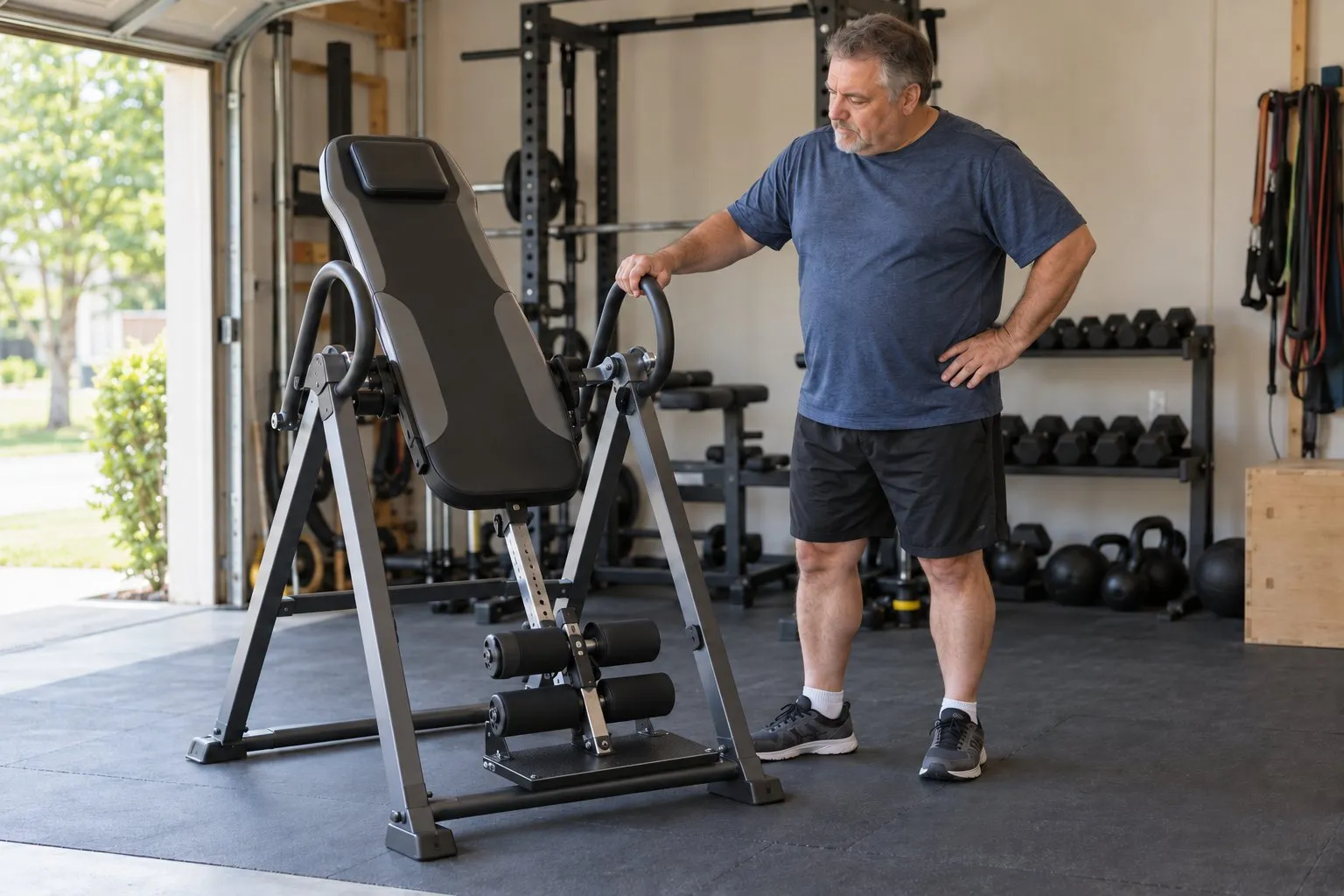
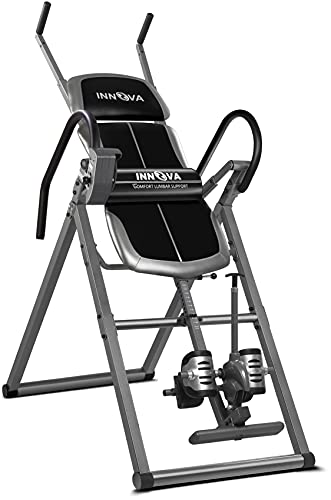
Our pick above 300 lb
Innova ITX1200
No, there is no 400 lb inversion table we could verify. The highest verified rating is 350 lb, and the ITX1200 is the best documented table at that ceiling.
- Rated to 350 lb on Innova's own product page, the highest verified rating
- Fits users from 4'10" to 6'6", with a three-position pin
- 50 lb of headroom over the standard 300 lb rating
- Weight limit
- 350 lb
- User height
- 4'10" to 6'6"
- Warranty
- 1 year
- Price range
- Mid-range
VerifiedSpecs from the maker's own product page
If you searched for a 400 lb inversion table, you probably already know the standard 300 lb rating doesn’t leave you enough room. We did not test these tables on people, but we checked every capacity against the manufacturers’ own pages and manuals, and if you buy through our links we may earn a commission that has no say in which table we pick.
The Short Answer: No Verified Inversion Table Has a 400 lb Capacity
Weight limits are the spec most often inflated in listings, because a bigger number sells. So we started from the manufacturer, not the product title.
What We Checked
We went to the makers behind the tables that show up for capacity searches: Innova, Teeter, HARISON, Ironman, Sunny Health & Fitness and Health Mark, among others. For each one we looked for the capacity on a page or document the manufacturer controls: a product page, an owner’s manual, or the maker’s own blog. A number that only appears in a marketplace title did not count, because anyone selling the table can type any number into a title.
Why 350 lb Is the Real Ceiling
Three tables from three different makers land on exactly the same figure. Innova publishes “a 350 lbs. weight capacity” for its ITX1200 (Innova). HARISON writes that its HR-407 can carry users “up to 350 lbs heavy” (HARISON).
And the Ironman Gravity 4000 has “a maximum weight capacity of 350 lbs or 159 kgs,” according to the owner’s manual as hosted on ManualsLib (Ironman manual, via ManualsLib). Nothing we could confirm with a manufacturer goes higher and is still on sale.
One older table did publish more. Health Gear’s own product page for the ITM7.5, as archived in October 2024, rated it for “a 400 lb. weight capacity” (Health Gear, 2024 archive).
But Extreme Products Group, the company behind Health Gear, states on its own site that it “has ceased operations and is no longer in business” (Extreme Products Group, 2025), and it filed for Chapter 7 bankruptcy in September 2025, according to BankruptcyObserver (BankruptcyObserver, 2025). With no maker behind it, the ITM7.5 is a historical spec rather than a table you can buy and have supported today; our Health Gear inversion table page has the full record.
What This Page Won’t Tell You
We won’t tell you a 400, 500 or 600 lb inversion table is available to buy, because we could not confirm one. If a site recommends one, ask where the number comes from. In our research, the answer was always one of three things: a traction bench, a discontinued model, or a listing with no manufacturer behind it.
The 350 lb Inversion Tables: What Each Maker Actually Publishes
These are the three tables that reach the verified ceiling. They share the capacity, but not how well documented that capacity is.
| Table | Published capacity | Where the number comes from | Can we link it? |
|---|---|---|---|
| Innova ITX1200 | 350 lb | Innova’s product page | Yes, our pick |
| HARISON HR-407 | 350 lb | HARISON’s own blog post | No verified listing yet |
| Ironman Gravity 4000 | 350 lb | Owner’s manual, as hosted on ManualsLib | No verified listing yet |
Innova ITX1200: Our Pick Above 300 lb
The ITX1200 is the only table in Innova’s range rated above 300 lb, and Innova states it on the product page itself, with user heights of 4’10” to 6’6” and a three-position pin (Innova). That makes it the best documented 350 lb table we found: the capacity, the height range and the angle system are all on a page Innova controls, not in a blog post or a third-party copy of a manual.
Rated to 350 lbVerified
by Innova
Best for users over 300 lb who want a capacity the maker states itself.
Skip it if you weigh more than 350 lb: going over the published rating means using the table outside what the maker says it was built for.
It is the only table from either Innova or Teeter that the maker rates above 300 lb: Innova publishes 350 lb for it, where every other model in both ranges stops at 300 lb or lower.
- Weight limit
- 350 lb
- User height
- 4'10" to 6'6"
- Warranty
- 1 year
- Price range
- Mid-range
What we like
- 350 lb capacity, the highest in the Innova and Teeter ranges
- Adjustable stretch bars for a fuller stretch at lower slopes
- Reversible ankle holding system
- Pin with a protective cover
Keep in mind
- Only three pin positions, with degrees not stated
- One-year limited warranty
- Max height 6 ft 6 in, the same as the 300 lb models
- No heat or massage
Full specs
- Price range
- Mid-range
- Weight capacity
- 350 lb
- User height
- 4'10" to 6'6"
- Angle control
- Three-position pin with protective cover; degrees not stated; adjustable stretch bars for a fuller stretch at lower slopes
- Ankle system
- Reversible ankle holding system
- Heat and massage
- None
- Warranty
- 1 year limited
- FDA
- Not stated
VerifiedFrom the maker's product page. Not stated means the maker publishes nothing.
We may earn a commission. It never changes which table we pick, or the order they appear in.
It also comes with Innova’s standard one-year limited warranty, which covers only the original purchaser buying from an authorized retailer for personal use (Innova). That wording is from Innova’s ITX9600 manual; the ITX1200 page states the same one-year term. Innova does not state an FDA status for this table.
One practical caveat: stock on the ITX1200 has been limited, and it moves week to week. The card above shows the current availability. If it reads as scarce or unavailable, the spec still holds; it is the supply that changes.
HARISON HR-407: 350 lb on the Maker’s Own Blog
HARISON publishes the HR-407 at 350 lb, matching the ITX1200 rather than beating it (HARISON). The catch is where the number lives. It appears in a post on HARISON’s blog, not on a structured spec sheet, and the store page for the same table does not repeat the capacity or a height range. What the store page does state is a 12-month warranty (HARISON), and when we checked in September 2026 it showed the table as out of stock.
We don’t have a verified listing for the HR-407, so there is no product card for it here. If you find one, the 350 lb figure is real; just check that the seller is shipping the HR-407 and not a lookalike.
Ironman Gravity 4000: 350 lb According to the Manual
The Gravity 4000 has a maximum weight capacity of 350 lb, according to the owner’s manual as hosted on ManualsLib (Ironman manual, via ManualsLib). That figure comes from the hosted copy of the manual rather than a current Ironman product page, so treat it as the manual’s number, not a spec we could confirm with the maker. HARISON’s blog, comparing the two, also puts the Ironman at 350 lb (HARISON), which is consistent, though it is a competitor talking.
Ironman is sometimes described as having higher-capacity models. We found nothing from the brand above 350 lb.
How 350 lb Compares With a Standard Table
For context, here is the ITX1200 next to two of the most common tables from Innova and Teeter. Every cell comes from the manufacturer; where a maker publishes nothing, the table says so.
| Spec | Editor's choiceInnova ITX1200Mid-range, price tier 2 of 3Verified |  Innova ITX9600Budget, price tier 1 of 3Verified Innova ITX9600Budget, price tier 1 of 3Verified | 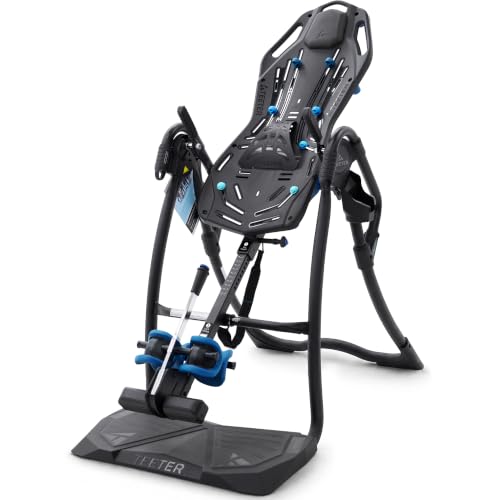 Teeter FitSpine LX9Premium, price tier 3 of 3Verified Teeter FitSpine LX9Premium, price tier 3 of 3Verified |
|---|---|---|---|
| Weight capacity | 350 lbHighest here | 300 lb | 300 lb |
| User height | 4'10" to 6'6" | 4'10" to 6'6" | 4'8" to 6'6" |
| Ankle system | Reversible ankle holding system | Reversible ankle holders (foam rollers and U-shaped holders can trade places) | Deluxe EZ-Reach ankle lock with Ankle Comfort Dial |
| Warranty | 1 year limited | 1 year limited | 5 years (extension to 10 sold separately)Highest here |
| Angle control | Three-position pin with protective cover; degrees not stated; adjustable stretch bars for a fuller stretch at lower slopes | Pin with protective cover; the manual labels the settings 15°, 30°, 45°, 60° and 85° (the product page calls it a six-position pin) | EZ-Angle tether marked at 20°, 40° and 60°; full inversion with secure lockout |
| Heat and massage | None | None | None |
| FDA | Not stated | Not stated | 510(k) cleared (K162702), Class I device |
| Assembly and setup | Not stated | Not stated | 85% pre-assembled, BILT app instructions (brand-wide claim) |
| Buy | See today's price: Innova ITX1200 on Amazon (opens in a new tab) | See today's price: Innova ITX9600 on Amazon (opens in a new tab) | See today's price: Teeter FitSpine LX9 on Amazon (opens in a new tab) |
Editor's choiceInnova ITX1200- Weight capacity
- 350 lbHighest here
- User height
- 4'10" to 6'6"
- Ankle system
- Reversible ankle holding system
- Warranty
- 1 year limited
- Angle control
- Three-position pin with protective cover; degrees not stated; adjustable stretch bars for a fuller stretch at lower slopes
- Heat and massage
- None
- FDA
- Not stated
- Assembly and setup
- Not stated
Innova ITX9600- Weight capacity
- 300 lb
- User height
- 4'10" to 6'6"
- Ankle system
- Reversible ankle holders (foam rollers and U-shaped holders can trade places)
- Warranty
- 1 year limited
- Angle control
- Pin with protective cover; the manual labels the settings 15°, 30°, 45°, 60° and 85° (the product page calls it a six-position pin)
- Heat and massage
- None
- FDA
- Not stated
- Assembly and setup
- Not stated
Teeter FitSpine LX9- Weight capacity
- 300 lb
- User height
- 4'8" to 6'6"
- Ankle system
- Deluxe EZ-Reach ankle lock with Ankle Comfort Dial
- Warranty
- 5 years (extension to 10 sold separately)Highest here
- Angle control
- EZ-Angle tether marked at 20°, 40° and 60°; full inversion with secure lockout
- Heat and massage
- None
- FDA
- 510(k) cleared (K162702), Class I device
- Assembly and setup
- 85% pre-assembled, BILT app instructions (brand-wide claim)
Verified from the maker's own page or manualClaimed retail listing onlyNot stated the maker publishes nothing
Fifty pounds of extra rating is the whole difference in capacity. The height ceiling is the same 6’6” on all three, so a table rated for more weight does not make room for a taller body. If height is your constraint as much as weight, our page on inversion tables for big, tall and large people looks at the whole body profile, not only the number on the frame.
- Teeter FitSpine X1300 lb
- Teeter FitSpine X3300 lb
- Teeter FitSpine LX9300 lb
- Innova ITX9600300 lb
- Innova ITM4800300 lb
- Innova ITM5900300 lb
- Innova ITM6000300 lb
- Innova ITX9900300 lb
- Innova ITX1200350 lb
Source: Teeter FitSpine X1, FitSpine X3, FitSpine LX9; Innova ITX9600, ITM4800, ITM5900, ITM6000, ITX9900, ITX1200.
What “Heavy Duty” Actually Means on an Inversion Table
If you searched for a heavy duty inversion table, you were probably looking for one built to carry more weight. The label won’t tell you that. “Heavy duty” is not a regulated term and it is not a number: no standard defines it, and a maker can print it on a table rated for 300 lb as easily as on one rated for 350 lb. So we read what Teeter, Innova and HARISON actually publish about how their frames are built, separately from the capacity figure.
What the Makers Say About Their Steel
Teeter describes the frame of its FitSpine X1, X3 and LX9 in identical words on all three product pages: “High-Grade Heat-Treated Steel FitSpine is 73% stronger and 10X as durable as the competition” (Teeter). That is Teeter’s claim, not a measurement anyone can check. The page does not say who “the competition” is, what was tested, or how.
Innova’s version is shorter. The model comparison on its ITX1200 page makes one construction claim for the whole line, “Heavy Duty Steel,” with the same wording for every model compared and no figure attached (Innova). The ITX1200 itself is described as having a “Heavy Duty Steel Frame,” again without a number.
HARISON argues from shape rather than material. Its blog post on the HR-407 sets its “sturdy and unique triangular frame” against the “extra-wide tubular steel frame” of the Ironman Gravity, and says the triangle “has much better heavy load performance” (HARISON). Both tables are rated at the same 350 lb, so this is a comparison of geometry, made by one of the two makers, with no test result behind it.
The One Safety Margin We Found Published
The only figure we found that says how much stronger a frame is than its rating comes from Teeter, and only in one place. On the EP-560 product page, a customer asks about the weight limit, and the answer Teeter published on the page reads: “The weight limit for our inversion table is 300 lbs. at a 400% safety rating” (Teeter).
That is a statement about build margin, not a higher capacity: the table is still sold to hold 300 lb. It is also a customer-service answer rather than a line in the spec sheet, it does not say how the rating was tested or who confirmed it, and it does not appear on the X1, X3 or LX9 pages we read. Treat it as a claim about the EP-560, not about Teeter’s whole range.
What None of Them Publish, and What to Compare Instead
What is missing matters more. None of the three makers publishes a steel gauge or a tube wall thickness for its frames. Teeter’s pages call the steel “High Gauge Heat-Treated Steel” with no number attached (Teeter), and when we searched the four Teeter product pages and Innova’s full ITX9600 manual for gauge or millimeter figures, the only measurements we found were bolt sizes, which describe hardware, not the frame.
HARISON’s post gives a shape, not dimensions. There is no published construction figure you could use to compare one “heavy duty” frame with another.
So for weight, the number that counts is the capacity the maker publishes, which is what the rest of this page goes by. Compare the rated capacity on the maker’s own page or manual first, then the ankle system and the height range.
Why Searches for a 400 lb Capacity Show Tables That Don’t Invert
Search for an inversion table with a 400 lb capacity and you will find products that really do carry 400 lb. The problem is that they are not inversion tables.
The Sunny Health & Fitness Table Is a Traction Bench
The most visible example comes from Sunny Health & Fitness. Its manufacturer page calls the product a “Traction Reset Table for Stretch and Decompression” and says, in its own words, “Decompress without the challenges of inversion … A safer alternative to traditional inversion tables, this spinal decompression table accommodates users up to 400 LBS” (Sunny).
The 400 lb figure is genuine. But Sunny itself presents the product as an alternative to inversion: you lie on it flat, and it never turns you upside down.
That is not a flaw in the product. It is simply a different machine, and it answers a different question from the one you asked.
Traction Table vs Inversion Table: the Difference That Matters
An inversion table uses your own body weight, tipped head-down, to pull on the spine. A traction or decompression bench stretches you while you stay level. Because the bench does not have to hold a full adult upside down by the ankles, the engineering problem is different, and so is the capacity a maker can publish.
It also changes the risks. The dangers specific to inversion, such as the rise in blood pressure and eye pressure, and the fall onto the head if the ankles slip, come from being upside down. A flat bench avoids those.
What it does not avoid is the open question about traction itself: a Cochrane review published in 2013 pooled 32 trials and found that traction, alone or combined with other treatments, made little or no difference to pain, function or return to work in low-back pain (Wegner, 2013). That covers traction in general, including the kind these benches provide.
How to Spot One in a Listing
Look for words like “decompression,” “traction,” “stretch table” or “reset table,” and check whether the product photos show anyone tilted past horizontal. If the frame has no pivot and no ankle lock, it is a bench. Some listings put “inversion” in the title of a bench anyway, because that is the word people search for. Read the manufacturer’s description, not the title.
What About 500 and 600 lb Inversion Tables?
We looked for these too, because they are the numbers people search after 400. Beyond the Health Gear ITM7.5 covered above, there is exactly one manufacturer-published figure above 400 lb that we could trace, and it comes with serious caveats.
The Health Mark Pro Max: 600 lb on a 2023 Page
Health Mark published a Pro Max Inversion Table with a “Weight capacity: 600 pounds,” height settings “to accommodate heights of 4-ft. 10-in. to 6-ft. 11-in.,” a one-year limited warranty, and manufacture in Taiwan (Health Mark, 2023 archive). That is the manufacturer’s product page as archived by the Wayback Machine on May 29, 2023, the most recent capture available, and we have no current page from Health Mark showing the table is still sold.
On that same archived page, the product was already marked “Out of stock.”
Why It Isn’t a Recommendation
Put those two facts together and you have a historical spec, not a table you can buy with confidence. We don’t know whether the Pro Max came back into stock, was discontinued for good, or changed since 2023.
A one-year warranty is also only as useful as the maker’s ability to honor it on a product it may no longer carry. So we are telling you it existed, because it is the only published 600 lb figure we found, and not pointing you to buy it. If you want to pursue it, contact Health Mark directly and ask whether the Pro Max is still made, before you order it from anyone.
Titles and Video Names Aren’t Specs
When we looked at what ranks for 500 and 600 lb searches, much of it was not a spec at all: a video called something with “600” in the name, a page whose title promised a high capacity while its own text gave a lower one, and the same 350 lb and 400 lb products from above. The only test that works is the one we used throughout this page: find the manufacturer’s own statement of the capacity.
Weight Is Not Only About the Frame
Even a table rated for your weight leaves one part of the system unrated: you. The frame holds the load, but your ankles and feet are what hold you on the frame.
Your Ankles Carry Your Whole Weight Upside Down
When you invert, the ankle clamp and your ankle joints hold your full body weight against gravity. The heavier you are, the more load goes through them. Innova’s manual lists “Weak ankles and/or feet” among the conditions that should keep you off the table without a doctor’s approval (Innova). That item is on Innova’s list and not on Teeter’s, and it is the one most directly tied to how inversion accidents happen.
Joe Rogan made a related point when he explained why he prefers Teeter’s DEX II, which he says avoids pulling on the knees and ankles; our page on what Rogan actually said about Teeter covers it.
The Makers Themselves List Weight as a Reason to Ask a Doctor
The same Innova list includes “Overweight” and “Extremely Obese” (Innova). Teeter’s list, which the company says also appears in its owner’s manual, puts obesity among the conditions where exercise may be restricted by a physician (Teeter). These are manufacturer lists, written with legal caution, not findings from a trial. But when both leading brands tell heavier users to get medical approval first, a higher-capacity frame is not a substitute for that conversation.
What the Fall Case Reports Recommend
The most serious documented risk is falling. In a 2021 report on three cervical spinal cord injuries after inversion table falls, the authors describe the mechanism as resembling a diving injury: once ankle strength is lost or the foot slips, the user lands on the top of the head (Jung, 2021). They recommend keeping sessions under one minute, placing an angled pillow or rubber ramp under the head so a slip becomes a slide, and they single out older and heavier users with weaker ankle strength as needing extra caution.
It is three cases, so it tells you nothing about how often this happens, and the recommendations are the authors’ own rather than a clinical consensus. They are still the most specific advice we found for heavier users.
Why the Ankle Clamp Matters More at Higher Weights
Ankle systems have failed before. In 2010 the U.S. Consumer Product Safety Commission announced a recall of about 33,000 inversion benches from three brands after 75 reports of the ankle clamp releasing or the rotation strap breaking, including 23 injuries, some to the head and neck (CPSC, 2010). Those were specific older models, not any table on this page.
For a fuller look at what can go wrong, see our page on inversion table side effects.
If You Weigh More Than 350 lb
This is the situation where a straight answer matters most, so here it is: we could not verify an inversion table rated for you, and we would rather say that than send you to one that isn’t.
Start With Your Doctor
Both Innova and Teeter tell heavier users to get a physician’s approval before inverting, and inversion raises blood pressure: in a small trial, two minutes upside down raised both systolic and diastolic pressure in healthy young women (Haskvitz, 1986). That sample was young and healthy, so it can’t tell you the size of the effect for you, which is exactly why the conversation belongs with someone who can examine you. Our page on who should not use an inversion table goes through each condition on the makers’ lists, with the evidence behind it.
Don’t Exceed the Published Rating
A 350 lb rating is the manufacturer’s maximum. Going over it means using the table outside what the maker says it was built for, and on a device that holds you head-down by the ankles, that is not a margin worth testing. If you are close to 350 lb, the ITX1200 is the only verified option we found, and we would not treat its rating as a target.
A Flat Traction Bench Is a Different Choice, Not a Bigger Inversion Table
If what you want is a stretch for your back and your weight is above every verified inversion rating, a traction or decompression bench is the category that publishes higher capacities, with Sunny’s bench at 400 lb as one example (Sunny). Be clear about what you are choosing. It is a different device with a different mechanism, it does not invert you, and the Cochrane evidence on traction for low-back pain, as described above, is not encouraging. Treat it as a separate decision and ask your doctor about it on those terms, not as a heavier-duty version of the same thing.
How to Check an Inversion Table’s Weight Limit Yourself
Listings change, and new tables will appear after we publish this. Here is how to check any of them the way we checked these.
Go to the Manufacturer, Not the Listing
Find the brand’s own website and look for the capacity on the product page or in the owner’s manual. We found a listing for one popular table claiming a higher capacity than its maker publishes, which is why we always side with the maker. If a brand has no website of its own, or its site is no longer operating, treat any capacity you see as unverified. Capacity is also not the same as build quality, but a heavy duty inversion table label is not something you can verify either: as we showed in the section on what “heavy duty” means, no maker we checked publishes a frame figure you could compare.
Check That It Actually Inverts
Look for a pivot, an ankle lock and photos of someone tilted past horizontal. If the product description talks about decompression while you stay flat, or calls itself an alternative to inversion, it is a bench, and its capacity does not answer your question.
Check Height as Well as Weight
A higher weight rating does not come with a higher height limit. Every Innova and Teeter table we checked stops at 6’6”, including the 350 lb ITX1200. If you are both tall and heavy, the height limit may rule a table out before the weight does.
Check the Warranty and Who Stands Behind It
Warranty terms differ more than capacities do. Innova’s is one year and applies only to the original purchaser from an authorized retailer. HARISON’s store page states 12 months. Teeter includes a five-year full warranty on its FitSpine tables (Teeter), but Teeter’s range stops at 300 lb.
If you are buying at the top of a table’s rated range, the length of the warranty and whether the maker is still in business both matter more than usual. For every use case below 350 lb, including tables with longer warranties, see our full guide to the best inversion tables.
Your questions, answered
Frequently Asked Questions
How much weight can an inversion table support?
Most support 300 lb, and that is the figure Teeter and Innova publish across nearly all their models. The highest current rating we could confirm with a manufacturer is 350 lb, on the Innova ITX1200, the HARISON HR-407 and the Ironman Gravity 4000. Anything advertised at 400 lb or more was either a traction bench that never tips you upside down or a product we could not confirm is still sold.
Can overweight people use an inversion table?
Some can, but it calls for a doctor's opinion first. Innova's manual lists being overweight or extremely obese among the conditions that need a physician's approval, and Teeter's list includes obesity too. The frame is only half of it: your ankles hold your full weight upside down, and the authors of a 2021 case series flagged heavier users as needing extra care against falls.
Is there an inversion table suitable for a 300-pound person?
Yes. At 300 lb you are at the published limit of most Teeter and Innova tables, which leaves no margin at all. The Innova ITX1200 is rated to 350 lb by Innova itself, which gives you 50 lb of headroom and the same 4'10" to 6'6" height range as the rest of the brand. Check your height against that range too, and get a doctor's go-ahead first.
18 sources used for this guide
Each linked to the original. Citations in the text jump here.
View sources
Innova. ITX1200 Inversion Table. innovaproductsinc.com, product page.
HARISON FITNESS LTD. HARISON Best Inversion Table HR-407 for Big People (post do blog). harisonfitness.com/harison-best-inversion-table-hr-407/.
Ironman Fitness (Paradigm Health & Wellness Inc.). Ironman Fitness Gravity 4000 Owner's Manual. Owner's manual, hosted on ManualsLib.
Extreme Products Group (Health Gear). ITM 7.5 Big & Tall Inversion Table. extremeproductsgroup.com product page, as archived by the Wayback Machine on October 9, 2024.
Extreme Products Group, LLC. Extreme Products Group, LLC has ceased operations. extremeproductsgroup.com, as archived by the Wayback Machine on January 20, 2025.
BankruptcyObserver. EXTREME PRODUCTS GROUP, LLC Chapter 7 Bankruptcy 2025. bankruptcyobserver.com, sourced from PACER.
Innova. ITX9600 Heavy Duty Deluxe Inversion Therapy Table, Owner's Manual (version 1709AJJ). Innova Products Inc., owner's manual.
HARISON FITNESS LTD. HARISON HR-407 Inversion Table (ficha de loja). harisonfitness.com/product/inversion-table-407/.
Teeter. FitSpine X3 Inversion Table. teeter.com, product page.
Teeter. EP-560 Inversion Table. teeter.com, product page.
Teeter. FitSpine X1 Inversion Table. teeter.com, product page.
Sunny Health & Fitness. Traction Reset Table (para Stretch e Decompressao), SF-BH623052. sunnyhealthfitness.com.
Wegner I, Widyahening IS, van Tulder MW et al. Traction for low-back pain with or without sciatica. Cochrane Database of Systematic Reviews 2013, CD003010.
Health Mark, Inc. Pro Max Inversion Table - Back Inversion Table. healthmarkinc.us product page, as archived by the Wayback Machine on May 29, 2023.
Teeter. Are there health issues that would prevent me from inverting?. teeter.com, Support Center (the same list appears in the owner's manual).
Jung SH, Hwang JM, Kim CH. Inversion Table Fall Injury, the Phantom Menace: Three Case Reports on Cervical Spinal Cord Injury. Healthcare (Basel) 2021;9(5):492.
CPSC. ICON Health & Fitness Recalls Inversion Benches Due to Fall Hazard. U.S. Consumer Product Safety Commission, cpsc.gov, recall 10-210, April 28, 2010.
Haskvitz EM, Hanten WP. Blood pressure response to inversion traction. Physical Therapy 1986;66(9):1361-1364.