Brand guide
Teeter Hang Ups Inversion Tables: How to Identify Yours, and What Teeter Sells Now
By the IntoInversion teamUpdated
- 14 sources
- 13 min read
We earn from qualifying purchases made through our links.
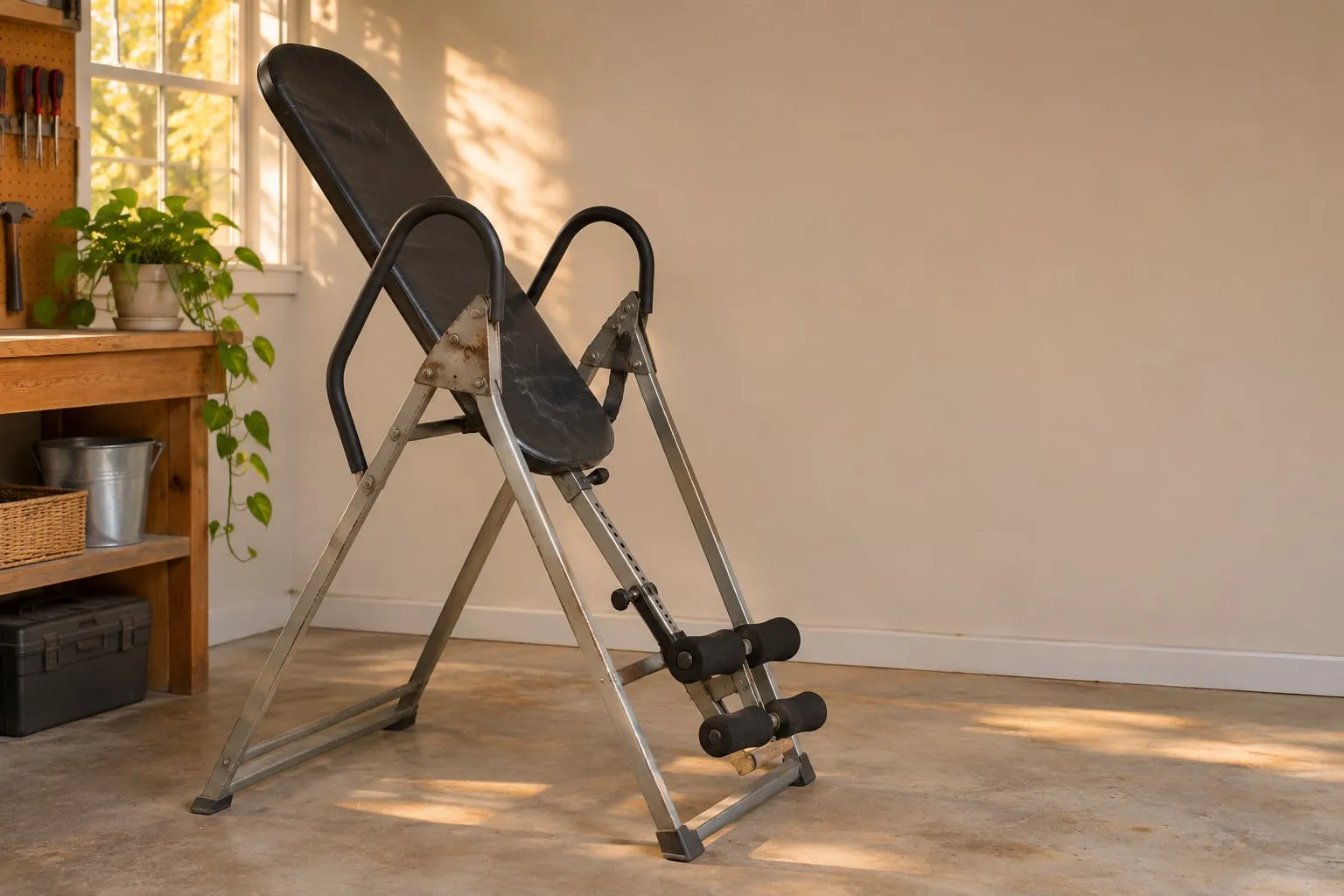

If you're replacing a Hang Ups table
Teeter FitSpine X3
The X3 is the closest thing to a like-for-like upgrade for someone who liked their Hang Ups table but wants clearer angle settings and an easier ankle lock. It keeps the same 300 lb and 6 ft 6 in ceiling, so it will not suit anyone the old table did not.
- Tether marked at 20, 40 and 60 degrees, so the angle is set before you get on
- Deluxe EZ-Reach ankle lock with an extra-long handle
- Five-year full warranty from the day of retail purchase
- Weight limit
- 300 lb
- User height
- 4'8" to 6'6"
- Warranty
- 5 years
- Price range
- Premium
Maker sourceSpecs from the maker's own product page

If you want the simplest current Teeter
Choose it if you want the same weight rating and five-year warranty and are happy to set the angle by tether without degree marks. Skip it if you want marked angles or the longer ankle-lock handle.
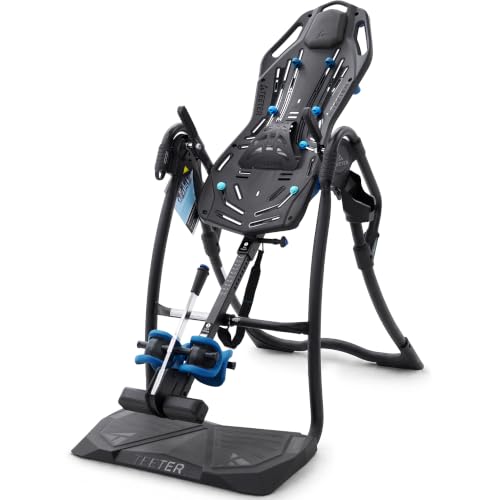
If getting on and off is the hard part
Choose it if a raised boarding platform and an arched frame would make mounting the table easier for you. Skip it if you do not need the platform, because the angle system matches the X3.
We did not test any of these tables. We read Teeter’s owner’s manual for the EP-550 and EP-650, a copy of the EP-960 manual, Teeter’s current product and support pages, and searched the CPSC recall database on November 19, 2026. When Teeter does not publish something, the page says “Not stated”. If you buy through our links we may earn a commission, which never decides which table we pick.
What Teeter Hang Ups Was
People who search for Teeter Hang Ups usually fall into one of three groups: they inherited a table, they found one on a marketplace, or they own one and the manual is gone. All three are asking the same thing in different words: which table is this, is it safe to use, and what do I do about it? This page answers those questions in that order.
First, the name. Hang Ups was the product name on a line of Teeter tables, and the model numbers you see on them start with EP, as in EP-550. Teeter’s current product list has no table under that name (Teeter). We could not find a Teeter source that says when the name started or when it stopped, so this page gives no year for either. What we can say is that the name appears in Teeter’s own document: the French and Spanish sections of the EP-550 and EP-650 owner’s manual still refer to Teeter Hang Ups parts (Teeter EP-550/EP-650 manual).
From Gravity Boots to a Table Line
Teeter tells its own story as a family business that began in 1981. By the company’s account, founder Roger Teeter found relief for his own back pain through inversion, and he and his wife Jenny started with Gravity Boots and a single inversion table (Teeter). That is the brand’s history in its own words, so treat it as the company’s account rather than an independent record.
What matters for you is the practical consequence. A Teeter table made years ago and a Teeter table sold today come from the same company, but they are not the same product. The ankle system, the way the angle is set and the paperwork have all changed, and that is what the rest of this page covers.
The Name Teeter Uses Now
Teeter’s product list today has four inversion tables: the FitSpine X1, the FitSpine X3, the FitSpine LX9 and the EP-560 (Teeter). The FitSpine X2 is not on that list. If you hear a seller call a table “a Teeter Hang Ups” and the listing shows one of those four names, they are using the old name for a current table.
If you want the full comparison of the current range, our guide to Teeter inversion table reviews is the place for it. This page stays with the older tables.
Teeter Hang Ups Models, and How to Identify Yours
The model number is the key to everything else. It tells you which manual to look for, which parts to ask about and which current table is the nearest neighbor. Here is what we could verify for each one.
EP-550 and EP-650
Teeter hosts a single owner’s manual for both tables, titled “EP-550/EP-650 Inversion Table” and carrying the document code EP-1750-M 0611-3 (Teeter EP-550/EP-650 manual). The code is a document number, not a date, so it does not tell you when your table was made.
The manual describes a table with an Angle Tether, an Ankle Comfort Dial that rotates between a high and a low setting, and front ankle clamps closed with a T-Pin Lock. It states the product is Listed by Underwriters Laboratories Inc. and does not mention the FDA (Teeter EP-550/EP-650 manual).
You will also see the name EP-560 in the same family. The EP-560 is on Teeter’s current list (Teeter). Teeter’s FitSpine page lists the same kind of features for it, an angle tether, a T-pin ankle closure and an Ankle Comfort Dial (Teeter FitSpine page). Our Teeter EP-560 inversion table guide covers it in detail.
EP-950, EP-960 and EP-970
We did not open a manual for the EP-950, so we state nothing about it beyond the name.
For the EP-960, Teeter’s English owner’s manual is document E61711, copyright 2017, and it gives the same limits as the EP-550 manual: do not use the table above 6 ft 6 in or 300 lb (Teeter EP-960 manual). The EP-970 has no public product page. The address that used to belong to it now leads to Teeter’s general FitSpine page, which lists the current tables and no EP-960 or EP-970 (Teeter FitSpine page). Teeter’s support center says its tables as a group are rated for users from 4 ft 8 in to 6 ft 6 in and up to 300 lb (Teeter support center), but that is a general statement, not a spec sheet for the EP-970.
Our Teeter EP-960 inversion table guide goes deeper on the EP-960 and EP-970, including how to tell them apart.
Where the Model Label Is
We could not find a Teeter page that says where the model name is printed on a table. What Teeter does say is where to find the serial number: for inversion tables, on the back of the table bed (Teeter). Start there, because the same label is usually where you read the rest of the identification.
The EP-550 and EP-650 manual also refers to warning notices posted on the equipment and tells owners that if a product label or the manual is lost, damaged or illegible, they should contact Teeter customer service for a replacement (Teeter EP-550/EP-650 manual). If the label on a used table is gone, treat that as missing information, not a minor cosmetic issue.
Old Model to Current Table
This table pairs each old name with the current Teeter we think is nearest. The pairing is ours, not Teeter’s, and “Not stated” means we found no source.
| Old name | What a Teeter manual says | Nearest current table |
|---|---|---|
| EP-550 and EP-650 | 300 lb, 6 ft 6 in ceiling; UL listed; FDA not mentioned | EP-560 |
| EP-950 | Not stated | Not stated |
| EP-960 | 300 lb, 6 ft 6 in ceiling; UL listed; FDA not mentioned | EP-560, or the X3 if you want marked angles |
| EP-970 | Not stated; no public product page | Not stated |
Teeter Hang Ups Instructions and Manuals
If you own one and have no paperwork, you are not stuck, but you do need to be exact about which manual you are reading. Using the wrong one is the main way people end up following the wrong ankle-lock steps.
Where Teeter Keeps Legacy Manuals
Teeter’s support center did not show a manuals or downloads section when we looked, and it did not mention the EP-550, EP-950 or EP-960. It sends owners of older tables to Contact Support. The EP-550 and EP-650 manual is nonetheless hosted as a PDF on Teeter’s own site (Teeter EP-550/EP-650 manual), and the EP-960 manual survives as a copy hosted by a third-party manuals library, ManualsLib (Teeter EP-960 manual).
In practice that gives you three routes. Search for the exact model and the document code printed on the manual’s cover. Ask Teeter customer service, whose US line is printed in the EP-550 and EP-650 manual as 1-800-847-0143 (Teeter EP-550/EP-650 manual). Or use a third-party copy, and then say plainly to yourself that it is a copy.
The Checks Every Manual Repeats
The two manuals we read are for different tables but repeat the same core instructions. They are worth knowing even before you find your own manual, though they do not replace it.
- Check the ankle lock every time. Both tell users to HEAR, FEEL, SEE and confirm the lock is secure. The EP-550 and EP-650 manual breaks it down: hear the locking pin click, feel that it is fully engaged in a hole setting, and see that there is no space between the pin and its base (Teeter EP-550/EP-650 manual). The EP-960 manual says the Ankle Lock System must be snug, close-fitting and secure (Teeter EP-960 manual).
- Respect the ceiling. Both say not to use the table above 6 ft 6 in or above 300 lb, and warn that structural failure could occur or the head and neck could hit the floor (Teeter EP-550/EP-650 manual) (Teeter EP-960 manual).
- Get approval first. Both say not to use the table until approved by a licensed physician, and both limit use to the home (Teeter EP-550/EP-650 manual) (Teeter EP-960 manual).
- Inspect and replace. The EP-550 and EP-650 manual says to inspect the equipment before every use, to replace defective components immediately, and that the table has no user serviceable parts (Teeter EP-550/EP-650 manual).
- Wear the right shoes. It also says to wear securely tied lace-up shoes with a flat sole, and not boots, high-tops or anything that extends above the ankle bone (Teeter EP-550/EP-650 manual).
For the technique itself, read our guide on how to use an inversion table after you have the right manual in hand.
Buying a Used Teeter Hang Ups
A used Hang Ups is cheap for a reason. It is old, you usually do not know how it was stored, and its safety depends on a few small parts that wear. Treat the purchase as an inspection, not a bargain hunt.
What to Inspect
Do the inspection in person, with the table standing. Do not buy an old table you cannot touch.
- The ankle lock. Work it several times. The pin or clamp should engage cleanly every time, with no play. The 2010 recall of three ICON Health & Fitness inversion benches, which involved about 33,000 units, came down to an ankle clamp that could release unexpectedly or a rotation strap that could break (CPSC, 2010). Those were other brands and models, but they show which parts to worry about.
- The angle tether. Look for fraying, cuts or a stitched section that has pulled. The manual says to attach the tether on first use (Teeter EP-550/EP-650 manual), so a table without one is missing something it was designed to use.
- Fasteners and pivot points. The EP-550 and EP-650 manual says to make sure all fasteners are secure before use (Teeter EP-550/EP-650 manual). Every bolt should be present and tight, and the pivot should move without grinding.
- Rust and cracks. We have no manufacturer inspection standard for rust, so use judgment: visible corrosion or a crack on a weight-bearing part is a reason to walk away.
- The label and the manual. If both are gone, you cannot confirm the model, and Teeter’s own text treats a lost label as something to replace (Teeter EP-550/EP-650 manual).
Does the Warranty Transfer?
We could not confirm it. Teeter’s warranty pages we opened do not say whether coverage passes to a second owner. The current FitSpine warranty runs from the day of retail purchase and is extended to “the owner” for five years (Teeter), and Teeter’s support article on the product warranty points to a separate PDF for the terms (Teeter). Neither tells you what happens on resale, and neither covers a table that old anyway. Assume a used Hang Ups has no warranty. If it matters to you, ask Teeter customer service in writing before you pay.
Recall Check
On November 19, 2026, we searched the CPSC recall database for Teeter by title and by product name, and searched recall descriptions for inversion products. The searches returned a 2025 playground tunnel recall and a 1988 gym set recall from other companies, plus recalls of inversion benches and tables from ICON Health & Fitness in 2007 and 2010 and from Stamina Products in 2008. None names Teeter or Hang Ups (CPSC recall database).
Read that carefully. It means we found no recall naming Teeter or Hang Ups in the CPSC database as of November 19, 2026. It does not mean a recall could not exist under another title or company, so run the search yourself with your exact model before you buy.
Replacement Parts for an Old Hang Ups
How to Ask Teeter for a Part
Teeter does not sell a labeled “parts” line for old tables. Its support site tells owners who need replacement parts to complete an online parts request form or call customer service (Teeter). The address that article links as the parts request form leads to Teeter’s general contact page, where choosing “Warranty / Parts Request” asks for the product, the model, the serial number, the date and place of purchase, and the specific part, referring to a part list by item number and name (Teeter).
Two things follow. You need the serial number, which Teeter says is on the back of the table bed for inversion tables (Teeter). And you need the part list, which Teeter does not publish as a download. It is the numbered exploded diagram that comes with the manual, so finding the right manual first saves you a round trip.
Accessory Parts in Teeter’s Store
Teeter’s store also lists several of the components that wear on a table as standalone accessory products, among them the Deluxe EZ-Reach Ankle System, the EZ-Angle Tether and a Lumbar Bridge for older ComforTrak models (Teeter). We confirmed that those products exist, not that any of them fits a Hang Ups table, so ask Teeter before you order. Our guide to inversion table replacement parts covers the process and the other brands.
Hang Ups vs Today’s FitSpine
If you are deciding whether to repair an old table or replace it, this is the comparison that matters. The three FitSpine tables below are the ones we would look at first, on the specs Teeter publishes.
The Specs Side by Side
| Spec | Teeter FitSpine X1Premium, price tier 3 of 3Maker source | Teeter FitSpine X3Premium, price tier 3 of 3Maker source | Teeter FitSpine LX9Premium, price tier 3 of 3Maker source |
|---|---|---|---|
| Weight capacity | 300 lb | 300 lb | 300 lb |
| User height | 4'8" to 6'6" | 4'8" to 6'6" | 4'8" to 6'6" |
| Angle control | Angle tether, no degree marks; full inversion with secure lockout | EZ-Angle tether marked at 20°, 40° and 60°; full inversion with secure lockout | EZ-Angle tether marked at 20°, 40° and 60°; full inversion with secure lockout |
| Ankle system | Ergo-Embrace ankle supports, spring-loaded closure, Ankle Comfort Dial | Deluxe EZ-Reach ankle lock, extra-long handle, micro-adjusting closure | Deluxe EZ-Reach ankle lock with Ankle Comfort Dial |
| Warranty | 5 years (extension to 10 sold separately) | 5 years (extension to 10 sold separately) | 5 years (extension to 10 sold separately) |
| FDA | 510(k) cleared (K162702), Class I device | 510(k) cleared (K162702), Class I device | 510(k) cleared (K162702), Class I device |
| Buy | See today's price: Teeter FitSpine X1 on Amazon (opens in a new tab) | See today's price: Teeter FitSpine X3 on Amazon (opens in a new tab) | See today's price: Teeter FitSpine LX9 on Amazon (opens in a new tab) |
Teeter FitSpine X1Maker source- Weight capacity
- 300 lb
- User height
- 4'8" to 6'6"
- Angle control
- Angle tether, no degree marks; full inversion with secure lockout
- Ankle system
- Ergo-Embrace ankle supports, spring-loaded closure, Ankle Comfort Dial
- Warranty
- 5 years (extension to 10 sold separately)
- FDA
- 510(k) cleared (K162702), Class I device
Teeter FitSpine X3Maker source- Weight capacity
- 300 lb
- User height
- 4'8" to 6'6"
- Angle control
- EZ-Angle tether marked at 20°, 40° and 60°; full inversion with secure lockout
- Ankle system
- Deluxe EZ-Reach ankle lock, extra-long handle, micro-adjusting closure
- Warranty
- 5 years (extension to 10 sold separately)
- FDA
- 510(k) cleared (K162702), Class I device
Teeter FitSpine LX9Maker source- Weight capacity
- 300 lb
- User height
- 4'8" to 6'6"
- Angle control
- EZ-Angle tether marked at 20°, 40° and 60°; full inversion with secure lockout
- Ankle system
- Deluxe EZ-Reach ankle lock with Ankle Comfort Dial
- Warranty
- 5 years (extension to 10 sold separately)
- FDA
- 510(k) cleared (K162702), Class I device
Maker source from the maker's own page or manual, not independently testedListing only retail listing, no maker spec sheetNot stated the maker publishes nothing
What Changed
Three differences stand out against the older manuals we read.
The angle. The EP-550 and EP-650 manual has you attach an Angle Tether and adjust it, with the angle you reach depending on how you set it (Teeter EP-550/EP-650 manual). The X3 and LX9 use an EZ-Angle tether embroidered with markings at 20, 40 and 60 degrees, per Teeter’s FitSpine page (Teeter FitSpine page). A marked tether lets you set a known angle before you get on.
The ankle lock. The older manual describes front clamps closed with a T-Pin Lock (Teeter EP-550/EP-650 manual). Teeter’s current X3 and LX9 use the Deluxe EZ-Reach Ankle Lock System with a micro-adjusting closure and a secondary gravity-lock mechanism (Teeter FitSpine page). The lock is a different design, and it is the part that matters most for safety.
The paperwork. Teeter’s FitSpine page lists its current tables as FDA-registered Class 1 medical devices (Teeter FitSpine page), and the FDA’s database shows a 510(k) clearance, K162702, decided on December 30, 2016, for the “Teeter Manual Inversion Table” under the non-powered traction category (FDA, 2016). A 510(k) shows equivalence to an earlier device, not proof that it works, and the record names a generic Teeter manual table, so we do not tie it to any single model. The two older manuals we read do not mention the FDA at all, so do not assume an old table carries the same status.
The ceiling did not change. Teeter’s support center gives the same 4 ft 8 in to 6 ft 6 in and 300 lb range for its tables (Teeter support center). If the old table was too small for you, the new one will be as well.
Which Teeter to Buy Instead
Match the choice to the reason you are leaving the old table.
If You Want the Nearest Match
The EP-560 is the current table that keeps the angle tether, T-pin closure and Ankle Comfort Dial design (Teeter FitSpine page). Read our EP-560 guide first, since it also covers the heat and vibration cushion.
If You Want More Than the Old Table Gave You
The X3 is the pick for marked angles and the easier ankle lock, as our recommendation at the top says. The X1 gives you the same weight rating and warranty with a plain tether. If getting on the table is the problem, the LX9 adds the raised boarding platform.
If none of these suits you, or you weigh more than 300 lb, our Teeter inversion table reviews show the full current range with its limits. The model that fits your body is worth more than the one with the right badge.
A Note Before You Spend
An inversion table is a medical-adjacent product, and the people who most want one often have the conditions that make it risky. Check with a clinician first, especially for high blood pressure, glaucoma, a heart condition or a recent injury. Our page on who should not use inversion tables lists the groups that most often need to avoid them.
Is an Old Hang Ups Safe to Use?
We cannot say that about your table, and no one can from a listing. What we can say is what makes the answer more or less likely to be yes.
When the Answer Leans Yes
It leans toward yes when the table is complete, the manual and label are present, the ankle lock engages cleanly every time, the tether is intact, the fasteners are tight, and the person using it is under 300 lb and 6 ft 6 in with a clinician’s approval. Teeter’s manuals ask for exactly these things: inspection before each use, immediate replacement of defective components, the HEAR, FEEL, SEE check at the ankles, and physician approval (Teeter EP-550/EP-650 manual) (Teeter EP-960 manual).
When It Leans No
It leans toward no when any one of those is missing. A table with a worn lock, a frayed tether or no way to confirm the model is not worth the repair if the repair requires parts you cannot identify. At that point replacement is the cheaper choice in every sense that matters, and the current range above gives you somewhere to go.
Your questions, answered
Frequently Asked Questions
What is a teeter inversion table?
A Teeter inversion table is a folding frame with a padded bed that tips you backward on a pivot while clamps hold your ankles, so you hang at an angle or fully upside down. Teeter says it has made them since 1981 and sells them as FitSpine and EP tables. Anyone with a medical condition should ask a clinician first.
What are the differences between the Teeter FitSpine X2 and X3 inversion tables?
Teeter's own product list names the X1, X3, LX9 and EP-560, and the X2 is not on it. A head-to-head with the X2 therefore compares a table Teeter no longer lists against a current one. If you are shopping now, compare the X3 with the X1 or the LX9 instead, because those are the tables you can still order.
Which brand is considered the best for inversion tables?
For an owner of an old Teeter, the first filter is your size. Teeter rates every table it makes for users up to 300 lb and 6 ft 6 in tall, so anyone above either limit should shop other brands before Teeter. Under those limits, Teeter's marked angles and warranty are the reasons people stay with it.
14 sources used for this guide
Each linked to the original. Citations in the text jump here.
View sources
Teeter. Our Story. teeter.com, About.
Teeter. Product sitemap. teeter.com/product-sitemap.xml.
Teeter. FitSpine Inversion Tables. teeter.com/fitspine/ (where teeter.com/product/ep-970/ now leads).
Teeter. ComforTrak EP-960 Inversion Table Owner's Manual (E61711, 0217-4, 2017), copy hosted by ManualsLib. Owner's manual, 2017 (copy hosted by ManualsLib).
Teeter. EP-550/EP-650 Inversion Table Owner's Manual (document EP-1750-M 0611-3). Owner's manual, teeter.com.
Teeter. What are the height and weight ratings for the Teeter inversion table? (support center). teeter.com support center.
Teeter. Contact Us (formulario que a KB chama de "online parts request form"; o URL /support-center/parts-request/ redirecciona para aqui). teeter.com/support/contact/.
Teeter. How do I receive my warranty service?. teeter.com, Support Center.
Teeter. What is the product warranty on the Teeter Inversion Table?. teeter.com, Support Center.
Teeter. FitSpine X1 Inversion Table. teeter.com, product page.
FDA. 510(k) Premarket Notification K162702: Teeter Manual Inversion Table. U.S. Food and Drug Administration, 510(k) database, decision date December 30, 2016.
CPSC. ICON Health & Fitness Recalls Inversion Benches Due to Fall Hazard. U.S. Consumer Product Safety Commission, cpsc.gov, recall 10-210, April 28, 2010.
CPSC. Recalls database search for Teeter and for inversion products. U.S. Consumer Product Safety Commission recall database, searched November 19, 2026.
Teeter. Are there health issues that would prevent me from inverting?. teeter.com, Support Center (the same list appears in the owner's manual).