Health guide
Can an Inversion Table Help a Pinched Nerve?
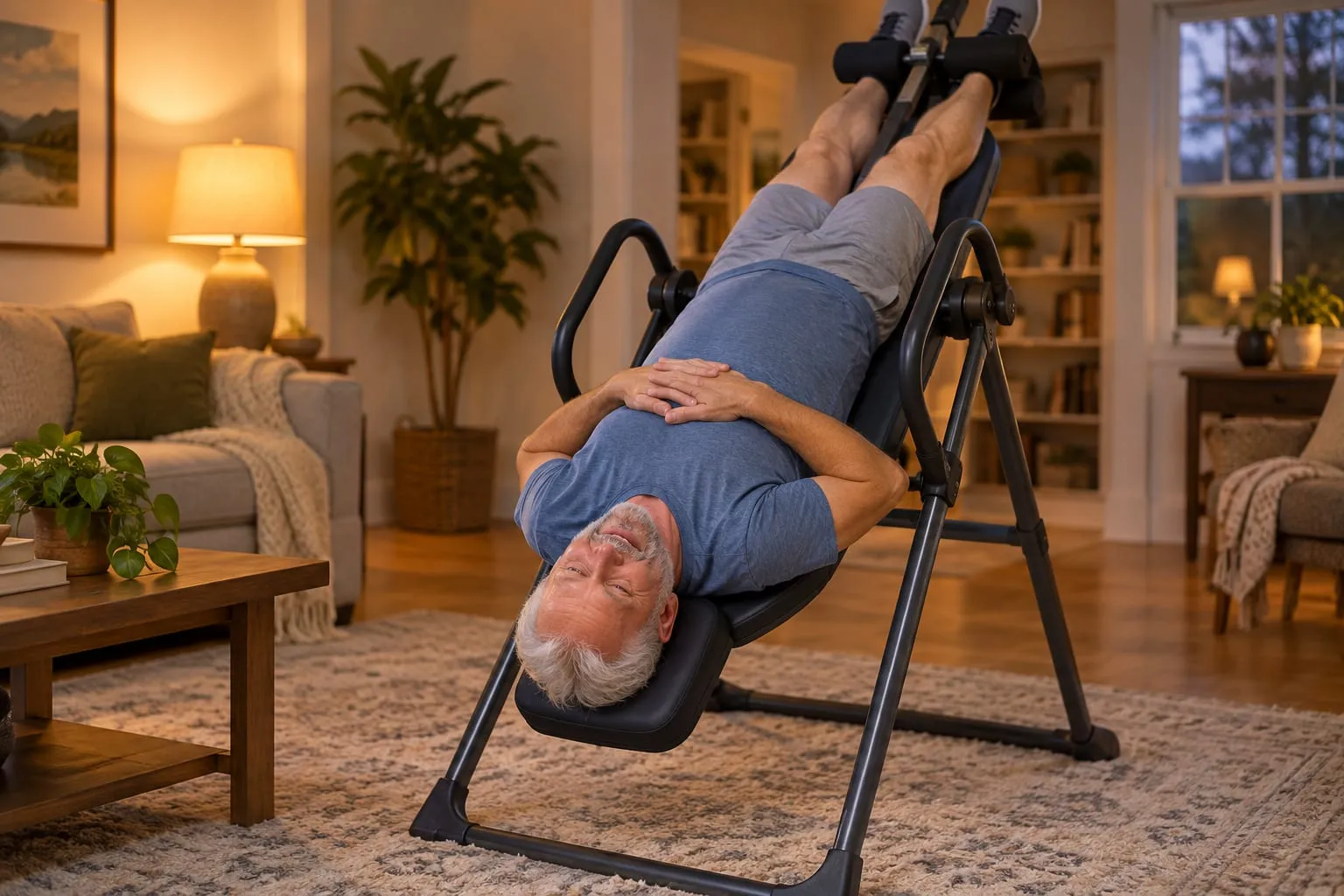
People who search for an inversion table for a pinched nerve usually have one of two problems: pain running down a leg, or pain, tingling or weakness running from the neck into an arm. We are not doctors and we did not test tables on people: this page is about the second problem, plus the compressed nerves that are not sciatica, and what we offer is an exact reading of the record.
What a Pinched Nerve Is, and Why Location Changes the Answer
“Pinched nerve” is an everyday phrase, not a diagnosis. Where the nerve is pinched decides which evidence applies to you.
The Clinical Name: Radiculopathy
When a nerve root is compressed where it leaves the spine, clinicians call the result radiculopathy. NASS defines the neck version, cervical radiculopathy, as “pain in a radicular pattern in one or both upper extremities related to compression and/or irritation of one or more cervical nerve roots,” and notes that it often comes with “varying degrees of sensory, motor and reflex changes” (NASS, 2010). In plain terms: pain that travels from the neck down the arm, often with tingling, numbness or weakness in the arm or hand.
If It Runs Down Your Leg, That Is Sciatica
Sciatica is a pinched nerve too, just in one specific place: the nerve roots of the lower back that form the sciatic nerve, with pain down the buttock and leg. It has its own guidelines and the only inversion-specific studies that found a benefit, so we cover it separately. If that is your problem, our page on inversion tables for sciatica is the one to read. Everything below is about nerves pinched elsewhere, mainly in the neck.
Neck Pain Without Nerve Symptoms Is a Different Question
A stiff, sore neck is not the same as a pinched nerve. If your pain stays in the neck and shoulders, with no tingling, numbness, electric-shock feeling or weakness in the arm, the question is general neck pain, and our page on inversion tables for neck pain deals with it. Come back here if the symptoms start travelling into the arm or hand.
What the Evidence Says About Traction for a Pinched Nerve in the Neck
An inversion table is a traction device. So the relevant evidence is the evidence on neck traction, and the first thing to know is that none of the studies below used an inversion table.
The NASS Guideline: A Consensus Opinion, Not a Recommendation
The North American Spine Society publishes an evidence-based guideline on cervical radiculopathy from degenerative disorders. On traction, its only statement reads: cervical halter traction and combinations of medications, physical therapy, injections and traction “have been associated with improvements in patient reported pain in uncontrolled case series. Such modalities may be considered recognizing that no improvement relative to the natural history of cervical radiculopathy has been demonstrated” (NASS, 2010).
That statement carries no grade. It is labelled a Work Group Consensus Statement, which the guideline itself explains is used when “in the absence of reliable evidence, it is the work group’s opinion that” a treatment may be appropriate (NASS, 2010). For comparison, the society’s guideline on lumbar disc herniation at least gives traction a formal grade, even if that grade is I, for insufficient evidence (NASS, 2012). For the neck, there was not enough evidence to grade at all.
What “Halter Traction” Means, and Why It Is Not an Inversion Table
Look at the device in that sentence: cervical halter traction. A halter is a harness around the head and jaw that pulls on the neck alone, usually with a weight or a machine. The NASS guideline never mentions inversion tables (NASS, 2010). So even the weak support it gives applies to a neck-only device, not to a table that tips your whole body upside down.
The One Study Behind It
The traction part of that statement rests on one retrospective case series by Olivero and colleagues: 81 patients with mild cervical radiculopathy, of whom 75% reported some pain relief with halter traction and a collar over about six weeks. NASS criticized it for using no validated outcome measures and a very short follow-up, and rated it as the lowest level of evidence (NASS, 2010).
There was no comparison group, and that matters more here than usual. The same guideline’s work group states, again as consensus, that “it is likely that for most patients with cervical radiculopathy from degenerative disorders signs and symptoms will be self-limited and will resolve spontaneously over a variable length of time without specific treatment” (NASS, 2010).
The Dose in That Study Looks Nothing Like Inversion
The details of the Olivero series, recorded in the guideline’s evidence table, show how modest the treatment was. Patients used 8 to 12 lb of halter traction, three times a day for 15 minutes, for six weeks, with more traction only if they were improving, alongside a cervical collar. “Patients with severe symptoms excluded from study,” the table notes (NASS, 2010).
The same table records “63 (78%) of patients responded to traction,” a slightly different figure from the 75% in the guideline’s recommendation text, and the guideline does not explain the gap. Either way, it is a single case series with no control group, in people whose radiculopathy was mild.
Set that beside an inversion table. The study’s pull was a measured 8 to 12 lb on the neck, chosen and repeated on a schedule.
An inversion table has no setting in pounds. It puts your whole body weight on your ankles, and the pull on each part of your spine depends on how much of you hangs below it, not on a dose anyone picked. If your symptoms are severe, you also fall outside the only group this study looked at.
A 2020 Meta-Analysis: Statistically Significant, Clinically Small
The most thorough look at neck traction for a pinched nerve is a systematic review with meta-analysis by Colombo and colleagues, published in the Journal of Clinical Medicine in 2020. It pooled seven randomized trials with 589 patients with cervical radicular syndrome, comparing traction added to other treatments with those other treatments alone (Colombo, 2020).
Adding traction did lower pain, and the difference was statistically significant: 5.93 points on a 0 to 100 scale, with a confidence interval running from 11.81 points down to just 0.04 (Colombo, 2020). But the authors had set 20 points in advance as the smallest change that would matter to a patient, and the result came nowhere near it. The quality of the evidence was low, and the authors concluded that “none of these effects were clinically meaningful” and that traction “does not appear to be essential in clinical practice” (Colombo, 2020).
None of Those Trials Used an Inversion Table
The traction in those trials was mechanical in six of the eight comparisons and manual, applied by a therapist, in the other two (Colombo, 2020). No inversion table appears anywhere in the review.
That cuts both ways. It does not prove an inversion table fails for a pinched nerve in the neck. It does mean that the best available analysis of neck traction contains no trial of an inversion table, so a claim that inversion is proven for neck nerves has nothing in this body of evidence to stand on.
We also looked for a UK guideline to set beside NASS. For the lower back, NICE’s advice is blunt: “Do not offer traction for managing low back pain with or without sciatica” (NICE, 2016). We found no equivalent NICE guideline for neck pain or cervical radiculopathy with a recommendation on traction.
How Inversion Is Supposed to Work, and Why the Neck Is Different
The theory behind inversion is simple. Whether it reaches the neck is a separate question.
Gravity Traction Is Described for the Lower Back
A 2023 paper in Disability and Rehabilitation describes inversion table therapy as “a form of spinal traction which is thought to have a role in relieving low back pain due to the gravity-facilitated traction of the spine which distracts the lumbar vertebrae” (Kassay, 2023). Two things stand out. The words “is thought to” mark a proposed mechanism, not a proven one. And the vertebrae named are the lumbar ones, in the lower back.
What Reaches Your Neck
When you hang from your ankles, the pull on any part of your spine comes from the body weight hanging below it. For the lower back, that is your whole upper body. For the neck, it is your head.
So an inversion table mostly tractions the lumbar spine, which is where the proposed mechanism is described, and we found no study that measured how much separation, if any, it produces between the vertebrae of the neck. A halter or a dedicated cervical traction unit pulls on the neck directly. An inversion table does not.
Traction’s Record in the Lower Back Is Weak Too
Even in the lower back, where the mechanism is described, traction has not done well. A Cochrane review of 32 trials with 2,762 people found that traction, “either alone or in combination with other treatments, has little or no impact on pain intensity, functional status, global improvement and return to work” in low back pain with or without sciatica (Wegner, 2013). That review is about the lower back, so it proves nothing about the neck. It does tell you that the general idea of traction has struggled whenever it has been tested properly.
What the Manufacturers Say, and What They Sell for the Neck
Inversion table makers write about pinched nerves. What they write is marketing, and it should be read that way.
Teeter’s Blog on Pinched Nerves
Teeter’s blog suggests “inverting 2 to 3 times per day, ideally to an angle of 60 degrees or greater,” and says routine stretching while inverted “can help target the muscles that oftentimes contribute to pinched nerves in the neck, back, hips and legs” (Teeter, 2012). The post cites no study for that schedule or that angle, and it does not separate a pinched nerve in the neck from one in the back. Treat it as the manufacturer’s usage advice, not as evidence.
Neck Restore Is Not an Inversion Table
If you search for Teeter and neck nerves, you will also find Teeter’s Neck Restore. It is a separate accessory, not a table: a self-massage tool with a rubber insert you can freeze, “for cooling relief that can help reduce inflammation, nerve activity, and joint pain,” usable on its own or strapped to a Teeter table (Teeter). It works by cold and pressure at the base of the skull, not by pulling on the spine. Whatever you think of it, its existence is not evidence that inversion helps a pinched nerve.
A Neck Pad Is Comfort, Not Neck Traction
Innova’s ITM6000 has a dual heat and massage pad, “one for the neck area and one for the back area” (Innova). That is the only dedicated neck feature we found on a table from either brand, and it is heat and vibration during ordinary whole-body inversion. It is not a separate mechanism for pulling on the neck, and Innova does not claim it is.
Falls: The Risk That Matters Most for Your Neck
The most serious documented injuries from inversion tables are to the neck itself, and they come from falling, not from traction.
How a Table Fall Injures the Neck
Doctors in South Korea reported three cases of cervical spinal cord injury after inversion table falls. They compare the mechanism to a shallow-water diving injury: “once the ankle power is lost or it slips, the user will land on top of their head,” and falls from one or two feet “are by no means negligible” (Jung, 2021). The authors describe severe neurological consequences such as tetraplegia among the possible outcomes.
Three cases cannot tell you how often this happens. They do tell you exactly where the damage lands: on the cervical spine, the part of you that already has a problem if your nerve is pinched in the neck.
What the Authors Recommend
The same authors recommend keeping sessions under one minute, placing an angled pillow or rubber ramp just below the head so a slip becomes a slide rather than a drop, and extra caution for older and heavier users with weaker ankle strength (Jung, 2021). That is their recommendation, not a clinical consensus. But it is the only session limit in the literature tied directly to preventing neck injury, and for someone with a pinched nerve in the neck it is the one we would follow.
Weakness Changes the Picture
Cervical radiculopathy can bring motor changes, meaning weakness in the arm or hand (NASS, 2010). Innova’s instructions, for example, have you invert by slowly raising one arm and then the other over your head, and return to horizontal before coming back up (Innova). If one arm is weak or numb, controlling that sequence is harder, and a spotter, which Innova’s own FAQ advises, stops being optional.
Before You Try One: Contraindications and When to Stop
A pinched nerve in the neck puts you inside the manufacturers’ own caution lists before anything else is considered.
Nerve Symptoms Are on Teeter’s Own List
Teeter’s contraindication list, which it says also appears in the owner’s manual, tells users not to invert until a licensed physician approves if they have “any condition, neurological or otherwise, which results in unexplained tingling, weakness or neuropathy,” or “any bone, skeletal or spinal cord condition or injury” (Teeter). Tingling and weakness in an arm are exactly the symptoms that bring people to this page. By the manufacturer’s own standard, that means a doctor’s approval first.
Innova Lists Spinal Injury
Innova’s ITX9600 manual tells users not to use the table without a licensed physician’s approval and lists conditions including spinal injury, weak ankles and/or feet, osteoporosis and high blood pressure, while noting the list “is for reference only and it is not a complete listing” (Innova). Both lists include other conditions, such as glaucoma and heart problems, that have nothing to do with your nerve but still apply. Our page on who should not use an inversion table goes through each item with the evidence behind it.
When to Stop and See a Doctor
When Cochrane reviewers pooled the traction trials for the lower back, seven of the 32 reported adverse effects, including “increased pain, aggravation of neurological signs and subsequent surgery” (Wegner, 2013). That was the lumbar spine, not the neck, but the warning sign translates directly.
Our page on inversion table side effects covers the other effects people report.
If Your Doctor Agrees to a Trial: What to Look For
This page recommends no table for a pinched nerve, because no table has been shown to treat one. If your doctor has examined you and thinks a cautious trial is reasonable, what matters is control: a shallow start, a repeatable angle, short sessions and a safe way on and off.
An Angle You Set Before You Get On
Teeter’s FitSpine X3 has a tether marked at 20, 40 and 60 degrees, so you set your limit while standing upright and return to the same angle each time. Innova’s ITX9600 uses a pin instead, and its manual labels the settings 15, 30, 45, 60 and 85 degrees (Innova), so you need the manual to know which hole is which. Innova’s FAQ advises starting at a low inversion position (Innova).
| Spec |  Teeter FitSpine X3Premium, price tier 3 of 3Verified Teeter FitSpine X3Premium, price tier 3 of 3Verified |  Innova ITX9600Budget, price tier 1 of 3Verified Innova ITX9600Budget, price tier 1 of 3Verified |
|---|---|---|
| Angle control | EZ-Angle tether marked at 20°, 40° and 60°; full inversion with secure lockout | Pin with protective cover; the manual labels the settings 15°, 30°, 45°, 60° and 85° (the product page calls it a six-position pin) |
| Ankle system | Deluxe EZ-Reach ankle lock, extra-long handle, micro-adjusting closure | Reversible ankle holders (foam rollers and U-shaped holders can trade places) |
| Weight capacity | 300 lb | 300 lb |
| Warranty | 5 years (extension to 10 sold separately)Highest here | 1 year limited |
| User height | 4'8" to 6'6" | 4'10" to 6'6" |
| FDA | 510(k) cleared (K162702), Class I device | Not stated |
| Assembly and setup | 85% pre-assembled, BILT app instructions (brand-wide claim) | Not stated |
| Buy | See today's price: Teeter FitSpine X3 on Amazon (opens in a new tab) | See today's price: Innova ITX9600 on Amazon (opens in a new tab) |
Teeter FitSpine X3- Angle control
- EZ-Angle tether marked at 20°, 40° and 60°; full inversion with secure lockout
- Ankle system
- Deluxe EZ-Reach ankle lock, extra-long handle, micro-adjusting closure
- Weight capacity
- 300 lb
- Warranty
- 5 years (extension to 10 sold separately)Highest here
- User height
- 4'8" to 6'6"
- FDA
- 510(k) cleared (K162702), Class I device
- Assembly and setup
- 85% pre-assembled, BILT app instructions (brand-wide claim)
Innova ITX9600- Angle control
- Pin with protective cover; the manual labels the settings 15°, 30°, 45°, 60° and 85° (the product page calls it a six-position pin)
- Ankle system
- Reversible ankle holders (foam rollers and U-shaped holders can trade places)
- Weight capacity
- 300 lb
- Warranty
- 1 year limited
- User height
- 4'10" to 6'6"
- FDA
- Not stated
- Assembly and setup
- Not stated
Verified from the maker's own page or manualClaimed retail listing onlyNot stated the maker publishes nothing
Ankle Locks and a Spotter Matter More Than Features
In the fall reports, the injury begins when ankle strength gives out or the feet slip (Jung, 2021). A secure ankle system and someone in the room during your first sessions do more for a pinched nerve in the neck than heat pads or massage. Our best inversion tables page compares the full range we verified, including ankle systems and weight limits.
Keep the Expectations Honest
If you try a table and your arm symptoms ease, that is useful information for you and your doctor, but it is not proof the table did it: cervical radiculopathy can improve with time, which is exactly what the NASS statement warns about (NASS, 2010). If nothing changes after a fair trial, the evidence above gives you no reason to push harder or hang steeper.
Your questions, answered
Frequently Asked Questions
Can an inversion table help with pinched nerves?
It depends on where the nerve is pinched, and the evidence is thin everywhere. For sciatica, a pinched nerve low in the back, one small English team found fewer operations among inversion users. For a pinched nerve in the neck, no trial has tested an inversion table at all, and the leading spine guideline offers only a consensus opinion on neck traction collars.
Are inversion tables good for pinched nerves in the neck?
Not on current evidence. The neck traction trials that exist used dedicated neck devices or a therapist's hands, never an inversion table, and when seven of them were pooled, the pain benefit was too small to matter clinically. The table's pull is described for the lower back. And a fall from a table lands on the head, the worst place for an already irritated neck.
Can hanging upside down help a pinched nerve?
It might feel good for some people, but nothing shows it fixes the nerve. Hanging upside down is a form of traction, and a Cochrane analysis of 32 low back traction trials found little or no effect on pain. For the neck, traction added to other care fell short of a clinically important change. If you want to try it, get your doctor's approval first and start shallow.
How do you decompress a pinched nerve?
No home method has been proven to decompress a pinched nerve. Traction devices aim to take pressure off the nerve root, but for the neck the North American Spine Society says only that traction may be considered, with no gain over natural recovery shown. Which treatment fits depends on what is pressing on the nerve, and that takes an examination, not a device.
What should you not do with a pinched nerve in your neck?
Do not start inverting without a doctor's approval. Teeter's contraindication list names any condition causing unexplained tingling, weakness or neuropathy, and Innova's manual lists spinal injury. If you do get approval, keep sessions short: doctors who treated neck injuries from table falls advise under a minute. And never push through numbness or weakness that is new or spreading.
13 sources used for this guide
Each linked to the original. Citations in the text jump here.
View sources
North American Spine Society (NASS), Cervical Radiculopathy from Degenerative Disorders Work Group. An Evidence-Based Clinical Guideline for the Diagnosis and Treatment of Cervical Radiculopathy from Degenerative Disorders. NASS Evidence-Based Clinical Guidelines, 2010.
North American Spine Society (NASS), Lumbar Disc Herniation with Radiculopathy Work Group. Lumbar Disc Herniation with Radiculopathy: An Evidence-Based Clinical Guideline. NASS Evidence-Based Clinical Guidelines, 2012.
Colombo C, Salvioli S, Gianola S, Castellini G, Testa M. Traction Therapy for Cervical Radicular Syndrome is Statistically Significant but not Clinically Relevant for Pain Relief. A Systematic Literature Review with Meta-Analysis and Trial Sequential Analysis. Journal of Clinical Medicine 2020;9(11):E3389.
National Institute for Health and Care Excellence (NICE). Low back pain and sciatica in over 16s: assessment and management, Recommendations. NICE guideline NG59, published 30 November 2016, last updated 29 July 2026.
Kassay A, Soliman MAR, Jhawar BS. Recommendations for inversion table therapy. Disability and Rehabilitation 2023;45(22):3779-3782.
Wegner I, Widyahening IS, van Tulder MW et al. Traction for low-back pain with or without sciatica. Cochrane Database of Systematic Reviews 2013, CD003010.
Teeter. How To Use Inversion To Relieve a Pinched Nerve. teeter.com/blog, published 2012-01-12, updated 2022-04-04.
Teeter. Neck Restore. teeter.com, product page.
Innova. ITM6000 Advanced Heat and Massage Therapeutic Inversion Table. innovaproductsinc.com, product page.
Jung SH, Hwang JM, Kim CH. Inversion Table Fall Injury, the Phantom Menace: Three Case Reports on Cervical Spinal Cord Injury. Healthcare (Basel) 2021;9(5):492.
Innova. Frequently Asked Questions. innovaproductsinc.com/faq/.
Teeter. Are there health issues that would prevent me from inverting?. teeter.com, Support Center (the same list appears in the owner's manual).
Innova. ITX9600 Heavy Duty Deluxe Inversion Therapy Table, Owner's Manual (version 1709AJJ). Innova Products Inc., owner's manual.