Health guide
The Inversion Chair in 2026: What It Is, What's Left, and What to Buy Instead
We earn from qualifying purchases made through our links. How we make money
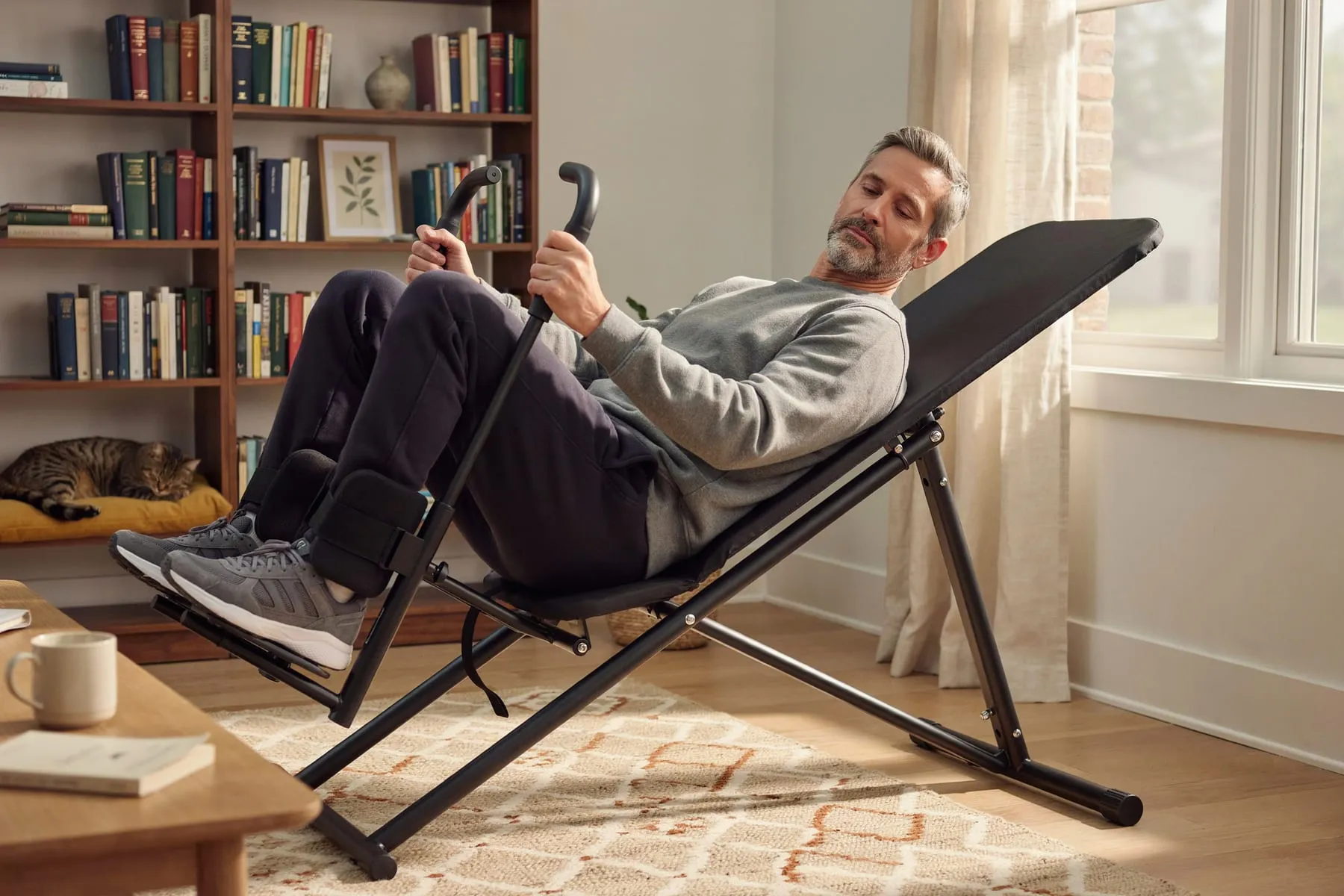
If you searched for an inversion chair, you probably want the benefit people associate with inversion without hanging by your ankles. We did not test chairs or tables on people: we read what each maker publishes, checked which companies are still trading, and matched the health claims to named studies.
What Is an Inversion Chair?
An inversion chair is a seated device that reclines backward so your head ends up lower than your hips. It is a cousin of the inversion table, built around a different way of holding you in place. It is also the opposite of gravity boots, which hang you by your ankles from a bar; our guide to hanging upside down in gravity boots covers that option.
How You Sit in One
You sit down, fasten a belt, hook your lower legs under padded rollers, and lean back with the chair. Health Mark’s Core Inversion Chair, the one chair we could document from a named maker, is typical of the design: an adjustable safety lap belt, a padded rolled front ankle and knee support, and a 300 lb weight capacity (Health Mark, 2024 archive). Your weight rests on the seat and the belt. Your ankles are not what holds you up.
How Far It Tips You
Less than a table. Chairs are designed for partial inversion, with your knees bent above your hips, not a vertical hang. Even here the numbers are shaky: Health Mark’s own page gives two different maximums, 60 degrees in its spec bullets and “up to 80 degrees” in its description.
We can’t tell you which is right, so we treat the maximum angle as not stated. Either figure is well short of the full inversion a table like the Teeter FitSpine X3 allows.
What It Is Supposed to Do
The idea behind any inversion device is gravity traction. An article on inversion therapy published in Disability and Rehabilitation in 2023 describes it as a form of spinal traction that “is thought to” relieve low back pain because gravity gently separates the lumbar vertebrae (Kassay, 2023). Note the wording: that is the proposed mechanism, not a proven result. Health Mark pitches its chair the same way, as traction at the lower back “without the necessity of hanging completely upside down.”
Inversion Chair vs. Inversion Table: The Real Differences
The two devices aim at the same thing and get there differently. These are the differences that matter when you choose.
| Feature | Inversion chair (Health Mark Core) | Inversion table (Teeter, Innova) |
|---|---|---|
| Maximum angle | Not stated (the maker gives 60° and 80°) | Up to full inversion, with a lockout on Teeter’s FitSpine range |
| What holds you | Seat, lap belt, padded leg rollers | Ankle system that carries your weight when inverted |
| Getting on | Sit down, then lean back | Stand on the platform, lock your ankles, tilt back |
| Published user height | Not stated | 4’8” to 6’6” (Teeter), 4’10” to 6’6” (Innova) |
Where Your Weight Is Held
This is the biggest difference. On a table, once you pass horizontal, your ankles carry you. That is why our table reviews start with the ankle system.
On a chair, you stay seated and belted, and the leg rollers hold your position. If your ankles or knees are the weak point, that difference is the whole appeal of a chair, and it is exactly what Health Mark markets its chair for.
How Far You Go
A chair gives you partial inversion and nothing more. A table gives you the whole range, which sounds like more risk but can be limited. Some tables let you set the stopping angle before you tip back, which turns a table into a partial inversion device too. We come back to that below, because it is the reason we recommend a table to most chair shoppers.
Getting On and Off
Sitting down is easier than stepping onto a platform and locking your ankles, and that is a real advantage for stiff or unsteady users. Tables have their own routine. Innova’s instructions tell you to raise one arm slowly over your head, then the other, to start at a low inversion setting, and to have a spotter with you (Innova). Neither routine is hard once learned, but the table asks more of your balance at the start.
What the Spec Sheets Tell You
Tables from Teeter and Innova come with full published specs: capacity, user height, angle settings, warranty. The one chair we could document from a maker publishes capacity and a contradictory angle, and no user height range. If you are very tall or very short, that gap matters, because a chair that doesn’t fit you won’t hold you where it should.
What’s Still Sold: The Inversion Chair Market in 2026
This is the part most inversion chair pages skip. We checked the makers one by one, and the category has very little left in it.
Stamina Dropped the Classic Reclining Chair
Stamina’s InLine Inversion Chair (model 55-1550) was a classic reclining seated chair. It is no longer part of Stamina’s current range. Stamina’s Back Health page still talks about “partial inversion chairs” in its general copy (Stamina), but the product it sells in that line today is different.
What Stamina Sells Instead Is Not a Chair
That product is the inLine Forward Inversion, which tilts you forward only. It does not recline you backward into inversion. Stamina rates it for 250 lb and users up to 6’4”, depending on torso length, with foam thigh pads instead of ankle holders and a warranty of one year on the frame and 90 days on parts (Stamina). It may suit someone who wants a forward decompression stretch, but it is not what people mean by an inversion chair, and we don’t list it as one.
Health Gear’s Maker Has Closed
Health Gear, a brand that still turns up in inversion searches, belonged to Extreme Products Group. The company’s own site announced that it “has ceased operations and is no longer in business” (Extreme Products Group, 2025), and it filed a Chapter 7 (liquidation) bankruptcy petition in Arizona in September 2025 (BankruptcyObserver, 2025).
Our page on the Health Gear brand and its old tables covers the models and what to buy in their place.
Health Mark’s Core Inversion Chair
This is the one chair we could tie to a named manufacturer with a published product page. The specs are above: 300 lb, a lap belt and padded leg rollers, and a maximum angle the maker states two different ways.
Two cautions. It publishes no user height range. And in the most recent copy of the product page we could read, from June 2024, the chair was marked out of stock on Health Mark’s own store. We could not confirm that it is available today, so we are not linking to it.
Teeter and Innova Make Tables, Not Chairs
Neither Teeter nor Innova sells a seated inversion chair. Innova’s range is tables. Teeter’s closest product, the DEX, is a decompression and back extension bench, not a chair that reclines you into inversion, so don’t mistake one for the other if you see it in results.
The Unbranded Listings
Search a marketplace for an inversion chair and most results are ordinary inversion tables, yoga headstand benches or ab chairs. A few compact folding “inversion chairs” come from private-label sellers with no manufacturer site and no spec sheet beyond the listing. We don’t recommend buying a device that holds you head-down from a seller you can’t reach, so none of them appear here.
Is an Inversion Chair Safer Than a Table?
We don’t know, and neither does anyone else on the evidence available. Here is what can be said.
The Documented Fall Risk Belongs to Tables
The most serious injuries on record come from falling off an inversion table. Authors reporting three cervical spinal cord injuries compared the mechanism to a shallow-water diving injury: once ankle strength is lost or a foot slips, the user lands on the top of the head (Jung, 2021). In 2010, the U.S. Consumer Product Safety Commission recalled about 33,000 inversion benches after 75 reports of the ankle clamp releasing or the rotation strap breaking (CPSC, 2010). Both describe a failure at the ankles while the user hangs inverted.
Why That Doesn’t Make a Chair Safe
A chair doesn’t hang you by your ankles, so that specific failure doesn’t carry over directly. That is a mechanical difference, not a safety finding. We found no injury study, case series or recall about inversion chairs, which means nobody has measured how often chairs fail or how. The one chair study we found, covered below, looked at the body, not at equipment failures.
Our page on inversion table side effects covers the documented risks in detail.
What Doesn’t Change When You Sit
Your body doesn’t know whether a chair or a table tipped it back. In a small trial, two minutes of inversion raised both systolic and diastolic blood pressure in healthy young women (Haskvitz, 1986). Eye pressure roughly doubled after five minutes fully inverted, in both healthy and glaucomatous eyes (Weinreb, 1984).
Those studies used full inversion, and a chair tilts you less, so the effect may be smaller. The one study of a chair we found, below, points that way for blood pressure, with heavy caveats, and it does not report eye pressure at all.
The One Study of a Seated Inversion Chair
In 1985, Vernon and colleagues at the Canadian Memorial Chiropractic College tested the Inverchair, a seated device that tipped users back to 60 degrees with the hips bent at 90 degrees. In 40 healthy young volunteers, three minutes in the chair produced no significant change in heart rate or blood pressure (Vernon et al., 1985). That does not mean the chair lowers blood pressure. It means this study did not detect a significant rise.
The authors set their result against the sharp rise Klatz and colleagues had measured two years earlier in people hanging fully vertical in gravity boots (Klatz et al., 1983), and they put the difference down to posture: seated, at only 60 degrees, with the back supported. Even so, they still advised screening for cerebral and cardiovascular disease before anyone used the chair.
Weigh the result with its limits. The study was funded by the Inverchair’s maker. It had no control group, the volunteers were healthy and had no symptoms, and it measured only what happened during three minutes.
It supports the idea that a seated, partial position is gentler on the circulation than a full hang. It is not proof that a chair is safe for someone with high blood pressure.
Who Should Not Invert at All
The published contraindication lists come from table makers, but they are about being head-down, not about the equipment. Teeter’s list says not to invert until a licensed physician approves if you have high blood pressure, heart or circulatory conditions, glaucoma, osteoporosis or hernias, among others (Teeter). Innova’s manual lists 21 conditions, including weak ankles and/or feet and spinal injury (Innova).
We found no chair maker’s own list, so treat these as the minimum. Our page on who should not use an inversion table goes through each condition.
Does an Inversion Chair Actually Help?
Before choosing any device, it helps to know what it can realistically do.
What the Evidence on Traction Says
No trial has tested inversion chairs on people with back pain. The best evidence covers traction broadly: a Cochrane review published in 2013 pooled 32 trials with 2,762 people and found that traction, alone or with other treatment, had little or no impact on pain, function or return to work in low back pain, with or without sciatica (Wegner, 2013). That is traction in general, manual and mechanical, not inversion specifically. Our summary of inversion table benefits sets out what the smaller, more encouraging studies found.
What the Inverchair X-Rays Showed
The 1985 Inverchair study also looked at the spine. In a separate group of 16 healthy men, X-rays taken after three minutes at 60 degrees showed the two lowest lumbar disc spaces, L4-5 and L5-S1, widening by about 1 to 2.2 mm on average. In the group of 40, forward bending of the trunk increased by about 25% (Vernon et al., 1985).
So a seated chair at a partial angle did produce measurable traction at the lower back, which is what chairs are sold on. The limits matter just as much: the study was funded by the chair’s maker, it had no control group, everyone in it was healthy and pain-free, and it measured only immediate effects.
It shows that the discs separated a little during the session. It does not show that this relieves back pain or lasts after you sit up.
Why People Still Use Them
Some users simply find a gentle backward stretch relieving, and a device doesn’t need to beat a trial to feel good. That is a fair reason to buy one, as long as you buy it for comfort and not as a treatment. If you are dealing with nerve pain down one leg, our guide to inversion tables for sciatica is more specific.
What to Buy Instead: A Table With a Set Angle Limit
If the appeal of an inversion chair is going partway and staying in control, a table can do that, and it comes from makers that publish full specs, back them with warranties and are still in business.
How a Table Gives You Partial Inversion
A table with an angle tether or pin stops at the angle you choose, so you never go further than a chair would unless you decide to. You get the controlled, partial stretch the chair promised, plus the option to go further later.
| Spec |  Teeter FitSpine X3Premium, price tier 3 of 3Verified Teeter FitSpine X3Premium, price tier 3 of 3Verified |  Innova ITX9600Budget, price tier 1 of 3Verified Innova ITX9600Budget, price tier 1 of 3Verified |
|---|---|---|
| Angle control | EZ-Angle tether marked at 20°, 40° and 60°; full inversion with secure lockout | Pin with protective cover; the manual labels the settings 15°, 30°, 45°, 60° and 85° (the product page calls it a six-position pin) |
| Ankle system | Deluxe EZ-Reach ankle lock, extra-long handle, micro-adjusting closure | Reversible ankle holders (foam rollers and U-shaped holders can trade places) |
| Weight capacity | 300 lb | 300 lb |
| User height | 4'8" to 6'6" | 4'10" to 6'6" |
| Warranty | 5 years (extension to 10 sold separately)Highest here | 1 year limited |
| FDA | 510(k) cleared (K162702), Class I device | Not stated |
| Assembly and setup | 85% pre-assembled, BILT app instructions (brand-wide claim) | Not stated |
| Buy | See today's price: Teeter FitSpine X3 on Amazon (opens in a new tab) | See today's price: Innova ITX9600 on Amazon (opens in a new tab) |
Teeter FitSpine X3- Angle control
- EZ-Angle tether marked at 20°, 40° and 60°; full inversion with secure lockout
- Ankle system
- Deluxe EZ-Reach ankle lock, extra-long handle, micro-adjusting closure
- Weight capacity
- 300 lb
- User height
- 4'8" to 6'6"
- Warranty
- 5 years (extension to 10 sold separately)Highest here
- FDA
- 510(k) cleared (K162702), Class I device
- Assembly and setup
- 85% pre-assembled, BILT app instructions (brand-wide claim)
Innova ITX9600- Angle control
- Pin with protective cover; the manual labels the settings 15°, 30°, 45°, 60° and 85° (the product page calls it a six-position pin)
- Ankle system
- Reversible ankle holders (foam rollers and U-shaped holders can trade places)
- Weight capacity
- 300 lb
- User height
- 4'10" to 6'6"
- Warranty
- 1 year limited
- FDA
- Not stated
- Assembly and setup
- Not stated
Verified from the maker's own page or manualClaimed retail listing onlyNot stated the maker publishes nothing
Teeter FitSpine X3: Marked Angles
The X3’s tether is marked at 20, 40 and 60 degrees, so you can see the limit while you are still standing, and return to exactly the same angle every time. It carries a five-year warranty, and its ankle lock has an extra-long handle. For a chair shopper who wants control above all, this is our pick.
Marked angle presetsVerified
by TEETER
Best for chair shoppers who want control above all, with marked angles.
Skip it if cost comes first: the Innova ITX9600 is the lower-cost way to try partial inversion.
If you are inverting for back pain, the marked 20°, 40° and 60° presets are the reason to pay more: you set the limit before you get on, instead of finding it upside down. The 5-year warranty against Innova's 1 year is the other half of the case.
- Weight limit
- 300 lb
- User height
- 4'8" to 6'6"
- Warranty
- 5 years
- Price range
- Premium
What we like
- Tether marked at 20°, 40° and 60°, set before you get on
- Five-year full warranty, against Innova's one year
- Teeter's tables are FDA 510(k) cleared under K162702
- EZ-Reach ankle lock with an extra-long handle
Keep in mind
- No heat or massage
- No raised boarding platform, unlike the LX9
- Rated to 300 lb, max height 6 ft 6 in
Full specs
- Price range
- Premium
- Weight capacity
- 300 lb
- User height
- 4'8" to 6'6"
- Angle control
- EZ-Angle tether marked at 20°, 40° and 60°; full inversion with secure lockout
- Ankle system
- Deluxe EZ-Reach ankle lock, extra-long handle, micro-adjusting closure
- Heat and massage
- None
- Warranty
- 5 years (extension to 10 sold separately)
- FDA
- 510(k) cleared (K162702), Class I device
VerifiedFrom the maker's product page. Not stated means the maker publishes nothing.
We may earn a commission. It never changes which table we pick, or the order they appear in.
Innova ITX9600: The Budget Route
The ITX9600 sets the angle with a pin. The product page calls it six positions without giving degrees, but the owner’s manual labels the settings from 15 to 85 degrees, so you can find a shallow setting and stay there. Its ankle holders are reversible, it publishes a 300 lb capacity and a 4’10” to 6’6” height range, and the warranty is one year. It is the lower-cost way to try partial inversion from a maker that documents its product.
Reversible ankle holdersVerified
by Innova
Best for people who want a lower-cost way to try partial inversion.
Skip it if you want to see the angle while standing: the pin's degrees appear only in the owner's manual, and the warranty is one year against the X3's five.
It is the only entry table here with reversible ankle holders, so the foam roller can move to the front once inverting stops feeling new. One of its listing bullets says 350 lb; the maker's page says 300 lb, and 300 is what we publish.
- Weight limit
- 300 lb
- User height
- 4'10" to 6'6"
- Warranty
- 1 year
- Price range
- Budget
What we like
- Ankle holders reverse, so the foam roller can move to the front
- Manual labels the pin angles, from 15° up to 85°
- Pin with a protective cover, left at 15° after assembly
- Rated to 300 lb in both the manual and on the maker's page
Keep in mind
- One-year limited warranty, non-transferable
- No heat or massage
- Manual shows five pin angles, the product page says six
- Needs 2 ft clear at each side and 3 ft front and back
Full specs
- Price range
- Budget
- Weight capacity
- 300 lb
- User height
- 4'10" to 6'6"
- Angle control
- Pin with protective cover; the manual labels the settings 15°, 30°, 45°, 60° and 85° (the product page calls it a six-position pin)
- Ankle system
- Reversible ankle holders (foam rollers and U-shaped holders can trade places)
- Heat and massage
- None
- Warranty
- 1 year limited
- FDA
- Not stated
VerifiedFrom the maker's product page. Not stated means the maker publishes nothing.
We may earn a commission. It never changes which table we pick, or the order they appear in.
If a Table Isn’t Right for You
If your ankles can’t take your weight, or a doctor has told you not to invert, a table doesn’t fix that, and neither would a chair. In that case, the honest answer is no inversion device at all until you have talked it through with a clinician. If a table is right for you, our full guide to the best inversion tables compares every pick by use case.
Your questions, answered
Frequently Asked Questions
What does an inversion chair do for you?
It tips you backward while you stay seated, so gravity pulls along your spine without your ankles taking your weight. Health Mark describes its chair as giving gravity traction at the lower back without hanging completely upside down. That kind of traction is thought to separate the lumbar vertebrae slightly, which is the proposed reason it might ease back pain, not a proven result.
Do inversion chairs really work?
Nobody can promise that, because no trial has tested inversion chairs on people with back pain. The closest evidence is on traction in general: a Cochrane team pooled 32 trials and found little or no effect on low back pain, function or return to work. A chair delivers a form of gravity traction, so that result is the fairest yardstick until chair trials in patients exist.
How long should you sit in an inversion chair?
No chair maker we found publishes a session limit. The one chair study we found, funded by the chair's maker, held healthy volunteers for three minutes, and the only published figure linked to injury risk is under one minute per session, from the authors of a report on inversion table falls. Keep early sessions short and shallow, and a doctor's limit comes first.
Does an inversion chair help with sciatica?
There is no good evidence that it does. No trial has looked at inversion chairs for sciatica, and the Cochrane review of traction, which covered low back pain with or without sciatica, found little or no benefit. Nerve pain down the leg has several possible causes, so get it diagnosed before you try any kind of inversion at home.
What is the upside down chair called?
It is usually sold as an inversion chair, sometimes as a seated inversion chair. It tilts you backward from a seated position, held by a lap belt and padded leg supports, instead of hanging you by the ankles like an inversion table. Searches for an upside down chair also turn up furniture and yoga headstand benches, which are different products.
16 sources used for this guide
Each linked to the original. Citations in the text jump here.
View sources
Health Mark, Inc. Core Inversion Chair (SKU IVO18600). healthmarkinc.us, product page.
Kassay A, Soliman MAR, Jhawar BS. Recommendations for inversion table therapy. Disability and Rehabilitation 2023;45(22):3779-3782.
Innova. Frequently Asked Questions. innovaproductsinc.com/faq/.
Stamina Products, Inc. Back Pain Machines - Decompression Chairs & Stretch Benches. staminaproducts.com, category page.
Stamina Products, Inc. Stamina inLine Forward Inversion (SKU 55-1426). staminaproducts.com, product page.
Extreme Products Group, LLC. Extreme Products Group, LLC has ceased operations. extremeproductsgroup.com, as archived by the Wayback Machine on January 20, 2025.
BankruptcyObserver. EXTREME PRODUCTS GROUP, LLC Chapter 7 Bankruptcy 2025. bankruptcyobserver.com, sourced from PACER.
Jung SH, Hwang JM, Kim CH. Inversion Table Fall Injury, the Phantom Menace: Three Case Reports on Cervical Spinal Cord Injury. Healthcare (Basel) 2021;9(5):492.
CPSC. ICON Health & Fitness Recalls Inversion Benches Due to Fall Hazard. U.S. Consumer Product Safety Commission, cpsc.gov, recall 10-210, April 28, 2010.
Haskvitz EM, Hanten WP. Blood pressure response to inversion traction. Physical Therapy 1986;66(9):1361-1364.
Weinreb RN, Cook J, Friberg TR. Effect of inverted body position on intraocular pressure. American Journal of Ophthalmology 1984;98(6):784-787.
Vernon H, Meschino J, Naiman J. Inversion therapy: a study of physiological effects. Journal of the Canadian Chiropractic Association 1985;29(3):135-140.
Klatz RM, Goldman RM, Tarr RS, Pinchuk BG. Gravity inversion therapy. The Western Journal of Medicine 1983;139(4):538-540.
Teeter. Are there health issues that would prevent me from inverting?. teeter.com, Support Center (the same list appears in the owner's manual).
Innova. ITX9600 Heavy Duty Deluxe Inversion Therapy Table, Owner's Manual (version 1709AJJ). Innova Products Inc., owner's manual.
Wegner I, Widyahening IS, van Tulder MW et al. Traction for low-back pain with or without sciatica. Cochrane Database of Systematic Reviews 2013, CD003010.