Health guide
How to Use an Inversion Table, and for How Long
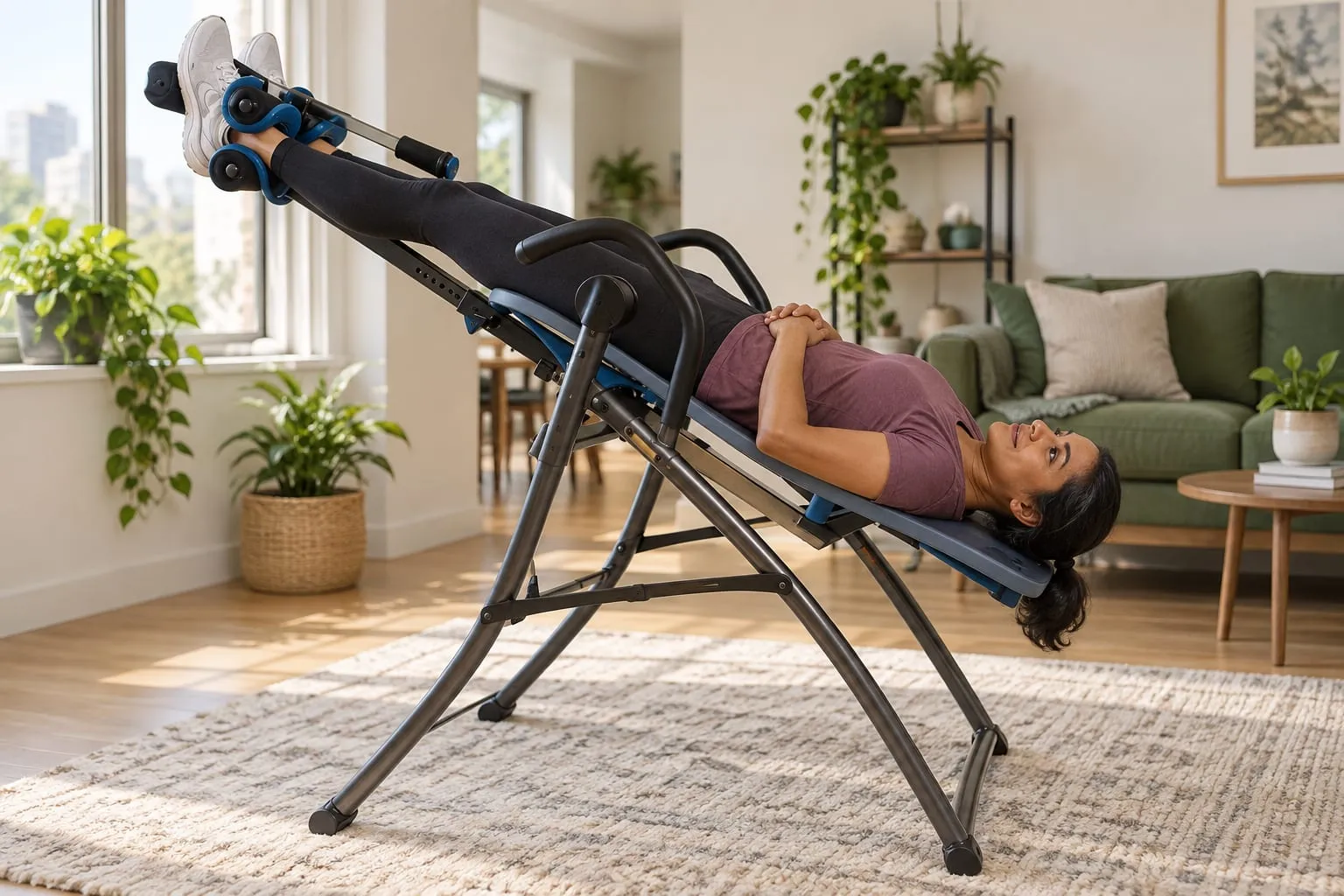
Knowing how to use an inversion table matters more than which one you buy: most of the risk sits in the first few sessions, in a table set for the wrong height, an ankle lock that isn’t closed, or an angle chosen while you are already upside down. We have not tested these tables on people. Everything below comes from the manufacturers’ own instructions, chiefly Teeter’s guide and the Innova ITX9600 owner’s manual, plus the few studies that have timed people upside down. Where the sources disagree, we show you both.
How an Inversion Table Works
Before the steps make sense, it helps to know what the table is doing. It has no motor. It is a bed on a pivot, and your body is the weight that tips it.
A Pivot and Your Center of Gravity
Teeter calls its approach “Precision Balancing” and explains the principle simply: the table works by distributing “weight evenly on each side of the pivot point” (Teeter, 2020). Innova’s manual says the same thing in its own words: “you will need to find your personal center of gravity,” using three adjustments, the height tube, the headrest pad and the footrest plate (Innova).
When your weight is balanced on the pivot, the table barely moves on its own. That is the goal, because it means you, not gravity, decide how far and how fast you tip.
Your Arms Steer the Angle
With the table balanced, small movements do the work. Innova’s instruction is to “slowly raise one arm and move it up and over your head,” at which point the table “should begin to tilt back slowly,” then to raise the other arm the same way (Innova). Bringing your arms back to your sides reverses it. Teeter describes the same control: with the right settings you manage “your speed and angle of inversion with just simple movements of your arms” (Teeter, 2020).
What Gravity Does to Your Spine
Once you are tipped back, your own body weight pulls along the spine. A 2023 paper in Disability and Rehabilitation describes inversion table therapy as “a form of spinal traction,” thought to help low back pain because gravity-assisted traction separates the lumbar vertebrae (Kassay, 2023). That is the proposed mechanism, not proof of relief. What the trials found is on our page about inversion table benefits.
Before Your First Session
Three checks come before the table is even set up. None takes long, and each addresses a way people actually get hurt.
Rule Out the Conditions That Make Inversion Unsafe
Teeter tells users not to invert until a licensed physician approves if they have any condition made worse by higher blood pressure, pressure inside the skull or the strain of the inverted position (Teeter). Its list includes high blood pressure, heart disease, glaucoma, retinal detachment, osteoporosis, hernias, pregnancy and the use of blood thinners, among others. Innova’s manual has a similar list. Our page on who should not use an inversion table goes through each one with the evidence behind it.
Wear Laced Shoes, and Have a Spotter
The ITX9600 manual says in capitals to “always wear athletic shoes with top laces” to help secure your ankles (Innova). It also recommends having someone with you during inversion to “spot” you. Teeter says the same: its owner’s manual explains how to find your settings while “testing with a spotter until you have it just right for you” (Teeter, 2020).
Clear the Space Around the Table
The table swings through an arc, so it needs room. The ITX9600 manual asks for at least 2 feet of clearance on the left and right sides and 3 feet at the front and back (Innova). Keep children and pets out of that space while you use it.
How to Set Up an Inversion Table for Your Height
This is the step that decides whether the table feels controllable or alarming. Take your time over it the first day and write your settings down.
Set the Height on the Main Shaft
Every table has a sliding shaft, marked in heights, that carries the ankle unit. Innova’s instruction is to pull the height adjustment knob, slide the tube to your height number and make sure the knob “locks securely into a hole” (Innova). Teeter adds a useful starting point: the markings “are just a guide to get started,” your real setting “may vary by several inches depending on your weight distribution,” and Teeter recommends starting 1 inch taller than your actual height, then testing your balance (Teeter, 2020).
Test Your Balance, Then Adjust One Hole at a Time
Here is where the two makers’ instructions differ in direction, because the mechanisms differ. On a Teeter, if rotation is “too aggressive” and returning upright is hard, you lengthen the main shaft; if it isn’t aggressive enough, you shorten it (Teeter, 2020). On the Innova ITX9600, if the table won’t invert you move the height tube up one position, and if it inverts too quickly you move it down one position (Innova).
Set the Angle Limit Before You Get On
The angle limit is chosen while you are standing, never while you are upside down. On Teeter tables a tether strap does this, and Teeter calls limiting the angle “important when you are just getting started” (Teeter, 2020). The FitSpine X3 and LX9 mark three presets on the strap:
These are product settings, not a recommended progression. Follow the current manual and any restrictions given by your clinician.
Innova uses a pin instead. The ITX9600 manual labels five settings, 15, 30, 45, 60 and 85, and says beginners should use the setting marked 15 (Innova). Innova’s FAQ says new users should begin at “15 or 30” (Innova).
| Spec |  Teeter FitSpine X3Premium, price tier 3 of 3Maker source |  Innova ITX9600Budget, price tier 1 of 3Maker source |
|---|---|---|
| Angle control | EZ-Angle tether marked at 20°, 40° and 60°; full inversion with secure lockout | Pin with protective cover; the manual labels the settings 15°, 30°, 45°, 60° and 85° (the product page calls it a six-position pin) |
| Ankle system | Deluxe EZ-Reach ankle lock, extra-long handle, micro-adjusting closure | Reversible ankle holders (foam rollers and U-shaped holders can trade places) |
| Weight capacity | 300 lb | 300 lb |
| User height | 4'8" to 6'6" | 4'10" to 6'6" |
| Buy | See today's price: Teeter FitSpine X3 on Amazon (opens in a new tab) | Not linked |
Teeter FitSpine X3Maker source- Angle control
- EZ-Angle tether marked at 20°, 40° and 60°; full inversion with secure lockout
- Ankle system
- Deluxe EZ-Reach ankle lock, extra-long handle, micro-adjusting closure
- Weight capacity
- 300 lb
- User height
- 4'8" to 6'6"
Innova ITX9600Maker source- Angle control
- Pin with protective cover; the manual labels the settings 15°, 30°, 45°, 60° and 85° (the product page calls it a six-position pin)
- Ankle system
- Reversible ankle holders (foam rollers and U-shaped holders can trade places)
- Weight capacity
- 300 lb
- User height
- 4'10" to 6'6"
Maker source from the maker's own page or manual, not independently testedListing only retail listing, no maker spec sheetNot stated the maker publishes nothing
Lock Your Ankles
Getting on is its own small routine. Teeter’s order: “carefully step over the Main Shaft,” rest your lower body on the bed without leaning back, then “step onto the foot platform one foot at a time” and close the ankle system snugly (Teeter, 2020). Teeter tells users to confirm the closure with its “Hear, See, Feel, Test” method every time, and says every user in a household should learn their own settings.
Innova’s manual describes its own system: slide your feet between the U-shaped holders and the foam rollers, make sure the backs of your ankles touch the rollers, and pull the ankle knob until it locks, with no gap (Innova). Whatever the brand, the rule is the same: nothing happens until the lock is confirmed.
What a Session Looks Like, Step by Step
With the table set, the session itself is short. The ITX9600 manual lists four things to do before you tip: set the height tube to your number, tighten the angle pin, secure your feet, and “lie flat on the backrest pad” (Innova).
Lie Back and Let the Table Settle
Lie back with your arms at your sides and let the table find its balance. Then raise one arm slowly over your head, then the other, and the table tips back to the limit you set. If it doesn’t move at all, the height setting needs another hole; don’t force it by throwing your arms back.
Breathe, Relax, and Rock Only If You Want To
Teeter’s advice once you are inverted is to relax, breathe deeply and let the muscles in your back release. It also suggests you can “oscillate, or rock, up and down” once the table is balanced, and claims this “helps get fluids moving to rejuvenate and hydrate the discs” (Teeter, 2020). That is Teeter’s claim, not a tested result, so treat rocking as optional.
Coming Back Upright
The return deserves as much care as the tip back. Innova’s manual says to move your arms slowly back to your sides, not to rush upright “to prevent dizziness,” to pause at horizontal, and not to “lift your head, try to sit up, or just rely on the handlebars” (Innova). Teeter’s version: “STOP and rest at just short of horizontal,” so your spine re-compresses gently (Teeter, 2020).
If you went fully inverted, Teeter says to “first pull the table back towards you from its locked-out position” and let your body settle at 60 degrees before bringing your arms down (Teeter, 2020). And if you don’t come up with the weight of your arms alone, stay relaxed and keep your head down: Teeter says to bend your knees and shift slightly toward the foot end, while Innova says to use the handlebars to pull yourself up slowly, then lower the height one position before your next session.
How Long to Stay on an Inversion Table
This is the question most people search for, and the honest answer has three parts: what the makers say, what the fall researchers say, and what the studies measured.
What the Makers Say: 1 to 2 Minutes to Start
Teeter’s FAQ: “You should begin with 1-2 minutes per session and advance only as you feel comfortable” (Teeter, 2014). Innova’s FAQ lands on the same figure: “Most people start with 1-2 minutes per session” (Innova). Two competing manufacturers, one starting number.
Working Up to 3 to 5 Minutes, With No Fixed Maximum
Over time, Teeter says, “work up to 3-5 minutes or as long as it takes for your muscles to relax and release.” It also says that “there is no predetermined time limit for using your inversion table” (Teeter, 2014). Innova says you may “slowly add more minutes to each session” as your body adjusts (Innova). Neither gives a ceiling.
The Case for Under One Minute
The authors of a 2021 report on three cervical spinal cord injuries from inversion table falls take the opposite view. Citing a muscle fatigue study, they note that the ankle muscles lose about a third of their maximum force after one minute of sustained effort, and recommend “to reduce usage time less than 1 min” (Jung, 2021). Their reasoning is mechanical: the fall starts when the ankles give out, so less time upside down means less time for that to happen. It rests on three cases, so it can’t tell you how common falls are.
What Time Upside Down Does to Your Body
The studies that timed people measured side effects, not the right session length. After two minutes of inversion, blood pressure rose significantly in 60 healthy young women (Haskvitz, 1986). At three minutes on an inversion table, researchers recorded significant changes in blood flow to the brain and in a marker of pressure inside the skull (Kondrashova, 2019). After five minutes fully inverted, eye pressure roughly doubled in healthy eyes (Weinreb, 1984).
How Long Should You Hang Upside Down, Then?
Put together: both makers publish one to two minutes as the starting point, and the fall researchers advise under one minute. We do not prescribe a duration. Your table’s manual and your clinician set it, and the measured effects above are the reason to ask. What these effects mean for particular conditions is on our page about inversion table side effects.
How Often to Use an Inversion Table
Frequency is where the makers are most consistent, and where their advice is easiest to follow.
The Makers Favor Several Short Sessions
Teeter says that “frequency (inverting more often) is more important than duration (inverting for longer periods of time),” and recommends inverting “several times a day” for the best results (Teeter, 2014). Innova agrees: “Frequency is typically more important than duration” (Innova). Neither statement comes from a trial comparing schedules; they are the makers’ recommendations.
Rest Between Sessions
If you do several sessions, the fall report adds a useful detail: its authors encourage users “to take at least 1.5 min recovery time between the trials” (Jung, 2021), giving the ankle muscles time to recover before the next one.
Morning, Evening, Every Day?
Teeter describes inversion as “a great morning wake-up or evening wind-down” and suggests it after “high impact, compressive, or rotational activities” (Teeter, 2014). No study has compared times of day. Daily use is what the makers intend, but nobody has published a long-term study of daily inversion, which is one more reason to clear it with your doctor if you have any condition on the lists above.
Angle Settings and What the Makers Say
Angle is the other dial. Someone hanging at 90 degrees for one minute is doing something very different from someone at 20 degrees for five.
20°Published tether mark
40°Published tether mark
60°Published tether mark
90°Full inversion, optional
Equipment positions drawn to scale: the three tether marks published for the Teeter FitSpine X3 and LX9, and full inversion. This is not a recommended progression. Duration and angle follow the manufacturer’s instructions and your clinician’s advice.
What Teeter and Innova Publish for New Users
Teeter’s instruction: “When starting out, limit your angle to somewhere between 20-45 degrees, then gradually increase that angle over time as you become more comfortable” (Teeter, 2020). On an Innova, the low settings are the 15 and 30 pins. Innova also reports that, “based on reviews and customer feedback, many users suggest” the 30 or 45 setting “provides sufficient results” (Innova). That comes from customer opinion, not a study. These are the makers’ statements about their own equipment, not a schedule we endorse, and a clinician who knows your condition may want a different limit.
Full Inversion Is Optional
Teeter advises against full inversion until you are completely comfortable at 60 degrees, the angle of the rear legs, and adds that “some people never want to fully invert, which is just fine” (Teeter, 2020). Full inversion is optional, and no study shows you need it. Whether and when it is appropriate for you is a question for your clinician.
A Shallow Angle Is Not Risk-Free
A partial angle is easier to control, but head-down positions still have measurable effects. In a 2015 study, two minutes in the yoga pose Downward Dog raised eye pressure from about 17 to 28 mmHg in people with glaucoma and from about 17 to 29 mmHg in people without it (Jasien, 2015). That was yoga, not a table, with 10 people per group, but it shows you don’t have to hang at 90 degrees for pressure to rise.
From Here to Exercises
Teeter also publishes exercises: stretches, then gentle movement, then strengthening, most of them described for full inversion. They are set out, with the maker’s conditions, on our page of inversion table exercises for beginners. Check with your clinician before adding any movement.
Choosing a Table That Makes This Easier
Only after the medical check and the safety steps above does the choice of table matter. Everything above is easier on some tables than others. Marked angles let you see your limit without guessing, and an ankle lock you can reach easily makes the most important check less of a struggle. The Teeter FitSpine X3, our top pick, has both: a tether marked at 20, 40 and 60 degrees and an extra-long ankle lock handle.
If you are still choosing, our guide to the best inversion tables compares the current models by what their makers publish, and our Innova ITX9600 review reads the most popular budget table’s manual line by line. If you’d rather answer four questions and get a shortlist for your height, weight and budget, use Find your table.
Your questions, answered
Frequently Asked Questions
How long should you lay on an inversion table for?
Teeter and Innova both publish one to two minutes as the starting point for new users, and Teeter describes longer sessions as an option once that feels easy. The authors of a 2021 report on fall injuries advise under one minute. No trial has tested the best length, so follow your table's manual and ask your clinician before you choose one.
How often should you use an inversion table?
Both big makers favor shorter, more frequent sessions: Teeter recommends several short sessions a day, and Innova's FAQ says frequency is typically more important than duration. Neither is based on a trial comparing schedules. The authors of a report on inversion falls suggest resting at least a minute and a half between sessions. Ask your clinician what suits you.
How long can you stay upside down on an inversion table?
No manufacturer or study sets a safe maximum. Teeter says it has no predetermined time limit and tells users to listen to their body, while fall-injury researchers advise under one minute. What is measured is that blood pressure and eye pressure rise within two to five minutes upside down, so duration is a question for your clinician, not for the table.
11 sources used for this guide
Each linked to the original. Citations in the text jump here.
View sources
Teeter. How to Use an Inversion Table. teeter.com blog, 2020 (updated 2022).
Innova. ITX9600 Heavy Duty Deluxe Inversion Therapy Table, Owner's Manual (version 1709AJJ). Innova Products Inc., owner's manual.
Teeter. FAQ: Invert How Long And How Often?. teeter.com blog, 2014 (updated 2025).
Innova. Frequently Asked Questions. innovaproductsinc.com/faq/.
Jung SH, Hwang JM, Kim CH. Inversion Table Fall Injury, the Phantom Menace: Three Case Reports on Cervical Spinal Cord Injury. Healthcare (Basel) 2021;9(5):492.
Kassay A, Soliman MAR, Jhawar BS. Recommendations for inversion table therapy. Disability and Rehabilitation 2023;45(22):3779-3782.
Teeter. Are there health issues that would prevent me from inverting?. teeter.com, Support Center (the same list appears in the owner's manual).
Haskvitz EM, Hanten WP. Blood pressure response to inversion traction. Physical Therapy 1986;66(9):1361-1364.
Kondrashova T, Makar M, Proctor C, Bridgmon KA, Pazdernik V. Dynamic assessment of cerebral blood flow and intracranial pressure during inversion table tilt using ultrasonography. Journal of the Neurological Sciences 2019;404:150-156.
Weinreb RN, Cook J, Friberg TR. Effect of inverted body position on intraocular pressure. American Journal of Ophthalmology 1984;98(6):784-787.
Jasien JV, Jonas JB, de Moraes CG, Ritch R. Intraocular Pressure Rise in Subjects with and without Glaucoma during Four Common Yoga Positions. PLoS One 2015.