Buying guide
Yoga Trapeze: What It Is, How to Mount and Use It Safely, and How It Compares to an Inversion Table
We earn from qualifying purchases made through our links. How we make money
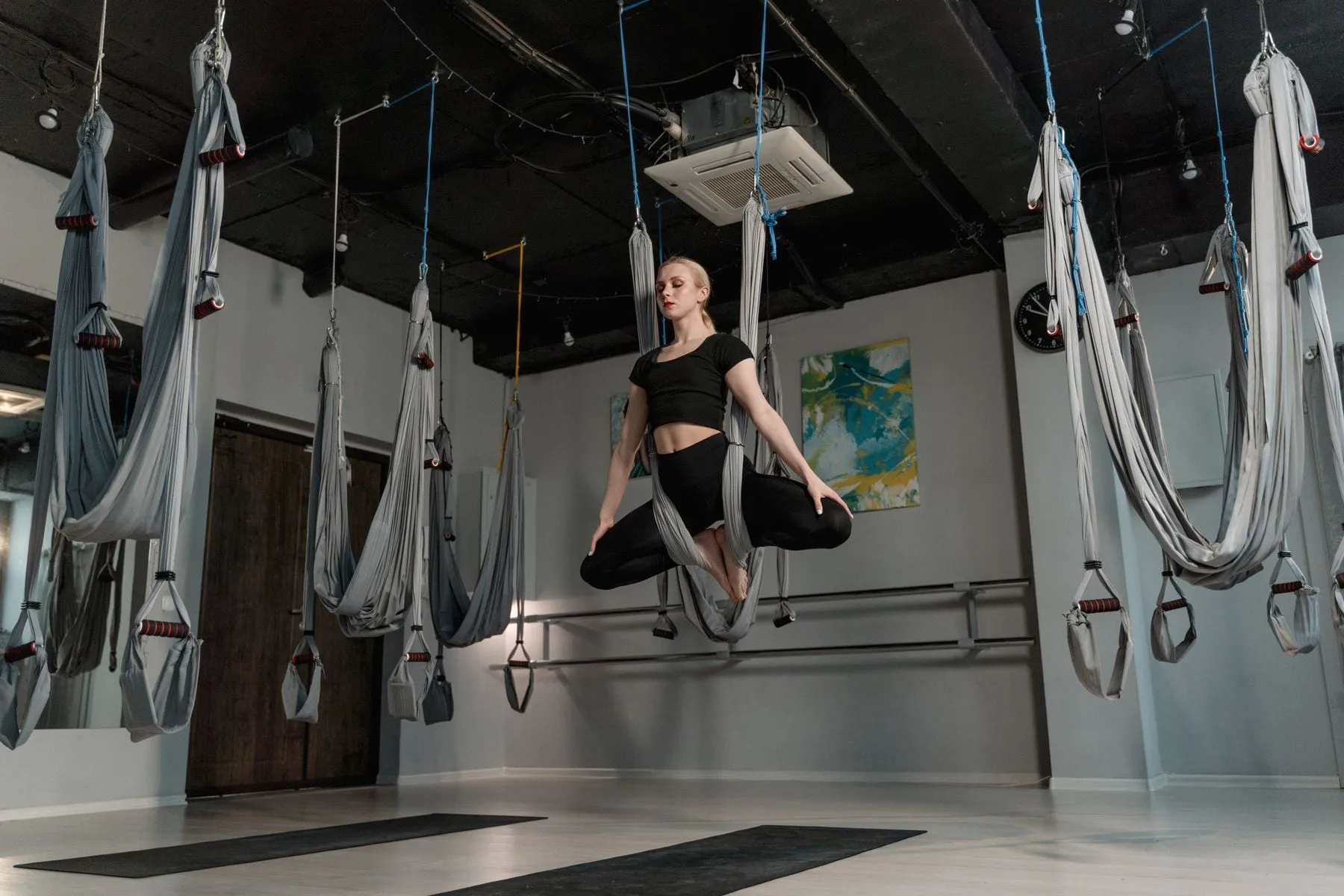

Our pick for a yoga trapeze
Yoga Trapeze (original)
The brand’s own swing, the only one where the specs in this guide match what you receive. The main risk is the mounting, not the fabric: the maker rates its hooks at 300 lb each and its stand at 350 lb of working load (600 lb is only the static test), and it warns never to anchor into drywall or plaster alone.
- The original Yoga Trapeze, sold on Amazon by the brand itself
- The same handles, straps and carabiners described on the brand's own site
- Hangs from a beam, an exposed joist or a bar
- Per ceiling hook
- 300 lb
- Price range
- Budget
VerifiedSpecs from the maker's own product page
A yoga trapeze is the simplest way to hang upside down at home: a sling, two pairs of handles, a set of straps and two carabiners. We have not tested these products: we read the maker’s own specifications and the studies on inverted positions, and report the numbers with their limits.
What Is a Yoga Trapeze?
The name belongs to a brand. The registered Yoga Trapeze® trademark sits with YOGABODY, which sells the training programs, while the gear is sold under the Yoga Trapeze name on its own store and on Amazon. We treat them as one brand here and name the store each fact came from.
The Parts: Sling, Handles, Straps and Carabiners
The brand’s own Pro Swing listing describes “rugged handles, adjustable straps, and gym-grade carabiners,” and says the whole set is “tested for a robust 600 lbs” (Yoga Trapeze). The sling is the wide padded fabric you sit or lie in. The handles give you something to pull on and hold while you tip back. The straps set the height, and the carabiners clip everything onto the anchor.
The same listing says the swing hangs from a chin-up bar, a beam or a sturdy tree branch, and that ceiling hooks and the stand are sold separately. Out of the box, then, a yoga trapeze is only half of the setup. The other half is whatever you hang it from.
Not the Same Product as an Aerial Silk or Hammock
Search Amazon for a yoga swing and you will see plenty of silk slings and aerial hammocks at lower budget tiers. Those are a different product. An aerial silk or hammock is a long loop of stretchy fabric, usually without the rigid handles that define the trapeze, and many poses are built around wrapping the fabric rather than gripping.
Neither is better in the abstract, but the specifications and warnings below belong to the Yoga Trapeze brand only. A generic sling’s weight rating has to come from its own maker’s page, and it is not interchangeable with these numbers.
What the Brand Says It Is For
YOGABODY describes the Yoga Trapeze as “a powerful yoga practice tool for posterior chain strength, backbends, spinal traction, shoulder and upper-back opening, core strength, inversion prep and more” (YOGABODY). The swing listing goes further, promising “instant back pain relief through traction and spinal decompression” (Yoga Trapeze).
That last claim is the one to read carefully. Spinal traction is the same mechanism inversion tables rely on: gravity is “thought to have a role in relieving low back pain” by separating the lumbar vertebrae (Kassay, 2023). “Thought to” is the honest wording, because the effect has not held up well in trials.
A Cochrane team that pooled 32 trials and 2,762 people found that traction, alone or combined with other treatment, “has little or no impact on pain intensity, functional status, global improvement and return to work” in low back pain (Wegner, 2013). That analysis covered traction in general, not the trapeze, and we found no trial on the yoga trapeze itself. So the strength and mobility pitch is plausible.
For what inversion is and is not shown to do, see our look at what inversion tables can realistically help with.
Mounting a Yoga Trapeze: Where the Real Risk Lives
An inversion table stands on its own frame. A yoga trapeze depends on your house. The brand says it plainly on its hook page: “The strength of your beam or ceiling, not the steel, is the limiting factor, so when in doubt have a professional check your mounting” (Yoga). That single sentence is the most important safety instruction the brand publishes, and it is about the building, not the body.
Ceiling Hooks: Joists and Concrete, Never Drywall
The brand’s hook kit uses lag bolts for solid wood beams and joists, and expander bolts for poured concrete, with both types in the box.
In practice that means finding a joist, not a convenient spot. If you cannot confirm solid wood or concrete above your ceiling, you do not have a mounting point yet.
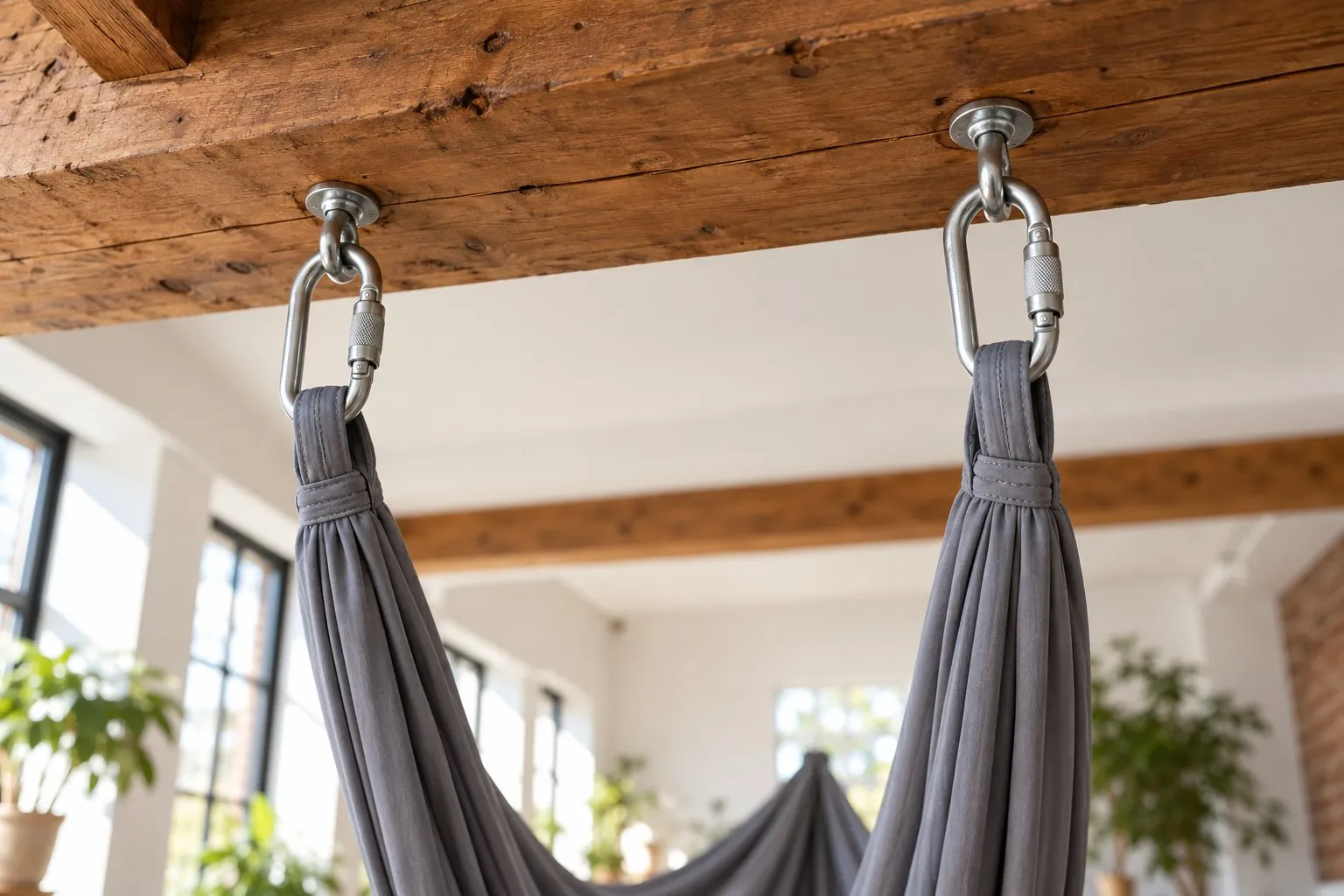
The hook rating is 600 lb tested across the pair, 300 lb per hook. The kit carries a one-year warranty on parts (Yoga). Note that the warranty covers the hooks, not your joist.
The Freestanding Stand: 600 lb Tested, 350 lb Working
For renters, plaster ceilings and garages with trusses too high to reach, the brand sells a freestanding Swing Stand. This is where its numbers get honest. Asked “What’s the real weight rating?”, the brand answers: “Static-tested to 600 lb (272 kg); rated for 350 lb (158 kg) of working load, that includes the dynamic forces of swinging and full inversions, not just standing weight. It’s the same rating as our ceiling hooks into a joist” (Yoga).
The stand’s listed specs: assembled height 9.8 ft, a footprint of 9.8 ft by 9.8 ft, a 59.7 lb frame, tool-free assembly in about five minutes, a travel bag included, and use on smooth floors or outdoor terrain (Yoga).
Which Weight Number to Trust
350 lb is the number that matters. The 600 lb figure appears across the brand’s marketing, and it is real, but it is a static test: a load hanging still. You will not be hanging still.
Swinging, dropping into a pose and tipping into a full inversion all add dynamic force, which is exactly why the maker publishes a lower working load for the stand and says the same rating applies to its hooks in a joist. The swing on its own only carries the 600 lb test figure, with no separate working load published. If you and your movement are anywhere near 350 lb, this is not your device.
Ceiling Height and Floor Space
For hooks, the brand gives a minimum ceiling of 94 inches (240 cm) for the swing, with 118 inches as ideal (Yoga). For the stand, you need about ten feet of clearance indoors, because the frame alone is 9.8 ft tall (Yoga). A standard eight-foot room cannot fit the stand, so the choice for most homes is simple: joist and hooks, or outdoors and a stand.
| Spec | Editor's choiceYoga Trapeze (original)Budget, price tier 1 of 3Verified |  Yoga Trapeze StandPremium, price tier 3 of 3Verified Yoga Trapeze StandPremium, price tier 3 of 3Verified |
|---|---|---|
| Weight capacity | 600 lbHighest here | 350 lb |
| Assembly and setup | Hangs from a beam, exposed joist or bar; ceiling hooks and stand sold separately | Freestanding, no drilling; needs about 9.8 ft of height and a 9.8 x 9.8 ft floor area |
| Angle control | No angle control: you choose how far to invert with your body | Not stated |
| Warranty | Not stated | Not stated |
| Buy | See today's price: Yoga Trapeze (original) on Amazon (opens in a new tab) | Not linked |
Editor's choiceYoga Trapeze (original)- Weight capacity
- 600 lbHighest here
- Assembly and setup
- Hangs from a beam, exposed joist or bar; ceiling hooks and stand sold separately
- Angle control
- No angle control: you choose how far to invert with your body
- Warranty
- Not stated
Yoga Trapeze Stand- Weight capacity
- 350 lb
- Assembly and setup
- Freestanding, no drilling; needs about 9.8 ft of height and a 9.8 x 9.8 ft floor area
- Angle control
- Not stated
- Warranty
- Not stated
Verified from the maker's own page or manualClaimed retail listing onlyNot stated the maker publishes nothing
The swing’s 600 lb is the static test. The stand’s 350 lb is the working load, the figure to plan around for both.
How to Use a Yoga Trapeze Safely
The brand’s own usage instruction is brief: hang it securely, “ensuring it can support your weight,” then work through poses, backbends and stretches, with online tutorials and a beginner’s pose chart included (Yoga Trapeze). That leaves most of the safety thinking to you. Here is how to fill the gap with what has actually been measured.
Before the First Session
Check the anchor, not the fabric. Confirm you are in a joist or concrete, or that the stand sits level on a smooth floor. Set the sling at roughly hip height so you can sit into it with your feet on the ground. Clear the space around you, and put padding under the spot where your head would land if you slipped.
That last step comes from inversion table research, not trapeze research. A three-case report from South Korea found that falls from inversion tables work like a shallow-water diving injury: the user lands “on top of their head,” and “falls from 1 or 2 feet high are by no means negligible” (Jung, 2021). Those were tables, where the ankle hold failed. On a trapeze the equivalent is losing your grip or your leg lock.
The authors recommend an angled pillow or rubber ramp just below the head so the user slides rather than drops (Jung, 2021). It is a small precaution for a serious outcome. Three cases cannot tell you how common these falls are, only that they happen.
Getting In and Coming Out
Start with poses where your feet stay on the floor: supported backbends, hanging stretches, shoulder openers. Only when you can get into and out of the sling without thinking should you try a full inversion. Innova, an inversion table maker, tells its users to start at a low inversion position and to have a spotter (Innova). The logic transfers directly.
Coming out matters as much as going in. Reverse slowly, bring your hands back to the handles before your legs release, and get your feet under you before you stand up.
How Long to Stay Upside Down
Keep it short. The same case-report authors recommend keeping inversion under one minute to reduce fall risk, with extra caution for older or heavier users with weaker ankle strength (Jung, 2021). That is their recommendation, not a clinical consensus, and it was written for tables.
For scale, the studies below measured changes in blood pressure at two minutes and eye pressure at five. There is no reason to hang longer than you need to.
Is a Yoga Trapeze Hard?
Harder than it looks. A table holds you; a yoga trapeze asks you to hold yourself. Grip, core and the backs of your legs all work at once, and the full inversions need you to trust your hold while upside down.
The brand markets the swing to “yogis of all levels,” but the programs YOGABODY sells treat strength flows as a progression, not a starting point (YOGABODY). Expect the first weeks to be mostly supported stretches, and treat that as normal.
Who Should Not Hang Upside Down in a Yoga Trapeze
This is where the yoga trapeze and the inversion table are the same device. Your head is below your heart either way, and your blood vessels and eyes respond to position, not to brand.
The Brand Publishes No Medical Warnings We Could Find
Teeter and Innova publish long contraindication lists. On the Yoga Trapeze product, hook and stand pages we read, we found none: the only safety warning is about the mounting. That does not mean the risks are absent. It means you need a list from somewhere else.
The most complete one in this market is Teeter’s, which says not to invert until a licensed physician approves if you have “any medical or health condition that may be made more severe by an elevation of blood pressure, intracranial pressure or mechanical stress of the inverted position” (Teeter). That list names high blood pressure, heart and circulatory disease, anticoagulants, glaucoma, retinal detachment, osteoporosis, hernias, pregnancy and recent surgery, among others.
It is Teeter’s list for its tables, written with legal prudence, and we apply it here by analogy, not because the Yoga Trapeze brand endorses it. The full list, with the evidence behind each item, is on our page on who should not use an inversion table.
Blood Pressure and the Brain
Two minutes of inversion raised both systolic and diastolic blood pressure significantly in 60 healthy women aged 20 to 30, and the authors wrote that “hypertensive individuals may need to avoid its use” (Haskvitz, 1986). The abstract gives no mmHg figure, and no one in the sample had high blood pressure to begin with.
On an actual inversion table, a 2019 ultrasound study found significant changes in a marker of intracranial pressure and in carotid and middle cerebral artery blood flow at three minutes of inversion, and concluded that “inversion therapy should be used with caution,” particularly for anyone with a history of raised intracranial pressure (Kondrashova, 2019). Nothing about hanging from a sling instead of a table changes the physiology.
Eye Pressure: Two of These Studies Are Yoga
This is the one area where the evidence already comes from yoga practice. After five minutes fully inverted, eye pressure rose from 16.8 to 32.9 mmHg in healthy eyes and from 21.3 to 37.6 mmHg in eyes with glaucoma, and the researchers advised glaucoma patients to refrain (Weinreb, 1984). Visual fields did not change afterward: the concern is the transient spike.
Yoga poses reproduce it. In Downward Dog held for two minutes, pressure rose from 17 to 28 mmHg in people with glaucoma and from 17 to 29 mmHg in people without, returning to baseline within two minutes (Jasien, 2015). In a headstand, 75 experienced practitioners showed a uniform two-fold rise that held for as long as the pose did (Baskaran, 2006). A full trapeze inversion is a fully head-down position, closer to the first study than to Downward Dog.
Injury Data: Only From Circus Artists
We found no study of injuries on the yoga trapeze itself. The closest data come from circus. In a one-year prospective study of 201 preprofessional and professional circus artists aged 13 to 69 in ten US cities, the highest discipline injury rates were in aerial work with ground elements, at 5.93 per 1,000 exposures, and aerial work alone, at 4.26 per 1,000; adults had proportionally more aerial injuries than adolescents (Greenspan, 2023).
Read that with a strong limit. These are trained performers on trapezes, rings and silks, often at height and at speed, not someone doing supported backbends in a living room. The rate says aerial work is not risk-free; it cannot tell you the risk of a home yoga trapeze.
A scoping review published in 2025, covering 49 studies of circus artists, found shoulder, ankle and spine the most common injury sites among acrobats and concluded that research on screening and injury prevention for this group has clear gaps (Straub, 2025). The honest summary is that nobody has measured home trapeze injuries yet.
There is no recall to go on either. The Consumer Product Safety Commission’s recall database, which does list recalls of inversion tables, such as a 2008 Stamina table whose center weld could fail when inverted, returns no recall with “yoga swing,” “yoga trapeze” or “aerial yoga” in the title. The only “trapeze” recalls it holds are for children’s playground trapeze rings and backyard gym swings, a different product (CPSC, 2008).
Treat that the right way round: the absence of a recall is not proof that a yoga trapeze is safe. It means no formal CPSC recall is registered under those names, and your mount and your own body remain the things to check. For what can go wrong during and after any inversion, see our guide to inversion table side effects.
Yoga Trapeze vs. Inversion Table
Both put you upside down, and both sell on spinal traction. They differ in who controls the angle, how you get on and off, and what has to hold your weight.
| Feature | Yoga trapeze | Inversion table |
|---|---|---|
| Angle | Set by your body and grip | Set by the frame, often with a stop |
| What holds you | Hands, legs, core | Ankle locks and a backrest |
| Entry and exit | Climb in and roll out yourself | Lock ankles standing, tilt back, tilt up |
| What bears the load | Your joist, beam or a stand | The table’s own frame |
| Other uses | Strength, backbends, stretching | Mostly inversion |
| Maker’s medical warning list | None we could find | Published by Teeter and Innova |
Angle Control vs. Inversion by Your Body
On a table, the angle is a setting. Innova tells users to begin at a low position and progress (Innova), and many tables let you fix a maximum. On a yoga trapeze there is no setting: you are either upright, partly back, or fully inverted, and the transition depends on your strength. For someone who wants a gentle, repeatable partial inversion, the table is the more controlled device.
Getting On and Off
A table’s weak point is the ankles. The fall injuries in the 2021 case series happened when ankle strength gave out or the hold slipped (Jung, 2021). A trapeze removes the ankle hold and replaces it with your grip and leg position.
That suits a strong, mobile user and punishes a tired or unsteady one. Neither is fall-proof.
Setup and Space
A table needs floor space and nothing else. A trapeze needs a verified joist and 94 inches of ceiling, or roughly a ten-foot-tall space for the stand. Renters usually end up with the stand; homeowners with a known joist usually end up with hooks.
Which One Fits Whom
If your main goal is decompression for back pain, and you want the angle chosen for you, a table fits better; our guide to the best inversion tables by use case compares them on published specs. If you want a strength and mobility tool that also inverts, have a place to mount it, and are comfortable holding your own weight upside down, the trapeze makes more sense. In both cases the medical cautions above are identical. Two other devices sit at either end of that choice: a pair of gravity boots hangs you straight down from a bar, and a reclining inversion chair tips you back while you sit.
Our Pick: The Original Yoga Trapeze
We recommend one product here, the brand’s own swing, because it is the only one where the specifications in this guide match what you actually receive.
Why the Brand’s Own Swing
The Amazon listing is sold by the Yoga Trapeze brand, with the same handles, straps and carabiners described on its own site. The 600 lb figure on it is the static test; plan around the 350 lb working load the brand gives for its hooks in a joist and its stand. Bought directly from the brand’s own store, unused items can be returned within 30 days of receipt, with tags and in the original packaging (Yoga). On Amazon, Amazon’s return policy applies instead.
Tested to 600 lbVerified
Yoga Trapeze (original)
by Yoga Trapeze
Best for people who want the original trapeze, with specs that match the maker's site.
Skip it if you want the angle chosen for you, or you have no joist, concrete or stand to hang it from: a table fits better.
The original Yoga Trapeze, sold on Amazon by the brand itself with the same specs as its own site, rather than a generic silk sling. The 600 lb figure is the maker's static test, not a working load.
- Weight limit
- 600 lb
- Price range
- Budget
What we like
- The original Yoga Trapeze, sold on Amazon by the brand itself
- Maker publishes a 600 lb test for the swing
- Hangs from a beam, an exposed joist or a bar
- You choose how far to invert with your body
Keep in mind
- 600 lb is a static test, not a working load
- Ceiling hooks and stand sold separately
- Needs at least 94 in of ceiling height
- Warranty not stated
Full specs
- Price range
- Budget
- Weight capacity
- 600 lb
- User height
- Not stated
- Angle control
- No angle control: you choose how far to invert with your body
- Ankle system
- Not stated
- Heat and massage
- None
- Warranty
- Not stated
- FDA
- Not stated
VerifiedFrom the maker's product page. Not stated means the maker publishes nothing.
We may earn a commission. It never changes which table we pick, or the order they appear in.
The Stand, if You Cannot Drill
The freestanding Yoga Trapeze Swing Stand is listed on Amazon by the brand, but at the time of writing it is on preorder, so we are not linking a card to it. It is the right choice if you rent, have plaster ceilings, or want to practice outdoors, and you have about ten feet of height. Its working load is 350 lb, not the 600 lb in its Amazon title.
See the cheaper slings and stands we didn't pick
Cheaper Silk Slings and Budget Stands
Generic aerial silks and hammocks are a separate product, as covered above. Cheaper third-party stands also exist, some advertising higher capacities than the brand’s stand. We have not verified any of their ratings against their makers’ own specification pages, and a stand rating you cannot confirm is not one to hang upside down from.
Your questions, answered
Frequently Asked Questions
What is a yoga trapeze?
It is a fabric sling with padded handles and adjustable straps that clips onto a beam, a bar, ceiling hooks or a freestanding frame. You lean into it to stretch, backbend or hang head down. It has no ankle locks and no angle stop, so your grip, legs and position decide how far you go, not a pin or a strap.
How do you use a yoga trapeze?
Hang it from a solid wood joist, poured concrete or a rated stand, set the sling near hip height, and begin with supported poses where your feet stay on the floor. Move to full inversions only once getting in and out feels routine. Keep the first upside-down holds short, work over padding, and have someone nearby for the early sessions.
Is yoga trapeze hard?
It is harder than it looks, because nothing holds you in place except your grip, your legs and your core. Supported stretches with your feet down are within reach for most healthy adults. Full inversions and strength flows ask for grip and body awareness that build over repeated practice, and the brand itself sells its strength class as intermediate work.
Is yoga trapeze a good workout?
It can be, although we found no trial that measured it. The brand pitches it for posterior chain, grip and core strength, backbends and shoulder opening, which are the muscles a hanging, pulling practice loads. Treat it as a strength and mobility tool. Treat back pain relief claims as marketing until someone studies this device in people with back pain.
Who should not do aerial yoga?
Get a doctor's clearance first if you have high blood pressure, glaucoma or ocular hypertension, a past stroke, retinal detachment or raised intracranial pressure, a hernia, osteoporosis, a pregnancy or recent surgery. We could not find a medical warning list from the Yoga Trapeze brand, so this follows the list Teeter, an inversion table maker, prints for its own devices.
What works better than an inversion table?
For back pain, nothing has been proven to beat it, because traction in general has weak trial support: a Cochrane team pooling 32 traction trials found little or no effect. A trapeze is not better, just different. It trades the table's angle control and ankle locks for freedom of movement, and it depends on your ceiling or stand holding.
18 sources used for this guide
Each linked to the original. Citations in the text jump here.
View sources
Yoga Trapeze. Yoga Trapeze Pro Swing (product data feed). yogatrapeze.com, product JSON endpoint.
Yoga Trapeze. Yoga Trapeze Ceiling Hooks. yogatrapeze.com, product page.
Yoga Trapeze. The Swing Stand (Yoga Trapeze Swing Stand). yogatrapeze.com, product page.
YOGABODY. Yoga Trapeze - Strength, Flow, Go! (digital program listing). shop.yogabody.com.
Kassay A, Soliman MAR, Jhawar BS. Recommendations for inversion table therapy. Disability and Rehabilitation 2023;45(22):3779-3782.
Wegner I, Widyahening IS, van Tulder MW et al. Traction for low-back pain with or without sciatica. Cochrane Database of Systematic Reviews 2013, CD003010.
Jung SH, Hwang JM, Kim CH. Inversion Table Fall Injury, the Phantom Menace: Three Case Reports on Cervical Spinal Cord Injury. Healthcare (Basel) 2021;9(5):492.
Innova. Frequently Asked Questions. innovaproductsinc.com/faq/.
Teeter. Are there health issues that would prevent me from inverting?. teeter.com, Support Center (the same list appears in the owner's manual).
Haskvitz EM, Hanten WP. Blood pressure response to inversion traction. Physical Therapy 1986;66(9):1361-1364.
Kondrashova T, Makar M, Proctor C, Bridgmon KA, Pazdernik V. Dynamic assessment of cerebral blood flow and intracranial pressure during inversion table tilt using ultrasonography. Journal of the Neurological Sciences 2019;404:150-156.
Weinreb RN, Cook J, Friberg TR. Effect of inverted body position on intraocular pressure. American Journal of Ophthalmology 1984;98(6):784-787.
Jasien JV, Jonas JB, de Moraes CG, Ritch R. Intraocular Pressure Rise in Subjects with and without Glaucoma during Four Common Yoga Positions. PLoS One 2015.
Baskaran M, Raman K, Ramani KK, Roy J, Vijaya L, Badrinath SS. Intraocular pressure changes and ocular biometry during Sirsasana (headstand posture) in yoga practitioners. Ophthalmology 2006;113(8):1327-1332.
Greenspan S, Stuckey MI. Untangling risk factors including discipline-specific exposure for injuries in preprofessional and professional circus artists in the USA. BMJ Open Sport & Exercise Medicine 2023;9(2):e001551.
Straub J, Jayaseelan DJ, Honigberg C, Scalzitti DA. Injury Characteristics and Physical Therapy Management Strategies for Circus Artists: A Scoping Review. Journal of Clinical Medicine 2025;14(17):5948.
CPSC. Inversion Therapy Tables Recalled by Stamina Products Due to Fall Hazard. U.S. Consumer Product Safety Commission, recall 08538, January 16, 2008.
Yoga Trapeze. Refund policy. yogatrapeze.com/policies/refund-policy.