Health guide
Inversion Therapy: How It Works, What the Evidence Shows, and Who Should Avoid It
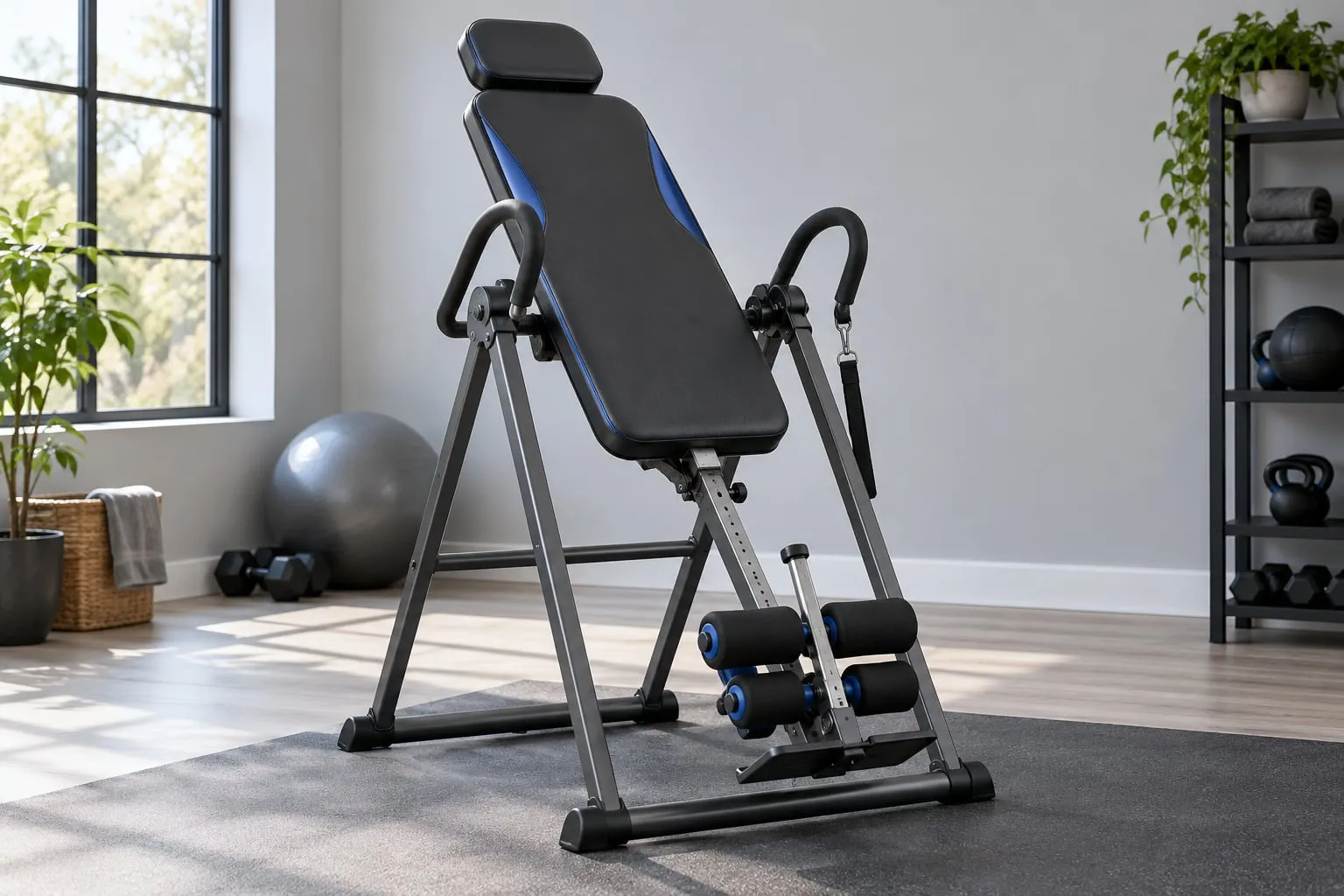
Inversion therapy is the practice of hanging at an angle, partly or fully head-down, so that gravity pulls the spine in the opposite direction from normal standing. It is sold as an inversion table, gravity boots, a chair or a fabric swing, and it is usually offered as a way to take pressure off the lower back. Some of that rests on measurements. Much of it rests on marketing. This guide separates the two, names the study behind each claim, and tells you where the evidence stops. We are not clinicians and we have not tested these devices on people, so everything below comes from published papers and manufacturer documents we read.
What Is Inversion Therapy?
Inversion therapy is a way of using gravity as a traction force. A 2023 paper on the topic in the journal Disability and Rehabilitation calls inversion table therapy “a form of spinal traction which is thought to have a role in relieving low back pain due to the gravity-facilitated traction of the spine which distracts the lumbar vertebrae” (Kassay, 2023). The wording matters: “is thought to” describes a proposed mechanism, and that paper is an opinion and regulatory piece, not a trial.
The Main Types of Equipment
Five kinds of device are sold for inversion therapy:
- Inversion tables have a padded bed that pivots on a frame. You lie on it, secure your ankles and tilt back.
- Gravity boots clamp around the ankles so you can hang from a bar.
- Inversion chairs keep you seated and tilt the whole seat backward.
- Mini inversion tables are small, seated devices that tilt you part of the way back.
- Yoga trapezes are fabric swings that support you in head-down positions.
The table comparison near the end of this guide sets out what each maker says about its design.
Inversion Therapy Versus Other Traction
Traction is any method that applies a pulling force to the spine, whether by a therapist, a machine or your own weight. Inversion therapy is the version where your body weight does the pulling. That is why the strongest summary of traction research, covered below, applies to inversion only by extension.
How Inversion Therapy Works on the Spine
Every proposed benefit starts from one idea: when you tilt head-down, the weight of your upper body acts as a pulling force on the lower spine. The research asks two questions about it. Does the spine actually lengthen? And what happens to the muscles around it?
Traction From Your Own Body Weight
The proposed idea is that the lumbar vertebrae are drawn slightly apart by your own weight while you are tilted, instead of being pressed together as they are when you stand. That is a mechanism, not a measured treatment effect.
What X-Rays and Tape Measures Found
Three small studies from the 1970s and 1980s measured the stretch directly.
- Nosse measured 20 healthy men and found that one minute of inversion on a motorized tilt table significantly increased spinal length (Nosse, 1978).
- Kane and colleagues took lateral X-rays of 15 healthy men before and after 10 minutes of full inversion. Separation increased at every lumbar level measured, though not every level reached statistical significance (Kane, 1985).
- Gianakopoulos and colleagues studied 20 people with chronic low back pain. Inverted traction widened the lower lumbar disc spaces by 0.3 to 4.0 mm in every case (Gianakopoulos, 1985).
Read these for what they are. None had a separate control group (Nosse compared each man with his own lying-down baseline), most volunteers were healthy, and a wider disc space during inversion says nothing about how long the gap lasts after you stand, or whether it eases pain. It confirms the mechanism, not the benefit.
Do the Back Muscles Relax? The Studies Disagree
Muscle relaxation is the second claim, and the research splits. A 1985 crossover study by deVries and Cailliet picked 12 healthy people with above-normal resting muscle tension. Two minutes of inversion cut resting neuromuscular tension by 28.3 percent, against 7.1 percent after the same time at rest (deVries, 1985). Nosse’s study also recorded lower muscle activity in the lower back during inversion (Nosse, 1978).
Kim and Kang reached the opposite conclusion in 2016. In 60 healthy men inverted for six minutes, activity in the lumbar erector spinae was higher after inversion than before, and the authors concluded that inversion is more likely to increase muscle tension and prevent relaxation (Kim, 2016). The two studies used different samples, different durations and different designs, so neither cancels the other. What they show together is that muscle relaxation is not established.
Does Inversion Therapy Work?
For pain and function, the honest answer is that it has not been shown to work reliably, and it has not been ruled out for everyone either. Three pieces of evidence matter most.
What the Cochrane Review Found
A Cochrane review published in 2013 included 32 randomized trials with 2,762 participants on traction for low back pain, with or without sciatica. The authors concluded that traction, alone or combined with other treatments, has little or no impact on pain intensity, function, global improvement or return to work, and that the effects seen were small and not clinically relevant (Wegner, 2013). Seven of the 32 trials reported adverse effects, including more pain, worse neurological signs and subsequent surgery, while four reported none (Wegner, 2013).
Two limits apply. The review covers manual and machine traction in general, not inversion tables specifically. And the authors rated the evidence as limited in quality, from small studies with moderate to high risk of bias.
The Small Trials That Look Better
Two groups of studies look more favorable, and both are small.
- The Newcastle pilot trial. Prasad and colleagues randomized 24 patients already listed for lumbar disc surgery. Surgery was avoided in 10 of 13 who added inversion to physiotherapy, against two patients in the physiotherapy-only group. Pain, disability and MRI scores did not differ significantly between the groups, and the authors describe it as a pilot (Prasad, 2012).
- The Güvenol comparison. In 29 people with a herniated lumbar disc and sciatica, ten sessions of inversion traction and ten of conventional mechanical traction were both clinically effective, with no significant difference between them. CT findings tended to favor conventional traction (Güvenol, 2000). There was no group that received no traction, so the result cannot separate the treatment from the natural course of sciatica.
The Registry Teeter Advertises
The same Newcastle team later published a registry of people who used inversion. In 85 inversion users the two-year surgery rate was 21 percent, against 39 percent in a matched control group (Mendelow, 2021). That registry was not randomized. Teeter supplied the tables and funded the study administrator, and the authors state the analysis was independent of the sponsor (Mendelow, 2021). Fewer operations in a self-selected group is a finding worth following up. It is not proof that inversion prevents surgery, and you should not read it as a promise.
What About Claims Beyond Back Pain?
The studies above measured spinal length, muscle activity, blood pressure, eye pressure and, in the trials, pain and surgery. They did not measure mood, sleep, brain function or immunity. Claims in those areas have nothing in this evidence to rest on. Our guide to hanging upside down benefits checks those wider claims one by one. For a fuller breakdown of the claimed benefits and what each one rests on, see our guide to inversion table benefits.
Risks and Who Should Avoid Inversion Therapy
Hanging head-down changes pressure in the body, and the studies that measured it found rises.
Blood Pressure and Heart Rate
Haskvitz and Hanten randomly assigned 60 women aged 20 to 30 to two minutes of inversion or standing. Both systolic and diastolic blood pressure rose significantly with inversion, and the authors said hypertensive people may need to avoid it (Haskvitz, 1986). In Gianakopoulos’s study of back pain patients, blood pressure rose by an average of about 17 mmHg systolic and 16 mmHg diastolic while inverted, three patients had persistent headaches and three had persistent blurred vision. The authors advised medical supervision (Gianakopoulos, 1985).
Eye Pressure and Glaucoma
Weinreb and colleagues measured eye pressure five minutes after full inversion. It rose from 16.8 to 32.9 mmHg in healthy eyes and from 21.3 to 37.6 mmHg in eyes with open-angle glaucoma. Visual fields did not change, and the authors recommended that people with ocular hypertension or glaucoma avoid inversion (Weinreb, 1984). Partial head-down positions matter too: in a study of yoga poses, two minutes in Downward Dog raised pressure from about 17 to 28 mmHg in people with glaucoma (Jasien, 2015).
Falls and Serious Injury
A 2021 report from South Korea described three people who suffered cervical spinal cord injuries after falling off inversion tables, a mechanism the authors compare to a shallow-water diving injury. It is a three-case report, so it cannot say how often this happens. The authors recommend sessions under one minute, an angled pillow or rubber ramp under the head, and extra caution for older or heavier users with weaker ankles (Jung, 2021). Separately, a 2023 regulatory paper notes that the FDA’s device-reporting database lists serious injuries from inversion table therapy, and that most makers avoid medical claims and so sit outside FDA regulation (Kassay, 2023).
Who Makers Say Should Not Invert
Manufacturers publish their own lists. Teeter says users with conditions such as high blood pressure, heart or circulatory conditions, glaucoma, retinal detachment, osteoporosis, fractures or implants, hernias, pregnancy or recent surgery should not invert until a licensed physician approves (Teeter). Innova’s ITX9600 manual lists 21 conditions, including some Teeter does not, such as weak ankles or feet and spinal injury (Innova). These are the makers’ lists, written with legal and clinical caution, not proven absolute contraindications. For the full breakdown, see who should not use an inversion table, and for the wider list of reported problems, see inversion table negative side effects.
How to Try Inversion Therapy at Home
If you have no condition on those lists and your clinician agrees, here is what the manufacturers’ own manuals say. These are instructions from makers, not clinical protocols.
Setting Up and Getting On
Teeter says to set the main shaft to your height with the locking pin, noting that this is only a guide that can differ by several inches depending on how your weight is distributed (Teeter, 2020). Innova’s ITX9600 manual says smooth inversion depends on finding your center of gravity with three settings: the height tube, the headrest pad and the foot position, and it tells users to wear athletic shoes with top laces to help secure the ankles (Innova). Innova’s FAQ adds that you should invert by slowly raising one arm and then the other, start at a low angle and have a spotter nearby (Innova).
Starting Slowly and Coming Back Up
Innova says most people begin with one to two minutes a session and that frequency is typically more important than duration (Innova). Teeter says there is no predetermined time limit and that users should listen to their body (Teeter, 2020). Neither cites a trial, and the fall-injury authors suggested under one minute (Jung, 2021). Returning matters as much as going down. Teeter tells users to let the body settle at 60 degrees, bring the arms to the sides, and, if they do not come upright, bend the knees rather than lift the head (Teeter, 2020). Innova’s manual says to pause at horizontal to prevent dizziness and not to sit up or rely only on the handlebars (Innova). Our step-by-step guide to using an inversion table covers the process in more detail.
Can It Replace Seeing a Clinician?
No. None of the research above tested inversion as a substitute for diagnosis or care, and the Cochrane authors found no reliable benefit from traction alone. If you try it, do so alongside your clinician’s advice, and report any new or worsening symptoms to them.
Inversion Therapy Equipment Compared
The table below describes how each type is built and used, using manufacturers’ own descriptions. Safety and effectiveness have not been compared across types in any trial we found.
| Type | How you are positioned | Angle control | Source of the description |
|---|---|---|---|
| Inversion table | Lie on a pivoting bed with ankles secured | Teeter says you can move gradually and stop at partial angles | Teeter |
| Gravity boots | Boots clamp the ankles and you hang from a bar | Teeter says you go straight to full inversion with no backrest | Teeter |
| Inversion chair | Seated, with a lap belt and padded ankle and knee support | Not stated | Health Mark |
| Mini inversion table | Sit on the front and lean back against a backrest | Maker describes a 135 degree position | Pain Management Technologies |
| Yoga trapeze | Fabric swing with handles and straps | Not stated | Yoga Trapeze |
Teeter’s own comparison says a table lets you move gradually between angles, while boots put you straight into full inversion with a free hang and no backrest to limit the angle (Teeter, 2026). Health Mark describes its inversion chair as a seat with an adjustable safety lap belt and padded ankle and knee support (Health Mark, 2024 archive). Pain Management Technologies calls its Mini Stretch a 135 degree mini inversion table (Pain), and Yoga Trapeze lists its swing with handles, straps and carabiners (Yoga Trapeze).
If you want to compare specific tables, see our best inversion tables guide, and if boots are your interest, see gravity boots.
Your questions, answered
Frequently Asked Questions
Does inversion therapy really work?
It depends on what you mean by work. It does stretch the spine while you hang, and X-rays measured that. Whether the stretch turns into lasting pain relief is unproven: the best summary of traction research found little or no benefit, and the positive inversion trials are small. Ask a clinician before you try it.
How long should you do inversion therapy?
No study has fixed a safe or effective duration. Innova suggests starting with one to two minutes, and Teeter sets no fixed limit. Researchers who documented fall injuries advised sessions under one minute. Studies that measured blood pressure and eye pressure used two to five minutes and saw rises. Your clinician should set the limit if you have any condition.
How long should someone hang for inversion therapy?
There is no tested hang time that is right for everyone. Manufacturers lean toward short, frequent sessions for beginners and leave the rest to how you feel, but neither maker backs that with a trial. Researchers who documented serious falls advised keeping each session brief. With a heart, eye or blood pressure condition, get clearance first.
22 sources used for this guide
Each linked to the original. Citations in the text jump here.
View sources
Kassay A, Soliman MAR, Jhawar BS. Recommendations for inversion table therapy. Disability and Rehabilitation 2023;45(22):3779-3782.
Nosse LJ. Inverted spinal traction. Archives of Physical Medicine and Rehabilitation 1978;59(8):367-370.
Kane MD, Karl RD, Swain JH. Effects of gravity-facilitated traction on intervertebral dimensions of the lumbar spine. Journal of Orthopaedic and Sports Physical Therapy 1985;6(5):281-288.
Gianakopoulos G, Waylonis GW, Grant PA, Tottle DO, Blazek JV. Inversion devices: their role in producing lumbar distraction. Archives of Physical Medicine and Rehabilitation 1985;66(2):100-102.
deVries HA, Cailliet R. Vagotonic effect of inversion therapy upon resting neuromuscular tension. American Journal of Physical Medicine 1985;64(3):119-129.
Kim CY, Kang JH. Analysis of electromyographic activities of the lumbar erector spinae caused by inversion traction. Journal of Physical Therapy Science 2016;28(4):1238-1240.
Wegner I, Widyahening IS, van Tulder MW et al. Traction for low-back pain with or without sciatica. Cochrane Database of Systematic Reviews 2013, CD003010.
Prasad KS, Gregson BA, Hargreaves G, Byrnes T, Winburn P, Mendelow AD. Inversion therapy in patients with pure single level lumbar discogenic disease: a pilot randomized trial. Disability and Rehabilitation 2012;34(17):1473-1480.
Güvenol K, Tüzün C, Peker Ö, Göktay Y. A comparison of inverted spinal traction and conventional traction in the treatment of lumbar disc herniations. Physiotherapy Theory and Practice 2000;16(3):151-160.
Mendelow AD, Gregson BA, Mitchell P et al. Lumbar disc disease: the effect of inversion on clinical symptoms and a comparison of the rate of surgery after inversion therapy with the rate of surgery in neurosurgery controls. Journal of Physical Therapy Science 2021;33(11):801-808.
Haskvitz EM, Hanten WP. Blood pressure response to inversion traction. Physical Therapy 1986;66(9):1361-1364.
Weinreb RN, Cook J, Friberg TR. Effect of inverted body position on intraocular pressure. American Journal of Ophthalmology 1984;98(6):784-787.
Jasien JV, Jonas JB, de Moraes CG, Ritch R. Intraocular Pressure Rise in Subjects with and without Glaucoma during Four Common Yoga Positions. PLoS One 2015.
Jung SH, Hwang JM, Kim CH. Inversion Table Fall Injury, the Phantom Menace: Three Case Reports on Cervical Spinal Cord Injury. Healthcare (Basel) 2021;9(5):492.
Teeter. Are there health issues that would prevent me from inverting?. teeter.com, Support Center (the same list appears in the owner's manual).
Innova. ITX9600 Heavy Duty Deluxe Inversion Therapy Table, Owner's Manual (version 1709AJJ). Innova Products Inc., owner's manual.
Teeter. How to Use an Inversion Table. teeter.com blog, 2020 (updated 2022).
Innova. Frequently Asked Questions. innovaproductsinc.com/faq/.
Teeter. Gravity Boots: What They Are, How They Work, and How to Get Started. teeter.com blog, April 17, 2026.
Health Mark, Inc. Core Inversion Chair (SKU IVO18600). healthmarkinc.us, product page.
Pain Management Technologies. Mini Inversion Table by Mini Stretch. paintechnology.com, product page (product code MSIT).
Yoga Trapeze. Yoga Trapeze Pro Swing (product data feed). yogatrapeze.com, product JSON endpoint.