Health guide
Dead Hang Exercise: How to Do It, Workouts and Progressions
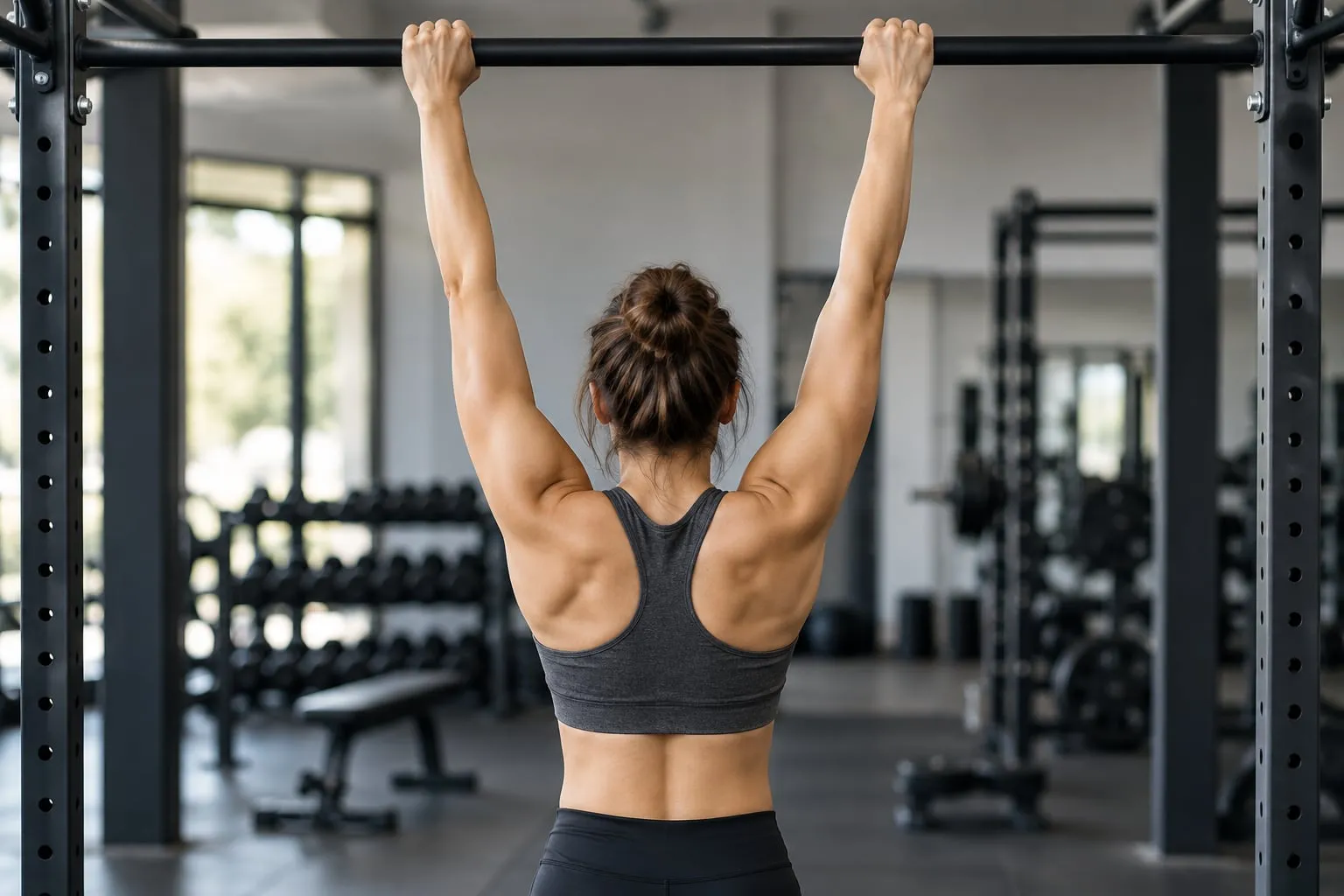
The dead hang exercise looks too simple to need instructions, and that is exactly why people do it badly. They hang from fully shrugged shoulders, swing, hold on until their hands fail, then drop to the floor. This guide covers how to do a dead hang with good form, three dead hang workouts you can run without a stopwatch, ways to make the hang harder, and how to set up at home. Every health claim is tied to a named source, and where the research is thin, we say so. We did not test anyone ourselves.
How to Do a Dead Hang Exercise With Good Form
Good form for a dead hang has three steps: grip the bar, set your shoulders, and hang still. The details below are the ones that matter in practice.
Grip
Take an overhand grip about shoulder width apart and wrap your thumbs around the bar. ACE’s instructions for the chin-up, the closest exercise it publishes, open the same way: grasp the handles “with a full grip position (thumbs wrapped around the handles)” and keep a neutral wrist, meaning your wrist stays in a straight line with your forearm (American). A full grip also spreads the load across your whole hand instead of pinching it into your fingertips.
If your hands slip before your body is ready to stop, that is a grip limit, not a form failure. For why hang times end where they do, see our guide to how long you should dead hang.
Shoulders
This is the step most people miss. Do not let your shoulders ride up around your ears. ACE tells people starting a pull to “depress and retract your scapulae (pull shoulders back and down)” and hold that position through the movement (American). In a dead hang you do not need a hard squeeze. Think of it as taking the slack out of your shoulders so they are not jammed up against your neck.
Keep your elbows straight and your gaze level. When a research team asked climbers for a maximal dead hang, they scored it on “fully extended elbows, and a horizontal gaze,” and ended the test when the elbows bent (Exel, 2026). That was an 11-person lab study of advanced male climbers on a narrow wooden edge, so it shows how researchers define the position, not a rule for everyone. It is still a useful picture of a clean hang: arms long, head neutral, body still.
Breathing
Breathe normally. Holding your breath tends to tighten your neck and shoulders, which is the opposite of what you want in a hang. We found no study that tested breathing patterns in a dead hang, so this is a practical cue, not a researched one. Slow breaths in and out through the nose or mouth are fine. If you notice you have stopped breathing, you are probably holding too hard.
Getting Down
Put your feet back on the floor or a step before you let go. ACE’s chin-up entry ends each rep by returning slowly to the start, not by dropping (American). The same applies to a hang: a drop lands your full weight on your ankles and knees, and on a doorway bar it can knock the bar loose.
If the bar is low, bend your knees. A spine clinic in Turkey uses a dead hang for X-rays with the patient’s knees bent to 90 degrees “and contact with the ground is cut off” (Ovali, 2023). You can do the same at home: cross your ankles behind you and let your body hang.
Dead Hang Workouts: Three Routines
No study has tested dead hang routines in ordinary adults, so these three are structures, not prescriptions. In each one, hang for as long as you hold good form, then stop. Good form means your elbows stay straight, your shoulders stay set and you are not swinging.
Beginner Dead Hang Workout
If you cannot hang with your feet off the floor yet, start with your toes or a chair taking some of the load. Hang, rest until your hands feel fresh, then hang again. Do a handful of hangs and stop while the last one still looks like the first. Repeating short, clean hangs teaches your hands and shoulders the position without grinding your grip down.
Grip Workout
For a grip session, use intermittent hangs: hang, pause briefly with your feet down, hang again. A randomized trial of 26 advanced climbers compared three eight-week finger programs. The group doing intermittent dead-hangs, 10-second hangs with 5-second pauses, twice a week, gained about 45% in hang time to failure, against about 34% for maximal weighted hangs, though the groups did not differ significantly from each other (Lopez-Rivera, 2019). The authors noted their groups were small and that the gains were in trained climbers on narrow edges. Treat the structure, short hangs with brief pauses, as the idea worth borrowing, not those exact numbers.
A second trial of 35 climbers found that 10 weeks of hangboard training increased maximal finger strength more than climbing alone (Hermans, 2022). Both trials were done on climbing hangboards, not pull-up bars.
After-Desk Workout
A hang between work blocks is a popular reset. Hang once or twice when you stand up from your desk, with your shoulders set and your feet on the floor if needed. Our guide to decompressing your spine covers what hanging can and cannot do for your back. The short version is that it stretches you while you hang, and not much more is proven.
How Often to Train
For frequency we have evidence about strength training in general, not about hanging. The American College of Sports Medicine’s 2026 position stand, an overview of the systematic review literature, found strength was enhanced by training at least two days a week, and said the upper limit could not be determined from its analysis (Currier, 2026). That was resistance training with loads, so it is a sensible benchmark, not a hang prescription. Two or three hang sessions a week is a reasonable place to start.
Dead Hang Progressions
Progress one thing at a time: first make the hang easier to start, then make it harder to hold.
Feet-Assisted Hangs
Stand on a step or box with the bar at chest height or above, grip the bar, and keep your toes or one foot on the support. You take as much weight off your hands as you need. As hangs become easy, take away the support in stages until your feet are off the floor. This also lets you practice the shoulder position without the fear of a long fall.
The Active Hang
Once a passive hang is steady, you can add the scapular cue ACE describes for the start of a pull: shoulder blades pulled back and down with your arms still straight (American). That small shoulder movement is the bridge between hanging and pulling. Our guide to the dead hang vs active hang covers when each one fits, and the dead hang grip guide covers hand position.
Weighted Hangs
Added weight is how climbers load their fingers. In the eight-week trial above, the maximal group hung with added weight on an 18 mm edge (Lopez-Rivera, 2019). That is advanced-athlete training. If you can hang with good form for a long time and want more challenge, a weighted hang is the next step, but only after your shoulders and elbows feel fine with plain hangs. Most people get more from clean, repeated bodyweight hangs first.
What a Dead Hang Exercise Trains
You will see long lists of dead hang benefits online. Here is the short, sourced version.
Benefits
The best-supported benefit is grip strength, with trial evidence in trained climbers (Hermans, 2022). Grip strength also predicts survival: in the PURE study of 139,691 adults in 17 countries, each 5 kg lower grip strength was associated with a 16% higher risk of death from any cause (Leong, 2015). That is a marker of risk, not proof that hanging adds years, and the authors themselves say it still has to be tested whether improving strength lowers mortality. Our dead hang benefits guide goes through every claim and rates the evidence: dead hang benefits.
Muscles Worked
Your hands and forearms hold your body weight, and your shoulder and upper arm muscles keep the arms from collapsing. In a surface EMG study, 25 climbers doing maximal dead-hangs on an edge showed activity in finger flexors, a wrist flexor and a finger extensor, and the pattern changed with grip position (Ferrer-Uris, 2023). In the 11-climber lab study, a fatiguing hang increased coupling between brachioradialis, biceps and trapezius signals (Exel, 2026).
A pull adds more: in 15 healthy adults, pull-ups at 1.5 times shoulder width showed no significant differences between traditional, suspension-trainer and towel versions in latissimus dorsi, biceps or posterior deltoid activity (Snarr, 2017). That is pulling, not hanging, so do not read it as a hang result. For a muscle-by-muscle breakdown, see which muscles a dead hang works.
Where to Do a Dead Hang Exercise at Home
You need one thing: a bar that holds your weight and a place to stand safely. A sturdy outdoor bar or a playground frame can work, if it is built to hold an adult. Many people use a doorway bar, which is where the risk is.
In 2011 the Consumer Product Safety Commission announced a recall of about 7,000 Perfect Pullup doorway bars because the plastic handle could crack, after about 2,200 reports of cracked handles and 38 injury complaints (bruises, strains and sprains) (CPSC, 2011). That recall covers one product, not all doorway bars. It shows the failure mode is real.
If you want a doorway bar, our guide to the best doorway pull-up bars compares doorway bars so you can choose one.
Who Should Be Careful With Dead Hangs
For most healthy adults, a short, controlled hang is low risk. The exceptions are about your shoulders, your body and your equipment.
Shoulder Problems
Hanging is widely promoted for sore shoulders, but we found no trial that tested it. If you have shoulder pain, a past dislocation or surgery, or pinching when you raise your arm, a full-weight hang loads the joint more than most people expect. ACE’s own chin-up page says the exercise “should be performed without compromise to the shoulder” (American). If a hang hurts, let your feet take the load or skip it and ask your clinician.
Back, Blood Pressure and Pregnancy
If you have a back condition, high blood pressure, a heart condition or are pregnant, talk to your clinician before adding hanging. We did not find research testing a dead hang in any of these groups, so we cannot tell you it is safe. Stop if you feel pain that spreads down an arm or leg, dizziness or numbness.
Scoliosis and Recent Injury
An X-ray study uses a dead hang to see how flexible a curve is in patients already heading for surgery. That is a measurement, not a treatment (Ovali, 2023). If you have scoliosis or a recent injury, ask your specialist first.
Your questions, answered
Frequently Asked Questions
Are dead hangs a core exercise?
Not mainly. The dead hang is a grip and upper body hold, and we found no study that measured abdominal muscle activity during a plain hang. What you can do is brace your midsection, as the American Council on Exercise tells people to do before a pull, so your ribs and lower back stay quiet while you hang.
Is it okay to do dead hangs every day?
For most healthy adults short hangs on most days are a reasonable habit, but no trial has tested daily hanging, so treat it as a judgment call. Pain at the elbows, shoulders or finger joints, or grip that gets worse instead of better, is your cue to take a day or two off.
Do dead hangs actually build muscle?
They build grip strength and endurance, and that is the part with evidence. We found no study showing that hanging adds visible muscle size. If size is your goal, pair hangs with pulling exercises, and note that the American College of Sports Medicine ties muscle growth to weekly volume, not to any one exercise.
10 sources used for this guide
Each linked to the original. Citations in the text jump here.
View sources
American Council on Exercise. Chin-ups (Exercise Library). acefitness.org, exercise library entry 190.
Ovali SA, Us AK. Comparison of traction, side-bending and dead-hang radiographs in preoperative evaluation and postoperative correction prediction in adolescent idiopathic scoliosis: A retrospective analysis of a novel flexibility radiograph. Medicine (Baltimore) 2023;102(50):e36461.
Exel J, Kaufmann P, Froschauer O, Baca A, Kainz H, Mochizuki L. Upper-Body Neuromechanical Coordination Strategies During Fatiguing Sustained Dead Hangs in Climbers. European Journal of Sport Science 2026;26(6):e70197.
Lopez-Rivera E, Gonzalez-Badillo JJ. Comparison of the Effects of Three Hangboard Strength and Endurance Training Programs on Grip Endurance in Sport Climbers. Journal of Human Kinetics 2019;66:183-195.
Hermans E, Saeterbakken AH, Vereide V, Nord ISO, Stien N, Andersen V. The Effects of 10 Weeks Hangboard Training on Climbing Specific Maximal Strength, Explosive Strength, and Finger Endurance. Frontiers in Sports and Active Living 2022;4:888158.
Ferrer-Uris B, Arias D, Torrado P, Marina M, Busquets A. Exploring forearm muscle coordination and training applications of various grip positions during maximal isometric finger dead-hangs in rock climbers. PeerJ 2023;11:e15464.
Snarr RL, Hallmark AV, Casey JC, Esco MR. Electromyographical Comparison of a Traditional, Suspension Device, and Towel Pull-Up. Journal of Human Kinetics 2017;58:5-13.
Currier BS, D'Souza AC, Singh MAF, et al. American College of Sports Medicine Position Stand. Resistance Training Prescription for Muscle Function, Hypertrophy, and Physical Performance in Healthy Adults: An Overview of Reviews. Medicine & Science in Sports & Exercise 2026;58(4):851-872.
Leong DP, Teo KK, Rangarajan S, et al. Prognostic value of grip strength: findings from the Prospective Urban Rural Epidemiology (PURE) study. The Lancet 2015;386(9990):266-273.
CPSC. Perfect Pullup Recalled by Perfect Fitness Due to Fall Injury Hazard. U.S. Consumer Product Safety Commission, cpsc.gov, release 11-136, February 17, 2011.