Health guide
Inversion Tables for Neck Pain: Evidence, Risks and What Actually Has a Neck Feature
We earn from qualifying purchases made through our links. How we make money
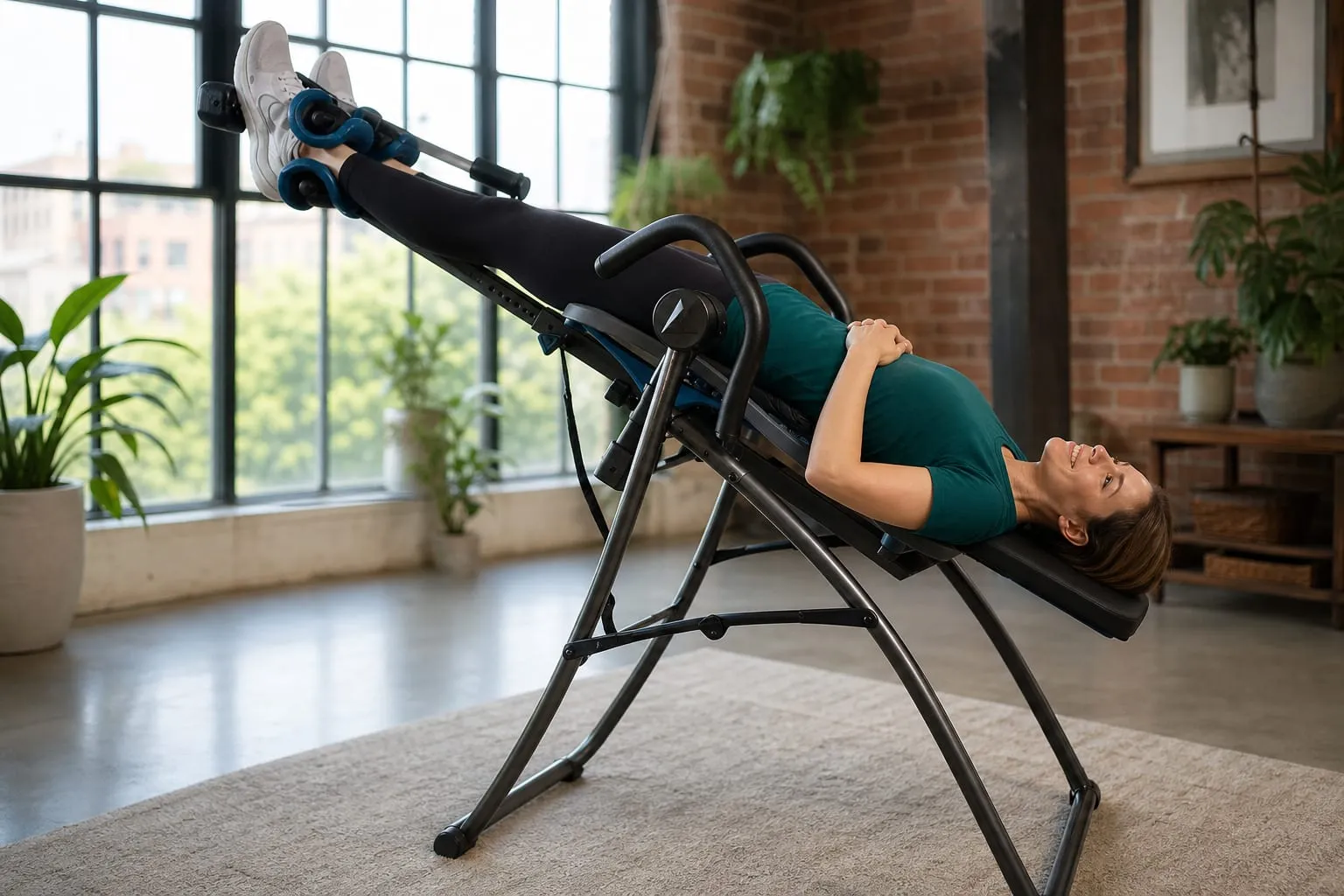
If you are searching for the best inversion table for neck pain, you will mostly find product lists that promise “decompression” and “realignment” without naming a single study. We are not doctors, and we did not test these tables on anyone: we read the traction research on the neck in full, the case reports on table falls, and the manufacturers’ own product pages, and we set out what each one says and where it stops.
Does an Inversion Table Help Neck Pain? What the Research Says
Before judging the tool, it helps to know what it actually does to the spine, and what has been measured.
What an Inversion Table Actually Stretches
Inversion tables are a form of spinal traction. A 2023 paper in the journal Disability and Rehabilitation describes inversion table therapy as traction thought to relieve low back pain “due to the gravity-facilitated traction of the spine which distracts the lumbar vertebrae” (Kassay, 2023). Lumbar means the lower back. When you tip back and hang from your ankles, the weight of your upper body pulls on the spine below it, and the lower back is where that pull is described.
Two things follow. First, the mechanism is proposed, not proven: the authors write “is thought to,” and their paper is a regulatory and opinion piece, not a trial (Kassay, 2023). Second, it says nothing about the neck.
Your head is the lowest point when you invert, so there is very little body weight below the neck to pull on it. Whether a table stretches the cervical spine in any useful way has simply not been measured.
The Closest Evidence: Dedicated Neck Traction
The nearest thing to an answer comes from cervical traction, meaning devices built to pull on the neck alone. A systematic review and meta-analysis published in 2020 by Colombo and colleagues pooled seven randomized trials with 589 patients who had cervical radicular syndrome, a pinched nerve in the neck. Adding traction to other treatments reduced pain by about 6 points on a 0 to 100 scale compared with those other treatments alone (Colombo, 2020).
That difference was statistically significant, but only just. The authors had set 20 points as the smallest change that would matter to a patient, and traction did not come close. They rated the quality of the evidence as generally low, wrote that “none of these effects were clinically meaningful,” and concluded that traction “does not appear to be essential in clinical practice” (Colombo, 2020).
Keep the limits in view. Traction was always given together with other care, never on its own against nothing. And these patients had nerve symptoms, not the stiff, tense neck most people mean by neck pain.
What the Physical Therapy Guideline Recommends
The clinical practice guideline for physical therapists treating neck pain, the 2017 revision by Blanpied and colleagues for the American Physical Therapy Association, published in the Journal of Orthopaedic & Sports Physical Therapy, lands in a similar place. It gives a Grade B recommendation, meaning moderate evidence, for “mechanical intermittent cervical traction, combined with other interventions such as stretching and strengthening exercise plus cervical and thoracic mobilization/manipulation” (Blanpied, 2017). Three conditions are built into that sentence, and each one narrows it.
- Only chronic neck pain with radiating pain. The recommendation covers pain that travels into the arm and has lasted, not the everyday stiff or sore neck.
- Only in combination. Traction is one part of a program with exercise and hands-on treatment, never a stand-alone fix.
- Only intermittent. For continuous traction, the guideline found “no benefit, when compared to a control,” for pain or disability, in acute or chronic cases (Blanpied, 2017).
The same guideline also reports that traction should not be routinely prescribed as part of nonsurgical care for moderate to severe cervical myelopathy, a compression of the spinal cord itself (Blanpied, 2017). And across its 83 pages it does not mention inversion at all. A cervical traction device is a dedicated unit that pulls the head away from the shoulders, and in the intermittent form the guideline backs, it pulls and releases in cycles. An inversion table is a different machine: it hangs your whole body from your ankles and holds you there.
No Trial Has Used an Inversion Table
In the Colombo review, mechanical traction was used in six of the eight comparisons and manual traction, applied by a therapist, in the other two (Colombo, 2020). We searched the full text for “invert” and “inversion” and found neither word. No trial in that review used an inversion table.
This is an absence, so be precise about what it means. It does not prove an inversion table fails for the neck. It means nobody has tested one, and the devices that were tested apply force differently: a harness or unit pulls the head away from the shoulders, while a table hangs the whole body from the ankles.
A Weak Record in the Lower Back Too
Traction has not done better where an inversion table’s pull is actually described. A Cochrane review of 32 trials with 2,762 people found that traction, alone or with other treatment, made little or no difference to pain, function or return to work in low back pain (Wegner, 2013). That covers traction in general, not inversion alone, but it is the same family of treatment, in the region it targets.
Neck Pain or a Pinched Nerve?
This page covers general neck pain: stiffness, muscle tension, soreness that stays in the neck and shoulders. If your pain shoots down an arm, or comes with tingling, numbness or weakness in the hand, that pattern points to a compressed nerve root, which has its own evidence and its own page: can an inversion table help a pinched nerve. Those symptoms are also a reason to see a doctor before trying any traction at home.
The Falls Risk Is a Neck Risk
On most inversion topics, falls are one hazard among several. For neck pain they are the central one, because the injury pattern is a neck injury.
How Table Falls Injure the Cervical Spine
In 2021, Jung and colleagues published three case reports of cervical spinal cord injury after falls from inversion tables. They compare the mechanism to a shallow-water diving injury: “once the ankle power is lost or it slips, the user will land on top of their head.” They also warn that “falls from 1 or 2 feet high are by no means negligible” (Jung, 2021). The injuries they describe include tetraplegia, paralysis of all four limbs.
Three reports from South Korea cannot tell you how often this happens, so we won’t call it common or rare. What they establish is the direction of the damage.
Ankle Locks Have Failed in Real Products
A fall usually starts at the ankles, and that part has failed in products sold in the US. In 2010 the Consumer Product Safety Commission announced a recall of about 33,000 NordicTrack, Gold’s Gym and Weider Club inversion benches after 75 reports of the ankle clamp releasing or the rotation strap breaking, “including 23 injuries, some of which were to the head and neck” (CPSC, 2010). In 2015, DICK’S Sporting Goods recalled its Fitness Gear Inversion Table after customers fell and were injured, even though the manual “clearly stresses the importance of ensuring the ankle locking systems are engaged” (DICK'S, 2015).
Those recalls concern specific older models, not the tables we cover. They show that the failure is real and repeats across brands.
What the FDA Record Shows
The same 2023 paper notes that the FDA’s device reporting database lists serious injuries from inversion table therapy, including spinal cord injury, fractures and death. It also explains that the FDA regulates only the tables whose makers claim a medical use, and most makers don’t, so most tables sit outside FDA oversight (Kassay, 2023). There is no count or rate behind that, but it tells you a label on the box is not a safety review.
Pressure in the Head: Blood Pressure, Eyes and Brain
The second set of risks sits right above the neck. Turning upside down sends pressure toward the head, and three studies have measured it.
Blood Pressure Goes Up
In a small randomized study of 60 healthy women aged 20 to 30, two minutes of inversion raised both systolic and diastolic blood pressure significantly compared with standing controls. The authors wrote that hypertensive individuals “may need to avoid its use” (Haskvitz, 1986). The abstract doesn’t give the rise in mmHg, and the sample was young and healthy, so an older adult with a stiff neck is not the group that was measured.
Eye Pressure Roughly Doubles
After five minutes fully inverted, eye pressure rose from 16.8 to 32.9 mmHg in healthy eyes and from 21.3 to 37.6 mmHg in eyes with glaucoma. The authors recommended that patients with ocular hypertension or glaucoma “refrain from this activity” (Weinreb, 1984). They also reported that visual fields did not change afterward, so the concern is the temporary spike, not measured damage.
Blood Flow to the Brain Changes
A 2019 ultrasound study on an actual inversion table found significant changes in a marker of intracranial pressure and in blood flow through the carotid and middle cerebral arteries after three minutes of inversion. The authors concluded that “inversion therapy should be used with caution,” especially for anyone with a history of raised intracranial pressure (Kondrashova, 2019). The published abstract gives no absolute values, so we don’t quote any.
None of this proves harm in a healthy user. It does explain why people who get tension headaches, or who already feel pressure behind the eyes, should not treat head-down time as a relaxation tool without asking a doctor.
Who Should Check With a Doctor First
Both major brands tell you not to invert without a physician’s approval. Teeter’s list includes high blood pressure, glaucoma, retinal detachment, osteoporosis, fractures, a history of stroke and severe headaches, among others (Teeter). Innova’s manual lists 21 conditions and adds some Teeter doesn’t name, including spinal injury and weak ankles and/or feet (Innova).
Spinal injury and weak ankles both matter directly to a neck: one describes the region at risk, the other the part that gives way in a fall. The full picture is in our guide to who should not use an inversion table.
Choosing the Best Inversion Table for Neck Pain
No table in the Innova or Teeter ranges applies traction to the neck on its own. They all invert the whole body. For a neck, the differences come down to comfort features and accessories, and it is worth being clear about what those are.
Innova ITM6000: Heat and Massage, Not Neck Traction
The Innova ITM6000 is the only table from either brand with a dedicated neck pad. Innova describes a dual heat and massage pad made of two affixed parts, one for the neck area and one for the back, with a neck pad “adjustable to desired position for maximum comfort,” two heat levels and a curved stretch bar (Innova).
Read that carefully. It is a heat and vibration comfort feature. It does not add a separate pull on the neck, and Innova doesn’t claim it does: the page makes no clinical claim about the neck beyond advising you to consult a licensed physician (Innova).
If warmth on your neck feels good while you lie on the table, this is the model that offers it. If you are hoping for neck traction, no table offers it.
Here is how its pad compares with Innova’s other heat and massage models, from the manufacturer’s published specs.
| Spec | 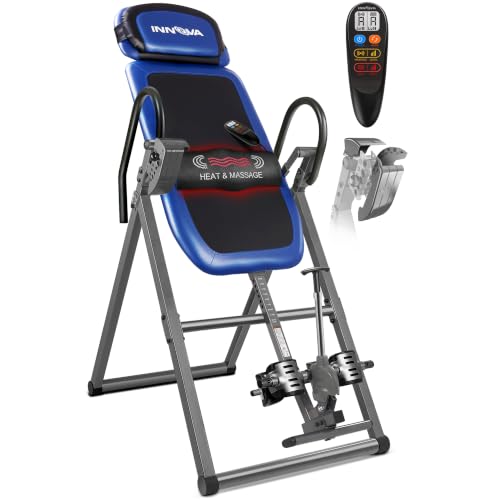 Innova ITM4800Mid-range, price tier 2 of 3Verified Innova ITM4800Mid-range, price tier 2 of 3Verified |  Innova ITM5900Mid-range, price tier 2 of 3Verified Innova ITM5900Mid-range, price tier 2 of 3Verified |  Innova ITM6000Mid-range, price tier 2 of 3Verified Innova ITM6000Mid-range, price tier 2 of 3Verified |
|---|---|---|---|
| Heat and massage | Heat and vibration on a lumbar band, adjustable position | Vertical heat and massage pad covering the entire spine | Dual pads, one for the neck and one for the back, two heat levels |
| Angle control | Six-position pin with protective cover; degrees not stated | Six-position pin with protective cover; degrees not stated | Six-position pin; slope adjustable without dismounting |
| Weight capacity | 300 lb | 300 lb | 300 lb |
| Warranty | 1 year limited | 1 year limited | 1 year limited |
| User height | 4'10" to 6'6" | 4'10" to 6'6" | 4'10" to 6'6" |
| Ankle system | Ergonomic ankle holding system, front and rear U-shaped holders | Ergonomic ankle holding system designed to reduce pressure on the ankle | Patented No Pinch U-shaped holders |
| FDA | Not stated | Not stated | Not stated |
| Assembly and setup | Not stated | Not stated | Assembly required |
| Buy | See today's price: Innova ITM4800 on Amazon (opens in a new tab) | See today's price: Innova ITM5900 on Amazon (opens in a new tab) | See today's price: Innova ITM6000 on Amazon (opens in a new tab) |
Innova ITM4800- Heat and massage
- Heat and vibration on a lumbar band, adjustable position
- Angle control
- Six-position pin with protective cover; degrees not stated
- Weight capacity
- 300 lb
- Warranty
- 1 year limited
- User height
- 4'10" to 6'6"
- Ankle system
- Ergonomic ankle holding system, front and rear U-shaped holders
- FDA
- Not stated
- Assembly and setup
- Not stated
Innova ITM5900- Heat and massage
- Vertical heat and massage pad covering the entire spine
- Angle control
- Six-position pin with protective cover; degrees not stated
- Weight capacity
- 300 lb
- Warranty
- 1 year limited
- User height
- 4'10" to 6'6"
- Ankle system
- Ergonomic ankle holding system designed to reduce pressure on the ankle
- FDA
- Not stated
- Assembly and setup
- Not stated
Innova ITM6000- Heat and massage
- Dual pads, one for the neck and one for the back, two heat levels
- Angle control
- Six-position pin; slope adjustable without dismounting
- Weight capacity
- 300 lb
- Warranty
- 1 year limited
- User height
- 4'10" to 6'6"
- Ankle system
- Patented No Pinch U-shaped holders
- FDA
- Not stated
- Assembly and setup
- Assembly required
Verified from the maker's own page or manualClaimed retail listing onlyNot stated the maker publishes nothing
Separate neck heat padVerified
Innova ITM6000
by Innova
Best for people who want warmth on the neck, not neck traction.
Skip it if you are hoping for neck traction: the pad gives heat and massage, and no table offers traction aimed at the neck alone.
The only table here with a separate neck pad. That is the reason to pay for it, and the only one.
- Weight limit
- 300 lb
- User height
- 4'10" to 6'6"
- Warranty
- 1 year
- Price range
- Mid-range
What we like
- Separate neck and back pads, with two heat levels
- Slope adjusts without getting off the table
- Patented No Pinch U-shaped ankle holders
- Rated to 300 lb, for users 4 ft 10 in to 6 ft 6 in
Keep in mind
- Neck pad gives heat and vibration, not neck traction
- Pin degrees not stated
- One-year limited warranty
- Assembly required
Full specs
- Price range
- Mid-range
- Weight capacity
- 300 lb
- User height
- 4'10" to 6'6"
- Angle control
- Six-position pin; slope adjustable without dismounting
- Ankle system
- Patented No Pinch U-shaped holders
- Heat and massage
- Dual pads, one for the neck and one for the back, two heat levels
- Warranty
- 1 year limited
- FDA
- Not stated
VerifiedFrom the maker's product page. Not stated means the maker publishes nothing.
We may earn a commission. It never changes which table we pick, or the order they appear in.
Teeter Neck Restore: An Accessory, Not a Table
Teeter sells a separate product called Neck Restore, and it ranks near the top of search results for this topic. It is not an inversion table. Teeter describes it as a support for “the upper neck/cervical spine for decompression of the neck and self-administered suboccipital release,” a pressure technique aimed at the muscles at the base of the skull (Teeter).
You use it lying on the floor, or strapped with hook-and-loop straps to a Teeter inversion table. Teeter also says the rubber insert can go in the freezer for cooling relief (Teeter).
Two cautions. “Decompression” here is the manufacturer’s word, and Teeter cites no study for it. And the mechanism, firm pressure on one spot under the skull, is a different thing from the traction a table applies to the spine. It may feel good; nobody has measured whether it changes neck pain.
What No Table Offers
It is worth saying plainly, because many listings imply otherwise: no inversion table we know of has been tested for neck pain, no table offers traction aimed at the neck alone, and no neck pad turns a table into a cervical traction device.
If Your Doctor Agrees You Can Try One
The things that matter most for a neck are the things that prevent falls and keep sessions shallow. Firm ankle holders, a way to set the angle before you get on, and a sturdy frame count for more than any pad. Teeter’s FitSpine X3, for example, has marked 20°, 40° and 60° presets, so you choose the limit while you are still upright. Our inversion table buying guide compares those features across our picks, and the Innova buying guide covers the ITM6000 against the rest of Innova’s range.
Using an Inversion Table More Safely When Your Neck Hurts
If you and your doctor decide a trial is reasonable, these precautions come from the people who treated the injuries and from the manufacturers themselves.
Short Sessions and a Soft Landing
The authors of the 2021 case reports recommend keeping sessions under one minute and placing an angled pillow or rubber ramp just below the head, “allowing the user to slide to the floor rather than fall directly on their head.” They add that older or heavier users with weaker ankle strength should take extra care (Jung, 2021). That is their recommendation, not a clinical consensus, but it is aimed squarely at protecting the neck.
A Spotter and a Low Start
Innova’s FAQ tells users to start at a low inversion position, to invert slowly by raising one arm and then the other, to have a friend or family member present, and to return to horizontal before coming back up (Innova). For someone with neck pain, the spotter matters most: a person in the room can help you back up if your ankles slip.
When to Stop
Our page on inversion table side effects covers what to watch for in more detail.
The Bottom Line
The honest answer to “which inversion table is best for neck pain” is that none has earned the title. The table’s pull is described for the lower back, the neck traction that has been studied helped too little to matter, and the worst injuries on record from table falls are neck injuries.
If warmth on the neck appeals to you, the Innova ITM6000 is the one table that provides it, as comfort and nothing more. Whatever you choose, get your neck examined first, keep sessions short and shallow, and never invert alone.
Your questions, answered
Frequently Asked Questions
Is an inversion table good for neck pain?
There is no good evidence that it is. No trial has put people with neck pain on an inversion table, and the table's pull is described for the lower back. Even dedicated neck traction, added to other care for a pinched nerve, cut pain by only about 6 points out of 100 when seven trials were pooled, well short of a change patients would notice.
Is hanging upside down good for neck pain?
Nothing shows that it is, and it carries risks that land on the neck itself. Head-down positions raise blood pressure and eye pressure, and a slip from an inverted table drops you onto the top of your head. If a doctor clears you to try it, keep the angle shallow, the session short, and another adult in the room.
Can I decompress my neck at home?
You can buy products sold for it, but none has a trial behind the word decompress. Teeter uses that word for its Neck Restore accessory without citing a study, and no inversion table has been tested on the neck. A physical therapist can check what is behind your pain first, then show you what is worth doing at home.
How do I decompress my cervical spine?
Start with a diagnosis, not a device. In the trials pooled by Colombo and colleagues, neck traction came from dedicated mechanical units or a therapist's hands, always combined with other treatment, and never from inverting the whole body. A clinician can tell you whether traction suits your problem, and whether arm pain or numbness points to a nerve that needs its own plan.
15 sources used for this guide
Each linked to the original. Citations in the text jump here.
View sources
Kassay A, Soliman MAR, Jhawar BS. Recommendations for inversion table therapy. Disability and Rehabilitation 2023;45(22):3779-3782.
Colombo C, Salvioli S, Gianola S, Castellini G, Testa M. Traction Therapy for Cervical Radicular Syndrome is Statistically Significant but not Clinically Relevant for Pain Relief. A Systematic Literature Review with Meta-Analysis and Trial Sequential Analysis. Journal of Clinical Medicine 2020;9(11):E3389.
Blanpied PR, Gross AR, Elliott JM, Devaney LL, Clewley D, Walton DM, Sparks C, Robertson EK. Neck Pain: Revision 2017. Journal of Orthopaedic & Sports Physical Therapy 2017;47(7):A1-A83 (APTA Orthopaedic Section clinical practice guideline).
Wegner I, Widyahening IS, van Tulder MW et al. Traction for low-back pain with or without sciatica. Cochrane Database of Systematic Reviews 2013, CD003010.
Jung SH, Hwang JM, Kim CH. Inversion Table Fall Injury, the Phantom Menace: Three Case Reports on Cervical Spinal Cord Injury. Healthcare (Basel) 2021;9(5):492.
CPSC. ICON Health & Fitness Recalls Inversion Benches Due to Fall Hazard. U.S. Consumer Product Safety Commission, cpsc.gov, recall 10-210, April 28, 2010.
DICK'S Sporting Goods. DICK'S Sporting Goods Voluntarily Recalls Fitness Gear Inversion Table. company recall notice via PR Newswire, January 8, 2015.
Haskvitz EM, Hanten WP. Blood pressure response to inversion traction. Physical Therapy 1986;66(9):1361-1364.
Weinreb RN, Cook J, Friberg TR. Effect of inverted body position on intraocular pressure. American Journal of Ophthalmology 1984;98(6):784-787.
Kondrashova T, Makar M, Proctor C, Bridgmon KA, Pazdernik V. Dynamic assessment of cerebral blood flow and intracranial pressure during inversion table tilt using ultrasonography. Journal of the Neurological Sciences 2019;404:150-156.
Teeter. Are there health issues that would prevent me from inverting?. teeter.com, Support Center (the same list appears in the owner's manual).
Innova. ITX9600 Heavy Duty Deluxe Inversion Therapy Table, Owner's Manual (version 1709AJJ). Innova Products Inc., owner's manual.
Innova. ITM6000 Advanced Heat and Massage Therapeutic Inversion Table. innovaproductsinc.com, product page.
Teeter. Neck Restore. teeter.com, product page.
Innova. Frequently Asked Questions. innovaproductsinc.com/faq/.