Buying guide
Inversion Table Alternatives: What Each One Does, Who It Suits, and What the Evidence Says
By the IntoInversion teamUpdated
- 2 picks
- 33 sources
- 12 min read
We earn from qualifying purchases made through our links.
Our Top Picks
The short list. Each pick is explained, with its trade-offs, further down the page.
- Our top pick

Tested to 600 lb
Budget, price tier 1 of 3
- 600 lb capacity
Hip-supported, no ankle load
Premium, price tier 3 of 3
- FDA 510(k)
People look for inversion table alternatives for five reasons: no room, a body weight above 300 lb, a medical reason to stay head-up, fear of hanging upside down, or the cost. This page sorts every option by which of those problems it solves, and sends you to the full guide for each one.
We did not test these devices on people. We read each maker’s own specifications, checked the studies behind every health claim, and say plainly when a figure is not published. If you buy through our links we may earn a commission, which never decides what we recommend.
Inversion Table Alternatives at a Glance
Here is every option on one table, with an inversion table as the yardstick. Each row links to a full guide further down.
The Comparison Table
| Alternative | Space it needs | Inverts you? | Angle control | Published weight limit | Evidence |
|---|---|---|---|---|---|
| Inversion table (yardstick) | About 81 in long in use (Teeter X3) | Yes, up to full | Yes, tether or pin | 300 lb (Teeter), 350 lb (Innova ITX1200) | Small trials of inversion; traction reviews find little or no effect |
| Inversion chair | Chair-sized | Partly | Set by the chair | 300 lb (Health Mark Core, stock unconfirmed) | One maker-funded study in healthy volunteers |
| Gravity boots | A bar or rack | Yes, full at once | None | 300 lb (Teeter boots); Teeter’s rack 250 lb | Pressure measured in one 1983 letter; no back pain trial |
| Yoga trapeze | 94 in ceiling minimum | Yes, as far as you go | Your body | 350 lb working (maker’s stand) | No trial on the device |
| Teeter DEX II | 41 x 29 in of floor | Forward, from the hips | One fixed stop | 350 lb | No study of the DEX |
| Back stretcher | Floor space to lie down | No | Arch height | Varies by product | Lab study of a similar posture |
| Decompression belt or traction bench | Worn, or a flat bench | No | Air pressure or crank | Varies; one bench is rated to 400 lb | One small study of a belt in healthy lifters |
| Dead hang | A pull-up bar | No | None | Set by the bar | No back pain trial |
| Neck stretcher | Pillow-sized | No | Varies | Varies by product | Guideline support for cervical traction, with conditions |
How to Read It
Two columns matter more than the rest. “Inverts you?” decides whether the blood pressure and eye pressure effects of hanging head-down apply to you. “Angle control” decides whether a beginner can start gently.
The evidence column is short for a reason. Not one of these devices has a trial showing it treats back pain better than an inversion table, and the table itself rests on small studies. If you are choosing for comfort, space or safety, that is a fair basis. If you are choosing for a cure, nothing on this list promises one.
Why People Look for an Inversion Table Alternative
Each reason points to a different alternative, so it is worth naming yours first.
There Is No Room for a Table
An inversion table is a long machine. Teeter lists the FitSpine X3 at 81.0 x 28.8 x 86.5 inches at full tilt, and 20.0 x 28.8 x 66.0 inches folded for storage (Teeter). Folding helps, but you still need the full length clear every time you use it. Gravity boots, a trapeze on a ceiling joist or a floor stretcher need a fraction of that.
You Weigh More Than 300 lb
Teeter states that all its inversion tables are rated up to 300 lb (Teeter). Innova’s ITX1200 publishes 350 lb, the only table in its range above 300 lb (Innova). Above that, verified inversion tables run out, which is why heavier users look elsewhere. Teeter rates the DEX II to 350 lb (Teeter DEX II product page), and Sunny Health & Fitness markets a flat traction bench, which never inverts you, for users up to 400 lb (Sunny). Our guide to the inversion table with a 400 lb capacity covers where the real ceiling sits.
A Doctor Has Told You to Stay Head-Up
Teeter’s own list says not to invert until a licensed physician approves if you have high blood pressure, glaucoma, a history of retinal detachment, heart or circulatory conditions, osteoporosis or hernias, among others (Teeter). If one of those applies, an alternative that still turns you upside down is not a way around it. Only the options that keep your head up change the picture, and even they need the same conversation with your doctor.
Hanging by Your Ankles Worries You
That worry has a basis. A 2021 report of three cervical spinal cord injuries after inversion table falls describes the user landing on the top of the head once ankle strength is lost or a foot slips (Jung, 2021). Innova’s manual lists “weak ankles and/or feet” among the conditions that need a doctor’s approval before using its table (Innova). Chairs, the DEX II and every head-up option take the ankles out of it; gravity boots put even more on them.
Alternatives That Still Turn You Upside Down
These three give you inversion without a table. They differ in how much control you keep over the angle.
Inversion Chair: Seated, Partial Inversion
A chair tips you back while you sit, held by a lap belt and padded leg rollers instead of ankle clamps. Health Mark’s Core Inversion Chair is rated to 300 lb and gives two different maximum angles on its own page, 60 and 80 degrees (Health Mark, 2024 archive).
The one study of a seated chair, funded by its maker, tipped 40 healthy volunteers back to 60 degrees for three minutes and found no significant change in heart rate or blood pressure (Vernon et al., 1985). That is healthy young people, no control group and a short session, so it is not proof that a chair is safe with high blood pressure.
The bigger problem is supply: almost no established maker still sells one. Our guide to inversion chairs explains what is left, and why a table with a set angle limit is often the better buy.
Gravity Boots: Full Inversion From a Bar
Boots strap around your ankles and hook over a bar, so you hang fully head-down. Teeter’s own comparison says a table lets you “move gradually between angles,” while boots place “the body in full inversion” (Teeter, 2026). There is no shallow setting to start at.
That matters because full inversion is where the measured effects are largest. In a 1983 letter, Klatz and colleagues hung 20 healthy volunteers in gravity boots for three minutes, and blood pressure rose from 119/74 to 157/93 mmHg (Klatz et al., 1983). In a later study of 18 healthy adults, several lumbar segments lengthened on an inversion frame but not in gravity boots (Ballantyne, 1986).
Check the bar before the boots. Teeter rates its boots to 300 lb, but the Chin-Up Rack it sells for them to 250 lb (Teeter). The full comparison is in our guide to the best gravity boots.

Five-year full warrantyMaker source
Teeter EZ-Up Gravity Boots
by TEETER
Best for people who already handle full inversion well and own a solid bar rated above their weight.
Skip it if you are new to inversion or want to start at a shallow angle: boots go straight to full inversion.
The only gravity boots with a full manufacturer spec sheet, a five-year warranty and an FDA record behind them. Fewer buyers have reviewed them than the budget pair, but every number here is Teeter's own.
- Weight limit
- 300 lb
- Warranty
- 5 years
- Price range
- Budget
What we like
- Five-year full warranty
- Named in Teeter's FDA 510(k) record, K162702
- Standard and XL sizes; XL is 1 in wider and 1.5 in taller
- Rated to 300 lb, on Teeter's own spec sheet
Keep in mind
- No angle control: you go straight to full inversion
- Teeter's own Chin-Up Rack is rated to only 250 lb
- Bar must be no more than 1.25 in across
- XL size comes without the calf loops
We are not linking to this model at the moment. The specs below still hold. See the alternatives we would pick instead.
Full specs
- Price range
- Budget
- Weight capacity
- 300 lb
- Angle control
- No angle control: hanging from a bar puts you fully inverted at once
- Ankle system
- Padded ankle cuffs with hooks, Standard and XL sizes
- Mounting
- Hooks onto a sturdy bar; Teeter sells a Chin-Up Rack rated to 250 lb
- Warranty
- 5 years full
- FDA
- Named in Teeter's 510(k) K162702, Class I device type
Maker sourceFrom the maker's product page. Not stated means the maker publishes nothing.
Yoga Trapeze: Inversion by Your Own Body
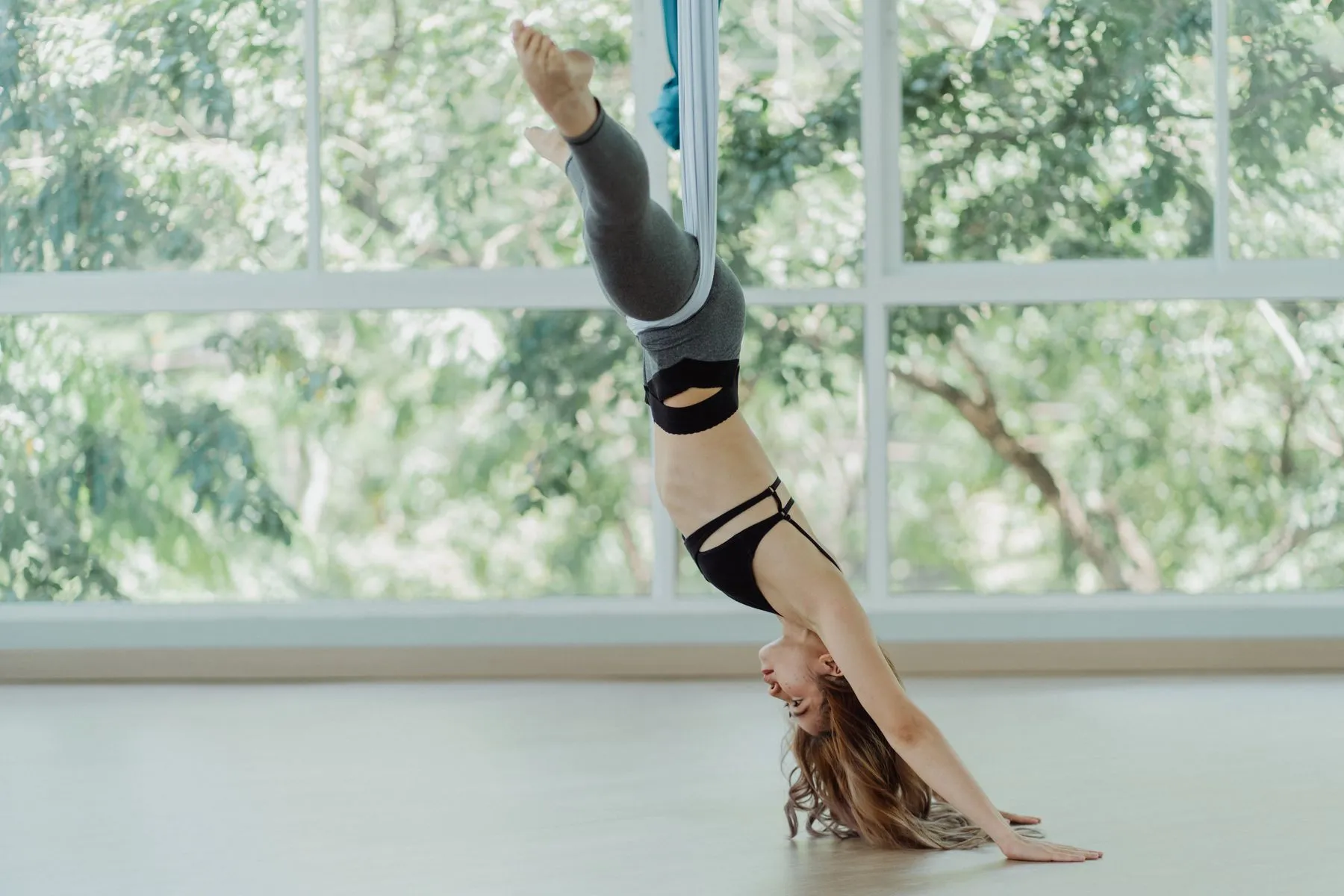
A yoga trapeze is a fabric sling with handles that hangs from a beam, a joist or a freestanding stand. You fold over it at the hips and decide how far to go. There is no lock, so control comes from your own strength.
The mounting sets your limit. Yoga Trapeze rates its freestanding stand at 350 lb of working load, and says that figure accounts for swinging and full inversions (Yoga). Its ceiling hooks are tested to 300 lb per hook, need solid wood joists or poured concrete, never drywall, and a ceiling of at least 94 inches (Yoga). Our yoga trapeze guide covers mounting and safe use.
Tested to 600 lbMaker source
Yoga Trapeze (original)
by Yoga Trapeze
Best for active users with a joist, concrete ceiling or stand who want inversion plus stretching.
Skip it if you want the angle chosen for you, or you have no solid point to hang it from.
The original Yoga Trapeze, sold on Amazon by the brand itself with the same specs as its own site, rather than a generic silk sling. The 600 lb figure is the maker's static test, not a working load.
- Weight limit
- 600 lb
- Price range
- Budget
What we like
- The original Yoga Trapeze, sold on Amazon by the brand itself
- Maker publishes a 600 lb test for the swing
- Hangs from a beam, an exposed joist or a bar
- You choose how far to invert with your body
Keep in mind
- 600 lb is a static test, not a working load
- Ceiling hooks and stand sold separately
- Needs at least 94 in of ceiling height
- Warranty not stated
Full specs
- Price range
- Budget
- Weight capacity
- 600 lb
- Angle control
- No angle control: you choose how far to invert with your body
- Mounting
- Hangs from a beam, exposed joist or bar; ceiling hooks and stand sold separately
- Warranty
- Not stated
Maker sourceFrom the maker's product page. Not stated means the maker publishes nothing.
We may earn a commission. It never changes which table we pick, or the order they appear in.
Teeter DEX II: Forward Inversion From the Hips
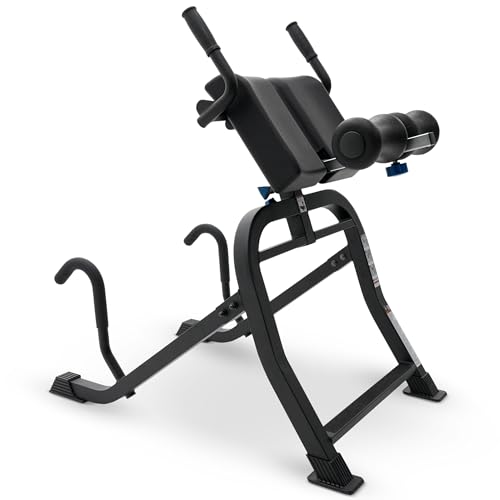
The DEX II is the closest thing to a table that does not hang you by your ankles.
How It Holds You
You stand on the base, lock your thighs between the leg supports and a lap pad, and rotate forward. Teeter says it supports you “from the hips in the bent-knee/bent-hip position,” with “no load on the ankles” (Teeter DEX II product page). It rotates to one fixed stop, so there is no gentle starting angle to choose.
Who It Suits
It is built for people whose ankles, knees or balance make a table uncomfortable, and for heavier users: Teeter rates it for 4 ft 8 in to 6 ft 6 in and up to 350 lb (Teeter DEX II product page). Teeter itself says “Neither position is better for everyone” (Teeter, 2026). The manual also asks new users to have a spotter strong enough to lift them back upright (Teeter DEX II manual).
What It Asks of Your Room
Teeter lists 41.0 x 29.0 inches of floor space (Teeter DEX II product page), about half the length of a table in use. The trade-off is that it does not fold: Teeter describes it as having a “Larger footprint, often left set up as a training station” (Teeter, 2026). Our Teeter DEX II review has the full specs and setup.
Hip-supported, no ankle loadMaker source
by TEETER
Best for people who want to decompress the lower back without hanging by the ankles, up to 350 lb.
Skip it if you want a shallow, adjustable starting angle or a machine that folds away.
If hanging by your ankles is the problem, the DEX II takes the ankles out: it holds you at the hips and thighs with your knees bent, and Teeter rates it to 350 lb, 50 lb more than any FitSpine table.
- Weight limit
- 350 lb
- User height
- 4'8" to 6'6"
- Warranty
- 5 years
- Price range
- Premium
What we like
- Holds you at the hips and thighs, with no load on the ankles
- Rated to 350 lb for users from 4 ft 8 in to 6 ft 6 in
- Doubles as a back extension and ab crunch station
- Five-year full warranty, like the FitSpine tables
Keep in mind
- No angle setting: one forward stop, so no gentle 20° start
- Does not fold; Teeter says it is often left set up
- The manual asks new users for a spotter strong enough to lift them
- No heat or massage
Full specs
- Price range
- Premium
- Weight capacity
- 350 lb
- User height
- 4'8" to 6'6"
- Angle control
- No angle setting: rotates forward to one fixed stop, knees and hips bent at about 90/90
- Ankle system
- None: your thighs lock between the leg supports and the lap pad, with no load on the ankles
- Door and frame fit
- Lap pad height set so your hips line up with its top edge; leg supports snug behind the thighs
- Mounting
- Five steps in the manual, two wrenches and a screwdriver supplied; BILT app instructions
- Use
- Stand on the base, lean forward on the cane handles and rotate until the lap pad reaches its stop, knees bent
- Warranty
- 5 years full (5-year extension sold separately)
- FDA
- Manual states Teeter inversion products are FDA-registered as 510(k) devices (brand-wide, no DEX-specific number)
Maker sourceFrom the maker's product page. Not stated means the maker publishes nothing.
We may earn a commission. It never changes which table we pick, or the order they appear in.
Alternatives That Keep Your Head Up
These options never turn you upside down. That removes the head-down pressure effects, and with them most of the reason a doctor would rule a table out.
Back Stretchers
An arched back stretcher is a curved board you lie on, face up, with the arch under your lower back. Most have several height settings. Nobody has run a trial of these boards in people with back pain that we could find. The nearest measurement is a lab study: ten healthy men lay for ten minutes over an inflatable cushion under the lower spine, and every one of them gained spine height after sitting (Kourtis et al., 2004). That is a similar posture, not the product, and height is not pain. Our guide to the best back stretcher compares the boards. The so-called mini inversion table belongs here too: despite the name, it is a backward bend over a padded roller with your feet on the floor.
Decompression Belts and Traction Benches
A decompression belt is an inflatable band worn around the waist that pushes the ribs and pelvis apart as it fills. In 12 healthy young weight trainers, 20 minutes in a pneumatic belt after heavy lifting restored 4.3 mm of spine height, against 1.8 mm for lying on the back (Cannon et al., 2016). Those were healthy lifters, not patients.
Flat traction benches stretch you with a crank or strap while you lie down; Sunny calls its version “A safer alternative to traditional inversion tables” (Sunny). Note that NICE tells clinicians not to offer belts or corsets for low back pain (NICE, 2016), though it does not single out inflatable decompression belts. Our guide to the best back decompression device covers belts, benches and home traction.
Dead Hang From a Bar
A dead hang is hanging from a pull-up bar by your hands with your feet off the floor, so gravity pulls your spine downward while you stay upright. One spine clinic uses exactly this position for X-rays, to apply “axial traction with the patient’s body weight,” when planning scoliosis surgery in teenagers (Ovali and Us, 2023). That shows the pull is real; it does not show it relieves back pain, and we found no trial that tested that. Your grip sets the session length. Our page on dead hang benefits goes further.
Neck Stretchers, for the Neck Only
If your problem is your neck, a body-weight device is the wrong tool. Neck stretchers and home cervical traction units work on the neck alone. The 2017 neck pain guideline from the American Physical Therapy Association’s orthopaedic section gives a moderate recommendation to mechanical intermittent cervical traction, but only combined with exercise and manual therapy, and only for chronic neck pain that radiates (Blanpied, 2017). A review of seven trials published in 2020 found traction’s added pain relief too small to be clinically meaningful (Colombo, 2020). See our guide to the best neck stretcher.
Inversion Table vs Decompression Table and Physical Therapy
Some readers are really asking whether to skip home devices and see a professional. Here is what each route offers.
What a Clinic Decompression Table Does
On a motorized decompression table you lie flat in a harness while a computer moves part of the table to stretch your spine. One maker says its sensors detect when your muscles resist and ease the pull until they relax, something a gravity table cannot do (Hill). The FDA classifies powered traction equipment as Class II (FDA), one class above the non-powered traction category that covers inversion tables (FDA). That is a regulatory category, not a verdict on results.
What the Trials Found
In a small randomized trial of 48 people with a herniated lumbar disc, a DRX9000 decompression course was “not superior to” conventional motorized traction on pain, function, mood or quality of life (Kocak, 2018). In another small trial of 29 people with a disc herniation and sciatica, inversion and conventional traction were both clinically effective with no significant difference (Güvenol, 2000). Neither trial had an untreated group. Our page on inversion tables for a herniated disc sets the clinic option out in more detail.
Physical Therapy and Exercise
The guidelines lean away from traction of any kind. The UK’s NICE guideline says: “Do not offer traction for managing low back pain with or without sciatica” (NICE, 2016). The American College of Physicians’ 2017 guideline recommends exercise, multidisciplinary rehabilitation, tai chi, yoga and spinal manipulation, among others, for chronic low back pain; traction does not appear in the recommendation lists of its published summary (Qaseem, 2017).
Safety: What Every Alternative Still Shares
Changing the device does not change your body. These risks travel with the position, not the brand.
Head-Down Means Higher Pressure
In a small trial of healthy young women, two minutes of inversion raised both systolic and diastolic blood pressure significantly (Haskvitz, 1986). Five minutes fully inverted roughly doubled eye pressure, from 16.8 to 32.9 mmHg in healthy eyes (Weinreb, 1984). Boots, a trapeze and the DEX II all put your head below your heart. Back stretchers, belts, benches and the dead hang do not.
Whatever Holds You Is the Weak Point
For boots it is the bar and the hooks; for a trapeze, the joist or the stand; for a dead hang, your grip and the bar. Check the rating of every part against your weight before you trust it, and treat any part with no published rating as unknown.
Traction Itself Is Not a Proven Treatment
A Cochrane review published in 2013 pooled 32 trials with 2,762 people and found traction, alone or with other treatment, had little or no impact on pain, function or return to work in low back pain (Wegner, 2013). That covers traction in general, which is what most of these devices deliver. Our page on who should not use an inversion table lists the conditions to clear with a doctor first.
How to Choose the Right Inversion Table Alternative
Match the device to the reason you ruled out a table.
If Space Is the Problem
Gravity boots if you already own a solid bar and handle full inversion well. A yoga trapeze if you have a joist or concrete ceiling at least 94 inches high and like to move. A back stretcher if you only want a lying stretch and can slide it under the bed.
If You Weigh More Than 300 lb
The DEX II, rated to 350 lb, or a flat traction bench rated above your weight. Avoid boots on Teeter’s own rack, which is rated to 250 lb, and check any trapeze hook or bar for a published figure first.
If You Should Not Be Head-Down
Stick to the head-up options: back stretchers, a decompression belt, a traction bench or a dead hang, and ask your doctor about each, because the same conditions can still apply to traction. For a neck problem, a neck stretcher rather than a whole-body device.
If Cost Is the Deciding Factor
Floor back stretchers, belts and doorway bars sit in the budget tier, gravity boots too, as long as you already have a bar to hang them from. The DEX II is a premium machine. We don’t print prices, because they move from week to week.
Your questions, answered
Frequently Asked Questions
What can I use instead of an inversion table?
It depends on why you are skipping the table. If space is the issue, gravity boots or a yoga trapeze take up far less floor. If hanging by your ankles is the issue, the Teeter DEX II holds you at the hips. If you should not be head-down at all, look at floor back stretchers, a decompression belt or a flat traction bench, none of which invert you.
How to mimic an inversion table at home?
You can get the same kind of pull without a table in two ways. One is gravity: hang from a bar by your hands, or by your ankles in gravity boots. The other is a device that stretches you while you lie or stand, such as an arched floor stretcher or an inflatable belt. What none of them copies exactly is a table's lockable angle, and no home method has been shown to treat back pain.
How to hang upside down without an inversion table?
The usual options are gravity boots hooked over a sturdy bar, a yoga trapeze slung from a joist or stand, or a seated inversion chair. Boots are the most direct and the least forgiving, because you go fully head-down at once. Whatever you hang from must be rated above your weight, and a spotter for the first sessions is sensible.
Is a decompression table better than an inversion table?
Not on the evidence available. A clinic table pulls with a motor while you lie flat, and in one small trial of 48 people it did no better than ordinary motorized traction. An inversion table uses your body weight instead, and in a separate small trial it matched conventional traction. Neither trial had an untreated group, so neither shows that either machine beats doing nothing.
How do you decompress your spine without an inversion table?
Take the load off it in a position that keeps your head up. Lying flat is the simplest version, since it takes your upper body's weight off the discs. Devices add a pull, from a dead hang on a bar to an arched floor stretcher or an inflatable belt. Each one changes spine height for a while; none has been shown to fix back pain on its own.
33 sources used for this guide
Each linked to the original. Citations in the text jump here.
View sources
Teeter. FitSpine X3 Inversion Table. teeter.com, product page.
Teeter. What are the height and weight ratings for the Teeter Inversion Table?. teeter.com, Support Center.
Innova. ITX1200 Inversion Table. innovaproductsinc.com, product page.
Teeter. DEX II Commercial Inversion & Core Training System. teeter.com, accessed September 2026.
Sunny Health & Fitness. Traction Reset Table (para Stretch e Decompressao), SF-BH623052. sunnyhealthfitness.com.
Teeter. Are there health issues that would prevent me from inverting?. teeter.com, Support Center (the same list appears in the owner's manual).
Jung SH, Hwang JM, Kim CH. Inversion Table Fall Injury, the Phantom Menace: Three Case Reports on Cervical Spinal Cord Injury. Healthcare (Basel) 2021;9(5):492.
Innova. ITX9600 Heavy Duty Deluxe Inversion Therapy Table, Owner's Manual (version 1709AJJ). Innova Products Inc., owner's manual.
Health Mark, Inc. Core Inversion Chair (SKU IVO18600). healthmarkinc.us, product page.
Vernon H, Meschino J, Naiman J. Inversion therapy: a study of physiological effects. Journal of the Canadian Chiropractic Association 1985;29(3):135-140.
Teeter. Gravity Boots: What They Are, How They Work, and How to Get Started. teeter.com blog, April 17, 2026.
Klatz RM, Goldman RM, Tarr RS, Pinchuk BG. Gravity inversion therapy. The Western Journal of Medicine 1983;139(4):538-540.
Ballantyne BT, Reser MD, Lorenz GW, Smidt GL. The effects of inversion traction on spinal column configuration, heart rate, blood pressure, and perceived discomfort. Journal of Orthopaedic and Sports Physical Therapy 1986;7(5):254-260.
Teeter (Stl International, Inc.). Gravity Boots & Doorway Inversion Systems (ficha de produto). teeter.com/product/gravity-boots/.
Yoga Trapeze. The Swing Stand (Yoga Trapeze Swing Stand). yogatrapeze.com, product page.
Yoga Trapeze. Yoga Trapeze Ceiling Hooks. yogatrapeze.com, product page.
Teeter. Inversion Table vs. DEX II: Recline vs. Forward Inversion. teeter.com blog, June 2026.
Teeter. DEX II Inversion & Core Training System: Assembly & User Guide. Owner's manual, label D12010.
Kourtis D, Magnusson ML, Smith F, Hadjipavlou A, Pope MH. Spine height and disc height changes as the effect of hyperextension using stadiometry and MRI. Iowa Orthopaedic Journal 2004;24:65-71.
Cannon J, Emond D, McGill SM. Evidence on the Ability of a Pneumatic Decompression Belt to Restore Spinal Height Following an Acute Bout of Exercise. Journal of Manipulative and Physiological Therapeutics 2016;39(4):304-310.
National Institute for Health and Care Excellence (NICE). Low back pain and sciatica in over 16s: assessment and management, Recommendations. NICE guideline NG59, published 30 November 2016, last updated 29 July 2026.
Ovali SA, Us AK. Comparison of traction, side-bending and dead-hang radiographs in preoperative evaluation and postoperative correction prediction in adolescent idiopathic scoliosis: A retrospective analysis of a novel flexibility radiograph. Medicine (Baltimore) 2023;102(50):e36461.
Blanpied PR, Gross AR, Elliott JM, Devaney LL, Clewley D, Walton DM, Sparks C, Robertson EK. Neck Pain: Revision 2017. Journal of Orthopaedic & Sports Physical Therapy 2017;47(7):A1-A83 (APTA Orthopaedic Section clinical practice guideline).
Colombo C, Salvioli S, Gianola S, Castellini G, Testa M. Traction Therapy for Cervical Radicular Syndrome is Statistically Significant but not Clinically Relevant for Pain Relief. A Systematic Literature Review with Meta-Analysis and Trial Sequential Analysis. Journal of Clinical Medicine 2020;9(11):E3389.
Hill DT Solutions LLC. What Is a Spinal Decompression Table?. hilldtsolutions.com/spinal-decompression-table-info.
FDA. Device classification, product code ITH: Equipment, Traction, Powered. U.S. Food and Drug Administration, device classification database (openFDA), 21 CFR 890.5900.
FDA. Device classification, product code HST: Apparatus, Traction, Non-Powered. U.S. Food and Drug Administration, device classification database (openFDA), 21 CFR 888.5850.
Kocak FA, Tunc H, Tomruk Sutbeyaz S, Akkus S, Koseoglu BF, Yilmaz E. Comparison of the short-term effects of the conventional motorized traction with non-surgical spinal decompression performed with a DRX9000 device on pain, functionality, depression, and quality of life in patients with low back pain associated with lumbar disc herniation: A single-blind randomized-controlled trial. Turkish Journal of Physical Medicine and Rehabilitation 2018;64(1):17-27.
Güvenol K, Tüzün C, Peker Ö, Göktay Y. A comparison of inverted spinal traction and conventional traction in the treatment of lumbar disc herniations. Physiotherapy Theory and Practice 2000;16(3):151-160.
Qaseem A, Wilt TJ, McLean RM, Forciea MA, Clinical Guidelines Committee of the American College of Physicians, et al. Noninvasive Treatments for Acute, Subacute, and Chronic Low Back Pain: A Clinical Practice Guideline From the American College of Physicians. Annals of Internal Medicine 2017;166(7):514-530.
Haskvitz EM, Hanten WP. Blood pressure response to inversion traction. Physical Therapy 1986;66(9):1361-1364.
Weinreb RN, Cook J, Friberg TR. Effect of inverted body position on intraocular pressure. American Journal of Ophthalmology 1984;98(6):784-787.
Wegner I, Widyahening IS, van Tulder MW et al. Traction for low-back pain with or without sciatica. Cochrane Database of Systematic Reviews 2013, CD003010.