Health guide
How Long Can You Hang Upside Down? What Happens to Your Body, Minute by Minute
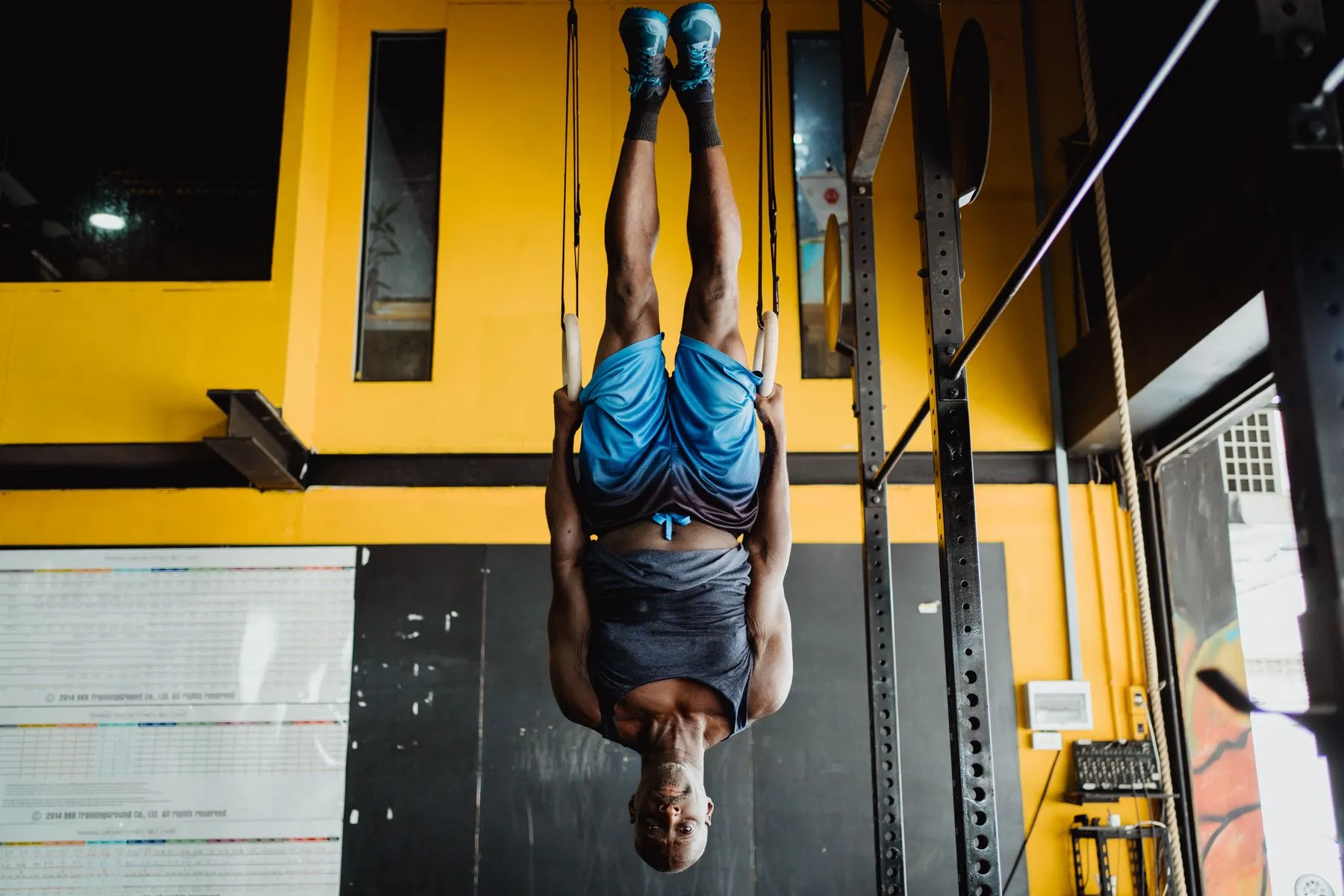
How long can you hang upside down? It depends on what “hang” means: a few minutes at 60 degrees on a table is a different thing from full inversion in gravity boots, and both are different from being trapped upside down after an accident. We have not hung anyone upside down. What follows is our reading of the studies that timed people inverted, the forensic reports on people who died head down, and what Teeter and Innova publish about duration. Where a number comes from a small study, a single case or an animal experiment, we say so.
What Happens to Your Body When You Hang Upside Down
Turning over reverses the pull of gravity on your blood. Instead of pooling in your legs, it shifts toward your head and chest, and the body has to deal with that load for as long as you stay there.
Blood Pressure Climbs Within Seconds
In 1983, Klatz and colleagues hung 20 healthy volunteers fully upside down in gravity boots for three minutes. Blood pressure went from 119/74 seated to 157/93 inverted, and the pressure in the artery feeding the retina rose from 45/26 to 105/62 (Klatz et al., 1983). A larger trial in 60 healthy young women found that just two minutes of inversion significantly raised both systolic and diastolic pressure compared with standing (Haskvitz, 1986).
The Rise Holds for as Long as You Stay Down
The effect doesn’t fade as your body “gets used to it.” In 18 healthy adults inverted for seven minutes, on a frame and in gravity boots, heart rate fell and blood pressure rose by an average of 20 mmHg, and that pattern held throughout the inversion (Ballantyne, 1986). The subjects also found the frame, which supports the back, more tolerable than hanging from boots.
Eye Pressure Roughly Doubles
The eyes react even more. After five minutes fully inverted, eye pressure went from 16.8 to 32.9 mmHg in healthy eyes and from 21.3 to 37.6 mmHg in eyes with glaucoma (Weinreb, 1984). In a yoga headstand, the doubling was maintained for as long as the pose was held (Baskaran, 2006). Ophthalmologist Thomas Friberg reported that his group measured weaker visual signals from eye to brain and visual field defects in normal subjects during inversion, changes that disappeared on returning upright (Friberg, 1985). Klatz’s group also noted reports of pinpoint bleeding around the eyes from gravity boots (Klatz et al., 1983).
The Brain and the Spine
At three minutes on an actual inversion table, a 2019 ultrasound study found significant changes in blood flow to the brain and in a marker of pressure inside the skull, and its authors concluded inversion “should be used with caution” (Kondrashova, 2019). Lower down, the spine does lengthen: X-rays of 15 healthy men after 10 minutes of full inversion showed more space between the lumbar vertebrae at every level measured (Kane, 1985). That stretch is the point of inversion, and it fades once you are upright again.
A Realistic Answer for Each Situation
The honest answer to “how long can you hang upside down” changes with how you are hanging. The sections after this one give the evidence behind each line.
On an Inversion Table
This is the most forgiving setup: your back is supported, you choose the angle, and you can come back up by moving your arms. Teeter tells users to begin with 1 to 2 minutes and, over time, work up to 3 to 5 minutes or as long as it takes for the muscles to relax (Teeter, 2014). Teeter also says frequency matters more than duration, so a longer session is not the goal. Effects are smaller at a partial angle but not absent: two minutes in Downward Dog, a much shallower position, raised eye pressure from about 17 to 28 mmHg in people with glaucoma (Jasien, 2015).
Full inversion is where the doubling of eye pressure and the 20 mmHg blood pressure rise were measured, so keep those sessions short. Friberg wrote that the eye risk “can probably be reduced” by keeping inversion to 10 or 15 minute intervals (Friberg, 1985), but that was an upper bound from 1985, not a target, and he called long-term damage uncertain rather than ruled out. How long to use a table day to day, and how often, is in our guide on how to use an inversion table.
With Gravity Boots
Boots change the question, because there is no backrest and no stop at 30 or 60 degrees. Teeter’s own comparison says boots place you “in full inversion” from the start (Teeter, 2026). For new users, Teeter advises a shorter session, someone nearby for the first few, and a pause halfway on the way back up to reduce lightheadedness. It gives no number of minutes. Teeter also suggests its boots for people who enjoy full inversion for periods longer than five minutes (Teeter, 2014). That is a sales line for an accessory: it shows the maker expects some users to go past five minutes, not that those sessions are safe. Which boots publish real specs is on our gravity boots guide.
On a Bar or Bed
An aerial yoga swing or trapeze puts you upside down without ankle clamps, supported at the hips, and the same pressure changes apply; our yoga trapeze page covers the setup. A dead hang from a pull-up bar is the opposite: you hang right side up by your hands, with none of the head-down effects. What a dead hang does for the shoulders and spine is on our page about dead hang benefits.
Letting your head and shoulders drop off the edge of a bed is also a head-down position, but with no angle control and no ankle hold to release. We have no timed data on it, so there is no number to give. Treat it as unsupervised inversion and keep it brief. For what hanging upside down is claimed to do, and what is actually backed, see hanging upside down benefits.
Stuck Upside Down by Accident
If someone is trapped head down, treat it as an emergency, not a question of minutes. The rabbit experiment and the forensic cases below suggest death usually takes hours, but the farmer in the sprayer tank was dead within two, and age, alcohol, injury, obesity or heart disease all shorten the margin (Chaudhari, 2016). Getting the person down, and keeping their airway clear, matters more than any number.
How Long Can You Hang Upside Down Before It Becomes Dangerous?
There is no single number, because nobody has run the experiment that would give one. Here is what has actually been measured, from minutes to hours.
Minutes: What the Studies Timed
| What was timed | Position | Time | What happened |
|---|---|---|---|
| 60 young women | Inversion traction | 2 min | Blood pressure up significantly (Haskvitz, 1986) |
| 20 healthy volunteers | Gravity boots, full | 3 min | BP 119/74 to 157/93, eye pressure 19 to 35 mmHg (Klatz et al., 1983) |
| Healthy and glaucoma eyes | Full inversion | 5 min | Eye pressure about doubled (Weinreb, 1984) |
| 18 healthy adults | Frame and boots | 7 min | BP up about 20 mmHg throughout (Ballantyne, 1986) |
| 15 healthy men | Full inversion | 10 min | Lumbar spaces wider on X-ray (Kane, 1985) |
| Oscillating inversion | Rocking | 5 to 15 min | Eye pressure 17 to 33, 32 and 31 mmHg (Friberg, 1985) |
Two things stand out. Every one of these sessions was 15 minutes or less, and every subject was healthy and supervised. None of them tells you a safe ceiling; they tell you what the body does inside that window.
Hours: What Surgery Shows at a Partial Angle
The best data on long head-down periods come from the operating room. In robotic prostate surgery, patients are tilted head down for hours. In one study, patients held at 23 degrees for up to five hours saw eye pressure climb with time, from 18.9 mmHg at the start to about 24 mmHg at hours four and five; by the fifth hour, a quarter of eyes were at 30 mmHg or more, with a maximum of 36 (Hoshikawa, 2014). Pressure fell once they were laid flat, and a month later vision was unchanged with no complications. Those patients were anesthetized, which lowers eye pressure, and tilted far less than full inversion, so this is a floor, not a model of hanging upside down. The authors themselves note that pressure would change much more at a steeper angle.
Many Hours: Where the Forensic Literature Begins
Beyond surgery, the only data on very long periods upside down come from autopsies. A forensic review published in 2005 describes such deaths as rare and mostly accidental, and notes that “the prolonged head-down position itself may lead to fatal outcome” (Schafer, 2005). In an experiment on 14 rabbits hung head down, all died within 17 to 44 hours, an average of 26, as their breathing weakened (Uchigasaki, 1999). Rabbits are not people, and those hours are not a human limit. What the experiment does show is that, without other factors, death in this position is a matter of hours, not minutes.
Why There Is No Safe Maximum
Three gaps explain the missing number. No study has timed awake, healthy people fully inverted for more than about 15 minutes. The forensic cases record when someone was found, not when they died. And the people who die head down are rarely healthy adults who chose to be there. So when you read “you can survive X hours upside down” elsewhere, ask where X came from.
How People Actually Die Upside Down
This is the part of the question most people are really asking. The cases are rare, but they are documented, and they share a pattern.
Heart Failure From the Extra Load
The review of 10 head-down deaths found that elderly people, especially those with existing heart disease, seemed most prone, and concluded that the usual end point is heart failure: a prolonged, markedly higher workload on the heart from the extra volume of blood in an inverted body (Schafer, 2005). Japanese pathologists reporting a 74-year-old man found dead head down reached a similar view, that the posture raises cardiac output and systemic and intracranial pressure while suppressing breathing (Yoshida, 1995). Bodies typically show “monstrous” congestion of the face, scalp and neck, swelling of the brain and lungs, and sometimes no clear anatomical cause at all (Madea, 1993).
Breathing Under the Weight of the Organs
Other forensic teams put more weight on breathing. In five drivers left hanging upside down by their lap belts after rollover crashes, four died of positional asphyxia; the authors proposed that the abdominal organs pressed on the diaphragm while a bent neck narrowed the airway (O'Donovan, 2021). An 83-year-old farmer stuck head down in the opening of a sprayer tank was found dead when rescuers arrived two hours later, from positional asphyxia with abdominal compression (D'Elia, 2025). A German case of a man suspended head down in a sack was attributed to both chest compression and too little blood returning to the heart (Madea, 1990).
The Common Thread: Not Being Able to Get Down
The cases differ in mechanism but agree on one thing: the person could not get out. A deer hunter died of positional asphyxia hanging upside down from a tree stand (Shields, 2011). A 64-year-old man who fell down a narrow staircase died wedged head down, because alcohol and a neck fracture left him unable to free himself (Doberentz, 2012). A 78-year-old man was found hanging by one leg in a blackberry bush two days after he was last seen, with a blood alcohol of 2.10 g/l and a BMI of 33.4 (De, 2008). Forensic authors list intoxication, drugs, obesity, psychiatric illness and injury as the factors that turn a head-down position into a fatal one (Chaudhari, 2016).
What the Manufacturers Say About Duration
The two biggest table makers publish similar starting advice, and neither publishes a ceiling.
Teeter: Start at 1 to 2 Minutes, No Fixed Maximum
Teeter tells users to begin with 1 to 2 minutes per session and, over time, “work up to 3-5 minutes or as long as it takes” for the muscles to relax (Teeter, 2014). It also says “there is no predetermined time limit” and that you should listen to your body. In the same article, Teeter suggests its gravity boots as an add-on for people who enjoy “full inversion for periods longer than five minutes,” so the maker plainly expects some users to go past five.
Innova: Start Short, With Someone Nearby
Innova’s FAQ says “most people start with 1-2 minutes per session” and adds minutes slowly, noting that frequency matters more than duration (Innova). The ITX9600 manual recommends that “someone be with you during inversion” to spot you (Innova). A spotter is also the simplest protection against the one scenario the forensic literature warns about: being unable to get back up.
For the step-by-step routine (angle, session length and how often), see our guide on how to use an inversion table.
Safety: Who Should Keep It Short or Skip It
For most healthy adults, a few minutes upside down produces temporary changes that reverse. For some people, the same changes are the problem.
Is Hanging Upside Down Good for You?
It can feel good, and gravity does stretch the spine for as long as you hang. Whether it relieves pain over time is far less certain: the trials are small and mixed, and a Cochrane team that pooled traction trials found little or no effect on low back pain. We go through the evidence, including what inversion can and can’t do, on our page about inversion table benefits. If inversion isn’t for you, our page on inversion table alternatives covers other ways to take load off the spine.
Who Should Not Hang Upside Down
Teeter tells users not to invert without a physician’s approval if they have high blood pressure, heart or circulatory disease, glaucoma, retinal detachment, osteoporosis, a hernia, pregnancy or take blood thinners, among other conditions (Teeter). Time adds to the eye risk: one published case describes a 67-year-old man with high blood pressure, heart failure and glaucoma who developed retinal detachments in both eyes after using an inversion table several times a month, for several minutes at a time, over seven years (Lerebours, 2017). It is a single case, but it is the kind of cumulative exposure the minute-long studies can’t capture. Each condition and its evidence is on our page about who should not use an inversion table, and the full list of reported problems is in our guide to inversion table side effects.
Signs It’s Time to Come Down
Come back up slowly, and stop the session if you feel a pounding headache, see blurred or dimmed vision, feel dizzy or short of breath, or notice pain that is getting worse. The authors of the fall report suggest keeping table sessions under one minute and resting at least 1.5 minutes between them (Jung, 2021), because tired ankles are what let go. If symptoms persist after you are upright, talk to your doctor.
Your questions, answered
Frequently Asked Questions
Is hanging upside down for 30 minutes bad?
Thirty minutes is far beyond what either big table maker suggests or what the classic studies timed: the longest inversion in that research ran 15 minutes. Blood pressure and eye pressure stay raised for as long as you stay down. Half an hour fully inverted is something to clear with your doctor first, with a spotter in the room.
What happens if you hang upside down for 3 hours?
Nobody has timed healthy, awake people fully inverted for three hours, so there is no measured answer. The closest data are surgical patients tilted 23 degrees for up to five hours, whose eye pressure kept climbing, and forensic cases of people trapped head down who died within hours, usually with age, alcohol, heart disease or injury involved.
Can you hang upside down for 10 minutes?
Yes, healthy volunteers have done it in research: 15 men were fully inverted for 10 minutes in a 1985 X-ray study. That doesn't make 10 minutes a goal. Teeter and Innova both start people at one to two minutes, and anyone with high blood pressure, glaucoma or a heart condition should get a doctor's approval before any session.
Is it healthy to hang upside down every day?
Nobody has run a long-term study of daily inversion, so no one can say it is healthy. Teeter recommends inverting several times a day, but that is the maker's advice. Each session briefly raises blood pressure and eye pressure, which most healthy people tolerate, and one published case linked years of table use to detached retinas in a man with eye disease.
Why shouldn't you hang upside down?
You shouldn't if a rise in blood pressure, eye pressure or pressure inside the skull could harm you. Teeter and Innova list high blood pressure, heart disease, glaucoma, retinal detachment, pregnancy and blood thinners, among others. Falls are the second risk, because a failed ankle hold drops you onto your head. And never invert where you could get stuck.
29 sources used for this guide
Each linked to the original. Citations in the text jump here.
View sources
Klatz RM, Goldman RM, Tarr RS, Pinchuk BG. Gravity inversion therapy. The Western Journal of Medicine 1983;139(4):538-540.
Haskvitz EM, Hanten WP. Blood pressure response to inversion traction. Physical Therapy 1986;66(9):1361-1364.
Ballantyne BT, Reser MD, Lorenz GW, Smidt GL. The effects of inversion traction on spinal column configuration, heart rate, blood pressure, and perceived discomfort. Journal of Orthopaedic and Sports Physical Therapy 1986;7(5):254-260.
Weinreb RN, Cook J, Friberg TR. Effect of inverted body position on intraocular pressure. American Journal of Ophthalmology 1984;98(6):784-787.
Baskaran M, Raman K, Ramani KK, Roy J, Vijaya L, Badrinath SS. Intraocular pressure changes and ocular biometry during Sirsasana (headstand posture) in yoga practitioners. Ophthalmology 2006;113(8):1327-1332.
Friberg TR. Ocular effects of gravity inversion. The Western Journal of Medicine 1985;143(4):530-531.
Kondrashova T, Makar M, Proctor C, Bridgmon KA, Pazdernik V. Dynamic assessment of cerebral blood flow and intracranial pressure during inversion table tilt using ultrasonography. Journal of the Neurological Sciences 2019;404:150-156.
Kane MD, Karl RD, Swain JH. Effects of gravity-facilitated traction on intervertebral dimensions of the lumbar spine. Journal of Orthopaedic and Sports Physical Therapy 1985;6(5):281-288.
Hoshikawa Y, Tsutsumi N, Ohkoshi K, Serizawa S, Hamada M, Inagaki K et al. The effect of steep Trendelenburg positioning on intraocular pressure and visual function during robotic-assisted radical prostatectomy. British Journal of Ophthalmology 2014;98(3):305-308.
Schafer AT. Death in a Head-Down Position. In: Tsokos M (ed.), Forensic Pathology Reviews, vol 3. Humana Press 2005:137-154.
Uchigasaki S, Takahashi H, Suzuki T. An experimental study of death in a reverse suspension. American Journal of Forensic Medicine and Pathology 1999;20(2):116-119.
Yoshida K, Harada K, Sorimachi Y, Makisumi T. Death in head-down position: an autopsy report with reference to physiological mechanism. Japanese Journal of Legal Medicine 1995;49(1):33-36.
Madea B. Death in a head-down position. Forensic Science International 1993;61(2-3):119-132.
O'Donovan S, Langlois NE, Heuvel CVD, Byard RW. Lethal mechanisms in cases of inverted suspension from the lap component of seat belts. Medicine, Science and the Law 2021;61(3):227-231.
D'Elia F, Da Broi U, Simonit F, Cappelli A, Cividino S, Zaninelli M, Tse R, Garland J, Ondruschka B, Desinan L. Fatal Asphyxia in the Head-down Position: An Uncommon Case of Accidental Work-related Death. American Journal of Forensic Medicine and Pathology 2025;46(4):348-352.
Madea B, Henssge C, Esser W. Death in inverted head position (article in German, English abstract). Archiv fur Kriminologie 1990;186(3-4):65-74.
Shields LB, Stewart D. Deer stand fatalities in Kentucky: two cases of reverse suspension and blunt force trauma. American Journal of Forensic Medicine and Pathology 2011;32(1):39-43.
Doberentz E, Madea B. Positional asphyxia: death in a head-down position after falling down stairs (article in German, English abstract). Archiv fur Kriminologie 2012;230(3-4):128-136.
De Donno A, De Fazio A, Greco MG, Introna F, Maglietta RA. Death in head-down position in a heavily intoxicated obese man. Legal Medicine (Tokyo) 2008;10(4):204-209.
Chaudhari VA, Ghodake DG, Kharat RD. Positional Asphyxia: Death Due to Unusual Head-Down Position in a Narrow Space. American Journal of Forensic Medicine and Pathology 2016;37(2):51-53.
Jung SH, Hwang JM, Kim CH. Inversion Table Fall Injury, the Phantom Menace: Three Case Reports on Cervical Spinal Cord Injury. Healthcare (Basel) 2021;9(5):492.
Kassay A, Soliman MAR, Jhawar BS. Recommendations for inversion table therapy. Disability and Rehabilitation 2023;45(22):3779-3782.
Teeter. FAQ: Invert How Long And How Often?. teeter.com blog, 2014 (updated 2025).
Innova. Frequently Asked Questions. innovaproductsinc.com/faq/.
Innova. ITX9600 Heavy Duty Deluxe Inversion Therapy Table, Owner's Manual (version 1709AJJ). Innova Products Inc., owner's manual.
Teeter. Gravity Boots: What They Are, How They Work, and How to Get Started. teeter.com blog, April 17, 2026.
Jasien JV, Jonas JB, de Moraes CG, Ritch R. Intraocular Pressure Rise in Subjects with and without Glaucoma during Four Common Yoga Positions. PLoS One 2015.
Teeter. Are there health issues that would prevent me from inverting?. teeter.com, Support Center (the same list appears in the owner's manual).
Lerebours VC, Rohl AJ, Shaikh S. Bilateral Retinal Detachments Associated with Inversion Table Therapy. Cureus 2017;9(3):e1098.