Health guide
Hanging Upside Down Benefits: What Studies Measured and What They Didn't
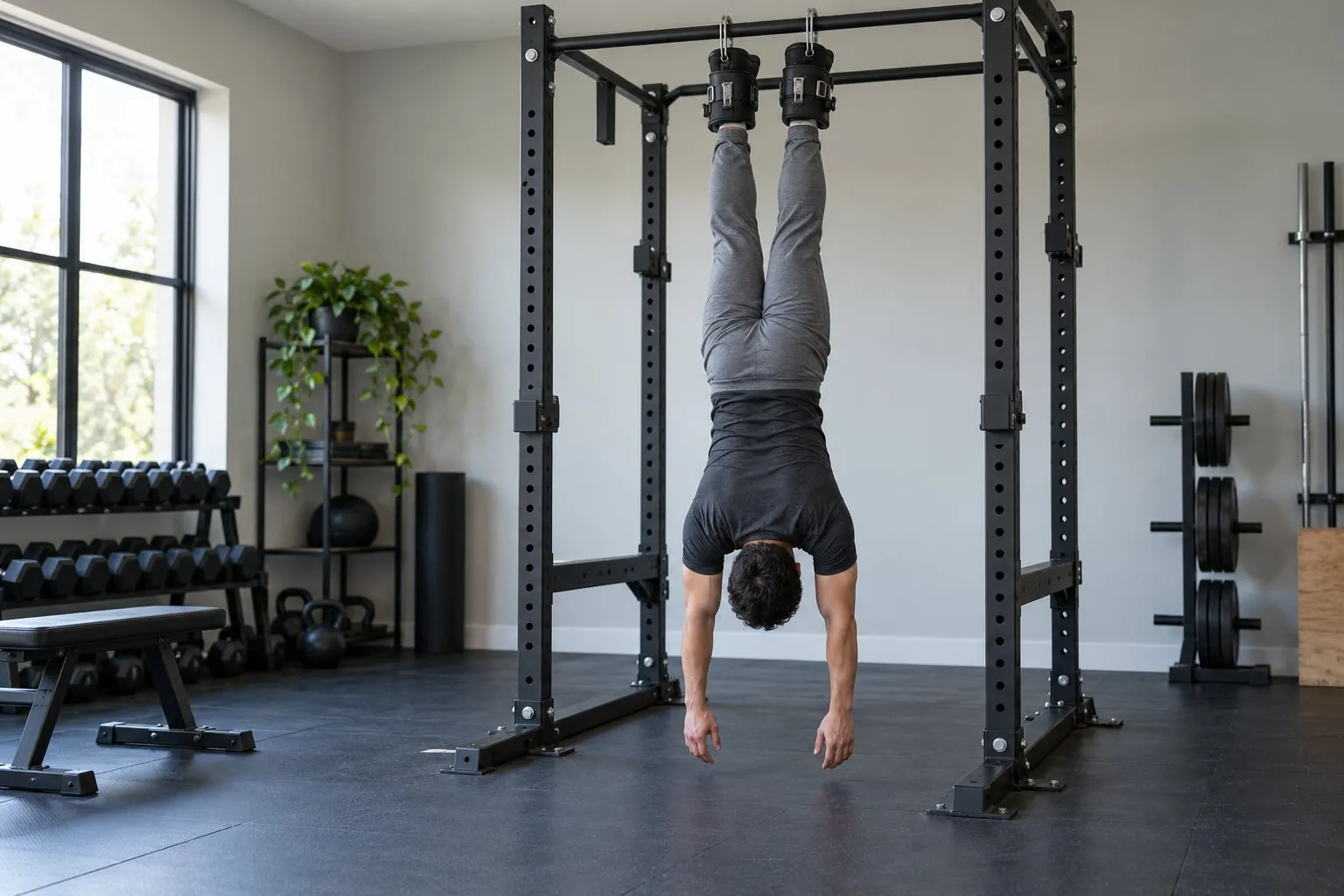
Hanging upside down benefits are easy to find on social media and hard to find in journals. This page goes through the popular claims one at a time and says, for each, what a named study measured, who was in it, and where the evidence stops. We have not hung anyone upside down ourselves. What follows is our reading of the published research, and nothing here is a promise that inversion will help you.
Hanging Upside Down Benefits, Claim by Claim
The benefits of hanging upside down that have been tested are mostly about the spine and muscles, and the studies are small, short, and done on healthy volunteers. That is useful for understanding what happens in the body. It is not proof of treatment.
Does It Lengthen Your Spine?
This is the best-supported claim, and it is a mechanical one. In 1978, Nosse had 20 healthy men lie on a motorized tilt table and found that one minute of inversion significantly increased spinal length, measured with a tape from sitting to inverted (Nosse, 1978). In 1986, a team led by Ballantyne suspended 18 healthy adults aged 22 to 31 for seven minutes and measured the spine with a computerized posture method. Distance between the lowest lumbar level and the sacrum increased and the thoracolumbar curves became shallower. The spine lengthened on a frame that supports the body, but not in gravity boots (Ballantyne, 1986).
Both are short-term findings in healthy people. They show that gravity can pull the spine longer for as long as you hang. They do not show that the lengthening lasts, or that it helps anything.
Does It Relax Your Muscles?
The evidence is split. In 1985, deVries and Cailliet tested 12 healthy people who had been screened for above-normal resting muscle tension. Two minutes of inversion cut resting neuromuscular tension by 28.3 percent, against 7.1 percent after resting for the same time (deVries, 1985). Nosse’s earlier study also found lower electrical activity in the lower back muscles during inversion.
A 2016 study from Korea found the opposite. In 60 healthy men, electrical activity in the lumbar erector spinae was higher after six minutes of inversion than before, and the authors concluded inversion is more likely to raise muscle tension and prevent relaxation (Kim, 2016). The two used different angles, times, samples and measurement moments, so they are not a clean contradiction. The honest summary is that nobody can say whether hanging upside down relaxes your back muscles.
Is It Good for Back Pain?
Here the evidence is thinner than the marketing. A small trial in 47 women with chronic low back pain reported that eight weeks of inversion at 60 degrees reduced pain and improved lumbar flexibility and trunk strength (Kim, 2013). It is a small, women-only trial in a niche journal, and we found no repeat of it, so treat it as a lead and not a verdict.
The larger picture is less encouraging. A Cochrane review published in 2013 pooled 32 trials with 2,762 people and found that traction, alone or with other treatment, has little or no impact on pain, function or return to work in low back pain (Wegner, 2013). That review covers traction in general, manual and machine, not inversion tables specifically. It also noted that seven of the 32 trials reported adverse effects, including more pain and aggravated neurological signs. If back pain is why you are here, the table-based version of this question is covered in our inversion table benefits guide, and our overview of inversion therapy sets out how the traction is supposed to work.
Does It Improve Circulation?
This is the claim people repeat most, and the one with the least support. In a 2019 ultrasound study on an actual inversion table, tilting into inversion produced significant changes in optic nerve sheath diameter (a marker of pressure inside the skull) and in blood flow through the carotid and middle cerebral arteries (Kondrashova, 2019). The authors did not call that a benefit. They concluded that inversion therapy “should be used with caution,” especially for people with a history of raised pressure inside the skull.
A change in blood flow is not an improvement in blood flow. Nothing in that study supports “better circulation” or “more oxygen to the brain.”
The Claims With No Evidence
Several of the most searched benefits of hanging upside down have never, as far as we could find, been put to a test. Not having evidence is not the same as proof of harm. It means that anyone promising these effects is guessing.
Is Hanging Upside Down Good for Your Face?
We found no study that measured skin, facial appearance or wrinkles in people who hang upside down. The idea is that blood flowing toward the head must nourish the face, and that is all the claim has going for it. No measurement shows fewer wrinkles, firmer skin or a better complexion afterward. The only head and face findings we could source are less flattering: Klatz and colleagues noted in 1983 that there had been reports of pinpoint bleeding around the eyes (periorbital petechiae) from hanging in gravity boots, and that research on the fully head-down position was sparse (Klatz et al., 1983). They gave no numbers for those reports. If you want to change how your face looks, a dermatologist is a better source than a gravity trick.
Hair Growth
We found no study that measured hair growth or scalp health after hanging upside down. The popular explanation, more blood to the scalp, borrows from the circulation claim above, which itself has no benefit shown. If you are losing hair, a clinician can check for causes that inversion would not touch.
Lymph, Detox and Cortisol
We found no primary study that measured lymph flow, “detox,” or cortisol in people who hang upside down. The studies that turn up for cortisol are about cortisol in general, not inversion. These words appear on wellness pages because they sound plausible, not because anyone measured them.
What Happens to Your Body Upside Down
Turn upside down and gravity shifts blood toward your head and chest. Your body responds within seconds, and the responses are the best-measured part of this topic.
Blood Pressure Rises
Haskvitz and Hanten randomly assigned 60 women aged 20 to 30 to two minutes of inversion or two minutes of standing. Systolic and diastolic blood pressure rose significantly in the inverted group. The authors wrote that this means caution is needed and that people with hypertension may need to avoid it (Haskvitz, 1986). In Ballantyne’s seven-minute study, heart rate fell while blood pressure rose by an average of 20 mmHg, and that pattern held throughout the session (Ballantyne, 1986).
Eye Pressure Climbs
Weinreb and colleagues measured eye pressure after five minutes fully inverted. It went from 16.8 to 32.9 mmHg in healthy eyes and from 21.3 to 37.6 mmHg in eyes with glaucoma. The visual fields did not change, but the authors recommended that people with ocular hypertension or glaucoma refrain from the activity (Weinreb, 1984).
Time matters too. In a 2014 study of anesthetized surgical patients tilted only 23 degrees head down for up to five hours, eye pressure kept rising, from 18.9 mmHg at the start to about 24 mmHg in hours four and five, and fell back when the patients were laid flat. Visual function a month later was unchanged (Hoshikawa, 2014). Those were anesthetized patients, not awake people on a table, so the study shows that duration counts, not a safe limit.
Ophthalmologist Thomas Friberg wrote in 1985 that it remained uncertain whether healthy people who invert for short daily sessions over years would suffer permanent eye damage (Friberg, 1985). The sources we reviewed for this page do not settle it.
How Long Is Too Long?
No one has set a safe maximum for awake adults. We break down the timing studies, the maker guidance and the forensic cases in how long you can hang upside down.
Ways to Hang Upside Down at Home
If you decide to try it after reading the risks, the method matters. None of these is shown to be better for health. They differ in how much support they give you and how likely you are to fall.
Inversion Table
A table holds your ankles and tilts you on a pivot, so you can choose the angle. A 2021 case series from South Korea described three people with cervical spinal cord injuries after falling from inversion tables, and the authors noted that falls of just one or two feet can land you on the top of your head (Jung, 2021). They recommended keeping sessions under one minute, an angled pillow or ramp under the head, and extra care for older or heavier users. That is the authors’ advice, not a clinical consensus, and it came from only three cases, so it says nothing about how common such falls are.
Gravity Boots and Bars
Boots hook your ankles over a bar so you hang fully inverted. In Ballantyne’s study, the supported frame lengthened the spine and the boots did not, and subjects found the frame more tolerable (Ballantyne, 1986). Boots also put you fully head-down, which is the position Klatz noted had little research behind it. Our gravity boots guide covers how they work and what to check before buying.
Inversion Chair or Yoga Trapeze
An inversion chair lets you tilt back while seated (see our inversion chairs roundup). A yoga trapeze is a fabric sling hung from a frame or ceiling anchor, where you control the depth of the inversion with your hands. See the yoga trapeze page for details. We found no inversion-specific trials of either, so the evidence above applies only loosely.
Hanging Off the Edge of a Bed
Letting your head and shoulders hang off the edge of a bed is a partial inversion at best. We found no study of it. It raises the same question as any head-down position, which is how much your blood pressure and eye pressure rise, and the bed edge gives you no support, no way to adjust the angle, and no easy way out if you feel faint. We would not recommend it.
Safety Basics for Any Method
- Check the equipment, the anchor point and the weight rating before every use.
- Start with a very short session. The only fall-prevention advice we found put the limit under one minute.
- Have another person in the room the first few times.
- Come back up slowly and sit for a moment before standing.
- Stop if you feel pressure in your head or eyes, a headache, dizziness or numbness.
Who Should Not Hang Upside Down
What the Manufacturer’s List Says
Teeter’s own list tells users not to invert until a licensed physician approves if they have high blood pressure, heart or circulatory conditions, glaucoma, a history of retinal detachment, a history of intracranial bleeding or stroke risk, anticoagulant use, osteoporosis, hernias, pregnancy or recent surgery, among others (Teeter). That is the manufacturer’s list, written with legal and clinical caution, so not every item is a proven contraindication. But every item on it connects to what the studies above measured: higher blood pressure, higher eye pressure, or mechanical stress on a weak spot.
If You Are on the List
Our full list, with the evidence behind each item, is in who should not use an inversion table. If you have a diagnosed condition, talk to your clinician before you invert.
What to Take From the Research
What Is Measured
The benefits of hanging upside down that studies have actually measured are modest: a temporary lengthening of the spine and, possibly, a change in muscle tension that one study found and another contradicted. The effects with the clearest data are the ones to respect: higher blood pressure and higher eye pressure. For back pain, the best available review of traction found little or no difference, and no large trial exists for inversion itself.
If You Try It Anyway
Keep it short, keep it supported, and keep your clinician in the loop if you have any condition on the lists above.
Your questions, answered
Frequently Asked Questions
Is hanging upside down good for a bad back?
Nobody can promise that. Small studies in healthy people show your spine lengthens while you hang, but a Cochrane review of traction trials found little or no difference to back pain overall. If you already have back pain, ask your clinician before you invert, because some trials of traction also reported more pain.
What happens when you hang upside down for 5 minutes?
Your blood pressure and eye pressure rise and your heart rate slows. In one study, five minutes fully inverted took eye pressure from 16.8 to 32.9 mmHg in healthy eyes. Your spine also lengthens slightly. In the studies, these rises held while people stayed inverted and reversed afterward.
How long can an average person hang upside down?
Studies of healthy volunteers timed sessions of one to a few minutes, with the longest around 15 minutes. No study has set a maximum for awake people, so there is no proven safe limit. People with heart, blood pressure or eye conditions should not invert without medical approval.
14 sources used for this guide
Each linked to the original. Citations in the text jump here.
View sources
Nosse LJ. Inverted spinal traction. Archives of Physical Medicine and Rehabilitation 1978;59(8):367-370.
Ballantyne BT, Reser MD, Lorenz GW, Smidt GL. The effects of inversion traction on spinal column configuration, heart rate, blood pressure, and perceived discomfort. Journal of Orthopaedic and Sports Physical Therapy 1986;7(5):254-260.
deVries HA, Cailliet R. Vagotonic effect of inversion therapy upon resting neuromuscular tension. American Journal of Physical Medicine 1985;64(3):119-129.
Kim CY, Kang JH. Analysis of electromyographic activities of the lumbar erector spinae caused by inversion traction. Journal of Physical Therapy Science 2016;28(4):1238-1240.
Kim JD, Oh HW, Lee JH, Cha JY, Ko IG, Jee YS. The effect of inversion traction on pain sensation, lumbar flexibility and trunk muscles strength in patients with chronic low back pain. Isokinetics and Exercise Science 2013;21(3):237-246.
Wegner I, Widyahening IS, van Tulder MW et al. Traction for low-back pain with or without sciatica. Cochrane Database of Systematic Reviews 2013, CD003010.
Kondrashova T, Makar M, Proctor C, Bridgmon KA, Pazdernik V. Dynamic assessment of cerebral blood flow and intracranial pressure during inversion table tilt using ultrasonography. Journal of the Neurological Sciences 2019;404:150-156.
Haskvitz EM, Hanten WP. Blood pressure response to inversion traction. Physical Therapy 1986;66(9):1361-1364.
Weinreb RN, Cook J, Friberg TR. Effect of inverted body position on intraocular pressure. American Journal of Ophthalmology 1984;98(6):784-787.
Hoshikawa Y, Tsutsumi N, Ohkoshi K, Serizawa S, Hamada M, Inagaki K et al. The effect of steep Trendelenburg positioning on intraocular pressure and visual function during robotic-assisted radical prostatectomy. British Journal of Ophthalmology 2014;98(3):305-308.
Klatz RM, Goldman RM, Tarr RS, Pinchuk BG. Gravity inversion therapy. The Western Journal of Medicine 1983;139(4):538-540.
Friberg TR. Ocular effects of gravity inversion. The Western Journal of Medicine 1985;143(4):530-531.
Jung SH, Hwang JM, Kim CH. Inversion Table Fall Injury, the Phantom Menace: Three Case Reports on Cervical Spinal Cord Injury. Healthcare (Basel) 2021;9(5):492.
Teeter. Are there health issues that would prevent me from inverting?. teeter.com, Support Center (the same list appears in the owner's manual).