Health guide
Dead Hang vs Active Hang: What Changes and When to Use Each
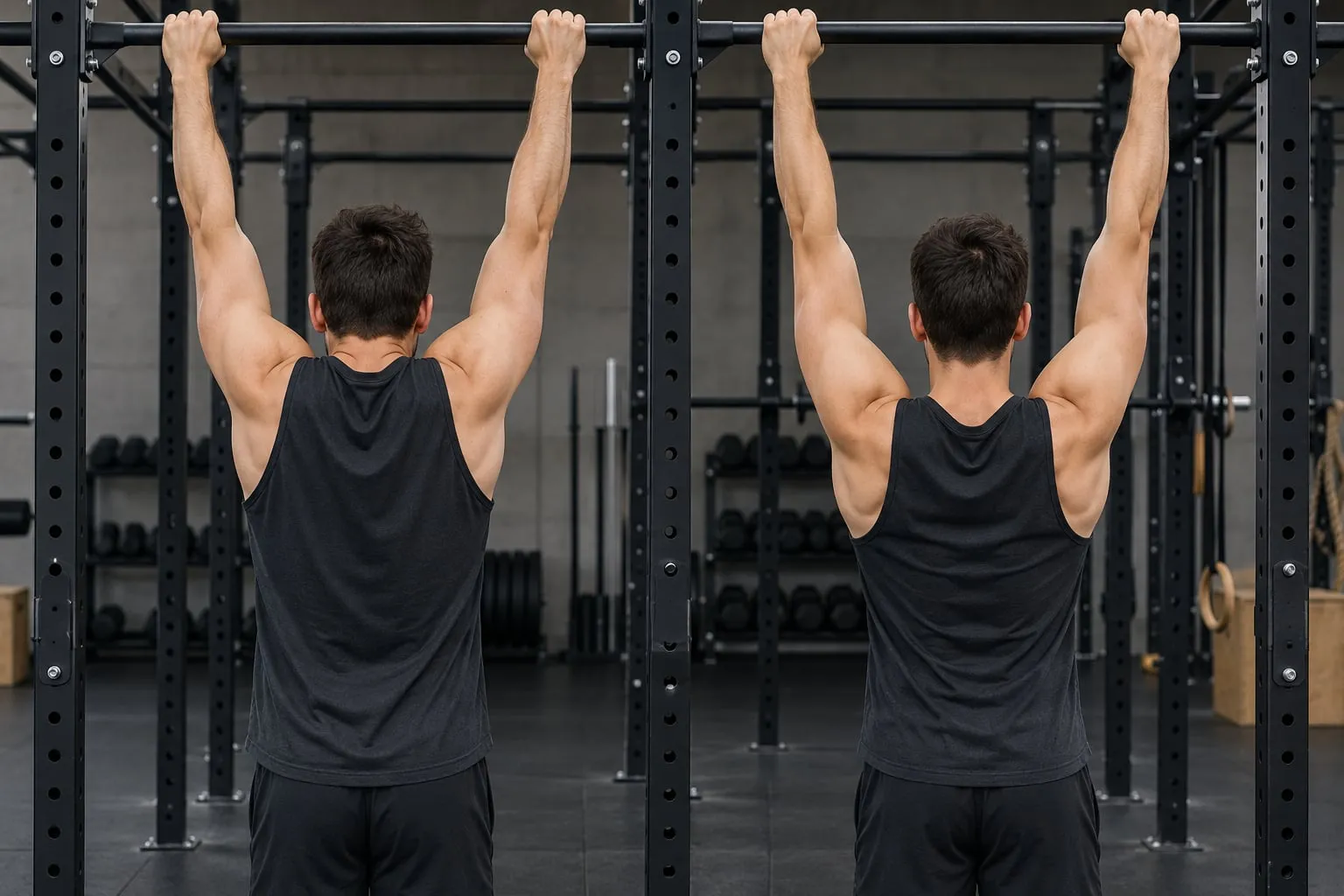
The dead hang vs active hang question comes down to one thing: what your shoulders are doing while your hands hold the bar. The two positions look almost the same in a photo. Your arms are straight, your feet are off the floor and your hands are on the bar. The difference sits between your ears and your hips, and it changes how the hang feels, how long you can hold it and which job it suits.
This page explains the difference in plain terms, shows how to do an active hang step by step, and says when each version makes sense. We did not test anyone ourselves. Where a claim needs evidence, it comes from a named study. Where nobody has measured the question, we say so. For the wider list of what hanging does and does not do, see our guide to dead hang benefits.
Dead Hang vs Active Hang: The Difference
The core difference is where the work goes. In a dead hang you stop doing anything with your shoulders. Your arms stay straight, your shoulders rise toward your ears as your body weight pulls down, and your hands do the holding. In an active hang you keep your arms straight but pull your shoulder blades down and slightly back, as if you were putting them into your back pockets. Your body rises a little and your shoulders stay set instead of loose.
| Feature | Dead (Passive) Hang | Active Hang |
|---|---|---|
| Shoulder position | Loose, shoulders rise toward your ears | Shoulder blades pulled down and set |
| Arms | Straight | Straight (no bend at the elbow) |
| Main effort | Grip and forearms | Grip plus a deliberate shoulder-blade pull |
| Pull on the spine and shoulders | Body weight hangs through them (measured on X-ray) | Not measured |
| Best for | A simple stretch, grip work | Shoulder control, pull-up preparation |
Two notes on that table. First, the row on pull reflects the one thing that has been measured: we found no published study that measured spinal or shoulder traction in an active hang. Second, “active” does not mean bending your arms. If your elbows bend, you are starting a pull-up, which is a different exercise.
What the Dead Hang Is Known to Do
The dead hang has one clear piece of research behind it. A spine clinic in Turkey X-rays scoliosis patients hanging freely from a pull-up bar, with knees bent so their feet are off the floor, to apply standardized traction from body weight. Across curves, the dead hang films showed significantly more curve flexibility than films taken lying down with traction (Ovali, 2023). The authors write, citing earlier work, that the spine in a dead hang is exposed to distraction forces of roughly 51% of body weight.
That is a picture of what a dead hang does to the spine while you are hanging, in 33 young patients, used to plan surgery. It is not a treatment.
What We Could Not Find for the Active Hang
We searched Europe PMC, which indexes PubMed, for studies that compare an active hang with a passive hang, or measure shoulder muscle activity in a scapular pull-up. We found none that answer that question. The advice you see online about which muscles an active hang “turns on” is coaching knowledge, not trial evidence. That does not make it wrong. It does mean you should treat any promise about lower trapezius or serratus gains as unproven.
How the Two Compare in Daily Use
In practice the choice is about feel and purpose:
- A dead hang is easier to learn and easier to hold for the whole set.
- An active hang asks you to pay attention to your shoulders from the first second.
- You can mix them in one set, which we cover below.
How to Do an Active Hang
You can do an active hang on any sturdy bar, including a doorway bar. If you are choosing one, our guide to the best doorway pull-up bar lists what to check on the frame and the weight rating before you hang from it.
- Start from a dead hang. Grip the bar with your hands about shoulder width apart, palms facing away. Step off a stool or the floor and let your arms straighten.
- Keep your arms straight. Do not bend your elbows. The movement is in your shoulder blades, not your arms.
- Pull your shoulder blades down. Think of moving them away from your ears and toward your hips. Your body will rise a small amount, often an inch or two.
- Hold the position. Keep your ribs calm and your neck long. If you are shrugging toward the bar, you have lost the position.
- Release slowly. Let your shoulders rise back to the dead hang, then lower yourself to the floor with control.
Start with short holds of a few seconds and repeat. That is a practical starting point, not a tested dose: no study has compared hang times for either version. If your shoulders hurt, stop.
Scapular Pull-Ups as a Bridge
A scapular pull-up is the active hang in motion. You start in a dead hang, pull your shoulder blades down so your body rises, then let your shoulders rise again, all with straight arms. Repeat that slowly for a few reps. It teaches the shoulder-blade action you need in the first inches of a full pull-up. It is also an easy way to find out whether you can feel the position at all before you hold it.
Common Mistakes
Most failed active hangs come from the same few errors. People bend their elbows and turn it into a half pull-up. They shrug instead of pulling down. They hold their breath. Or they hang longer than the position can be kept with good form. When the shoulder blades creep back up, take it as the signal to rest, not to push on.
When a Dead Hang Is the Better Choice
Choose the dead hang when your goal is a relaxed stretch or grip work, and when you want to hold the bar for longer without thinking about your shoulders.
Stretching and Decompression
The dead hang is the position researchers use when they want body weight to pull on the spine. In the Turkish X-ray series, the dead hang straightened curves more than lying traction did (Ovali, 2023). In one patient shown in the paper, a 43 degree thoracic and 47 degree lumbar curve standing measured 26 and 22 degrees in the dead hang. The curve returns when the person lets go, so this is a measure of flexibility, not a lasting change. For the full picture of what hanging does to the spine, see dead hang benefits.
Grip Work
If you want to build grip endurance, a dead hang puts the load straight into your fingers and forearms. In a randomized trial of 35 intermediate to advanced climbers, 10 weeks of hangboard training increased maximal finger strength more than climbing alone (Hermans, 2022). These were trained climbers hanging from narrow edges, not beginners on a round bar, so treat it as support for the idea that hanging builds grip, not as a plan for you.
Simplicity
The dead hang has one instruction: hold on. That makes it the easier of the two to learn and to repeat. For hold times, grips and progressions, our page on the dead hang exercise covers the full routine.
When an Active Hang Is the Better Choice
Choose the active hang when you want to control your shoulders or when you are working toward pull-ups.
Shoulder Control
A fully relaxed hang lets your shoulders ride up toward your ears. If that position feels vulnerable or uncomfortable, setting your shoulder blades first gives you a firmer position to hang from. We found no trial that tested whether this protects the shoulder, so it is a coaching cue, not a treatment. If you have a diagnosed shoulder problem, talk to your clinician before you pick either version.
Pull-Up Progression
An active hang followed by scapular pull-ups is the usual first rung on the way to a pull-up. It teaches the first part of the movement with no bend at the elbow, which keeps the exercise manageable for people who cannot yet do a full rep. Once you can hold an active hang and do slow scapular pull-ups, you are ready for negatives or band-assisted pull-ups. Our page on the muscles worked in a dead hang goes through which muscles carry each stage.
Grip Choice Matters Once You Pull
Once you move from hanging to pulling, your grip changes the load on your shoulder. In an observational study of 11 people who regularly do pull-ups, researchers tracked shoulder blade movement with skin markers in three techniques: palms facing away, palms facing you and wide grip (Prinold, 2016). The wide and palms-facing-you versions showed patterns the authors link to a higher risk of subacromial impingement. They say the palms-away version, with weight assistance, deserves more study as an option for weaker lifters. This was a small group of healthy young people performing pull-ups, not hangs, and it did not follow anyone for injuries, so it is a reason to be careful with grip width, not a verdict. Our dead hang grip guide covers width and hand position in more detail, and how long you should dead hang covers hold times.
Passive, Active and Everything Between
Hanging is not an either-or choice. Most people move along a range, and you can use that on purpose.
Alternating Passive and Active
One simple method is to alternate within a set: hang passively for a few seconds, pull into an active hang for a few seconds, then let go back to the dead hang. This gives your grip a break from the harder shoulder effort while you keep the bar in your hands. It is a convenient pattern, not a tested protocol. Pay attention to how your shoulders feel and stop when they tell you to.
Feet-Assisted Hangs
If a full hang is too much, keep your feet on the floor or on a box and take part of your weight through your legs. You can still practice the shoulder-blade action. The same trick works for the dead hang. The Turkish clinic bends the knees in its X-ray hangs to lift the feet off the ground (Ovali, 2023), and at home bending your knees also lets you use a bar that is set lower than your full height. Move toward a full hang as your shoulders and grip allow.
Safety
Hanging puts your full body weight through your hands, arms and shoulders. Most healthy adults tolerate short hangs, but several things call for care.
- Shoulders that feel unstable. If your shoulder slips, clicks painfully or feels like it will come out of the joint, do not hang until a clinician has looked at it.
- Pain that grows as you hang. Stop. A mild stretch is normal. Sharp pain, pinching at the top of the shoulder or tingling down the arm is not.
- A recent injury or surgery. Wait for clearance from the person treating you.
- The bar and the door frame. A bar that gives way is a fall risk. Check the weight rating, and test the bar with a gentle load before you hang from it.
Start with the version that feels safe for you, keep holds short, and move on only when form holds up. If you want to know more about what the exercise does for the body, go back to dead hang benefits.
Your questions, answered
Frequently Asked Questions
Do active hangs build muscle?
Probably a little, mostly in your hands and forearms, but we found no study that measured muscle growth from active hangs. What exists is a trial in trained climbers where weighted hanging raised finger strength. If you want visible muscle, a scapular pull-up or a full pull-up gives you more to progress with than a longer hold.
Who should not do dead hangs?
Anyone with shoulders that slip out of place, a recent shoulder or elbow injury, or pain that rises as you hang should skip them until a clinician has looked. We could not verify a contraindication list for bar hanging from any medical body, so this is caution, not a rule. Pain that spreads into an arm or leg means stop.
Are dead hangs actually good for you?
They are good at one thing we can point to: hanging work trains your grip. The spine stretch is real but brief, and claims about longer life, back pain relief or healthier shoulders have not been tested with hangs. Treat a dead hang as a simple grip and stretch exercise, not as a treatment.
3 sources used for this guide
Each linked to the original. Citations in the text jump here.
View sources
Ovali SA, Us AK. Comparison of traction, side-bending and dead-hang radiographs in preoperative evaluation and postoperative correction prediction in adolescent idiopathic scoliosis: A retrospective analysis of a novel flexibility radiograph. Medicine (Baltimore) 2023;102(50):e36461.
Hermans E, Saeterbakken AH, Vereide V, Nord ISO, Stien N, Andersen V. The Effects of 10 Weeks Hangboard Training on Climbing Specific Maximal Strength, Explosive Strength, and Finger Endurance. Frontiers in Sports and Active Living 2022;4:888158.
Prinold JA, Bull AM. Scapula kinematics of pull-up techniques: Avoiding impingement risk with training changes. Journal of Science and Medicine in Sport 2016;19(8):629-635.