Health guide
Exerpeutic Inversion Table: Can You Still Buy One?
We earn from qualifying purchases made through our links. How we make money
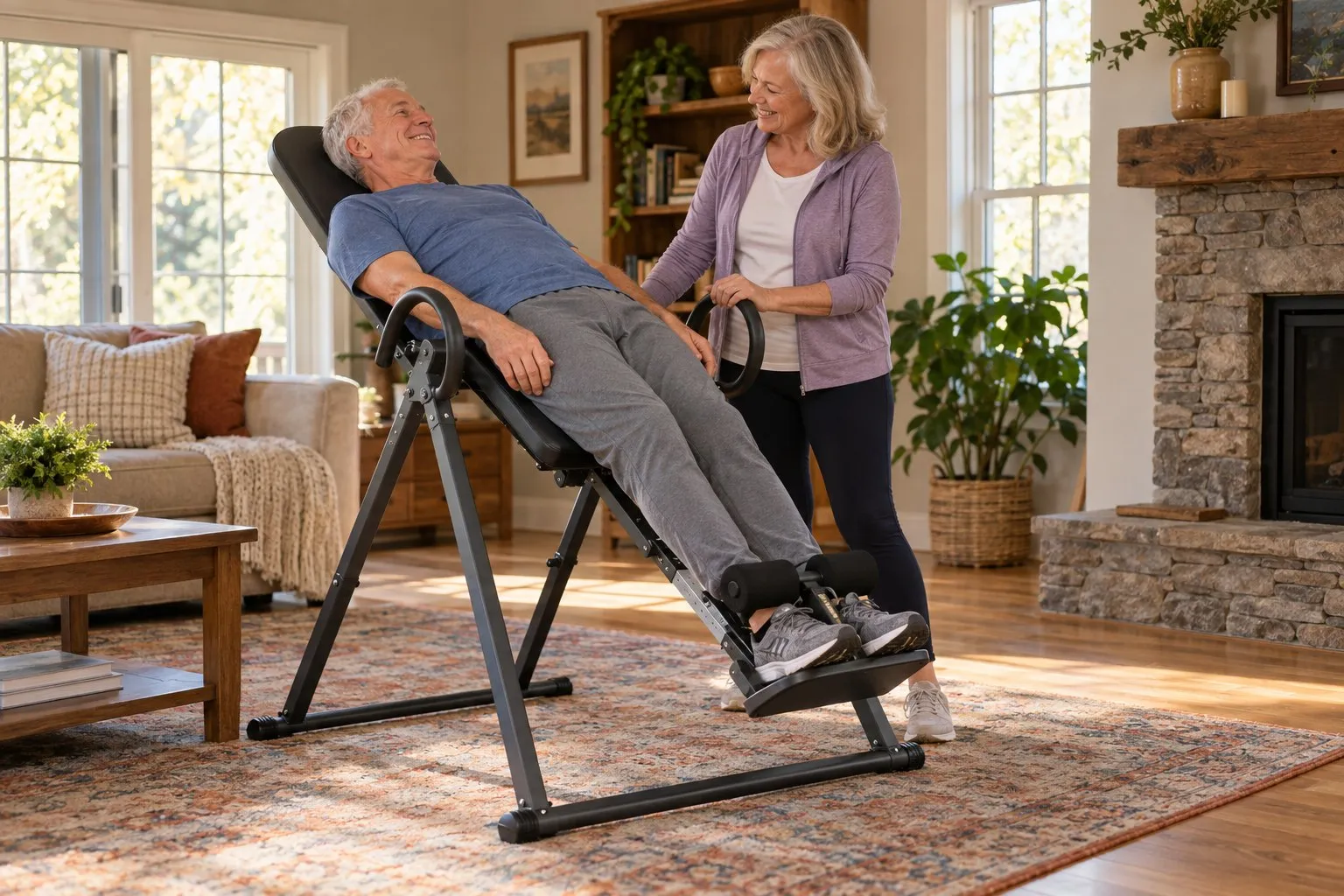
If you searched for an Exerpeutic inversion table, you likely want one of three things: to buy one new, to understand the table you already own, or to work out whether the Exerpeutic “traction table” on sale today is the same kind of device. We did not test these tables: every Exerpeutic number here comes from the manufacturer’s own owner’s manuals, checked against what is actually for sale, and we say plainly when a number isn’t published at all.
The Exerpeutic Inversion Tables That Exist on Paper
Exerpeutic is a brand name, not a company. Every owner’s manual we cite names Paradigm Health & Wellness, Inc. as the maker, and gives service@paradigmhw.com as the customer service address. Paradigm still sells Exerpeutic fitness equipment, such as exercise bikes, which makes this a different story from a brand whose maker has closed, like Health Gear, whose parent company filed for Chapter 7. Here, the company is alive; its gravity inversion line is what has gone quiet.
Item #5503: The Generic Exerpeutic Inversion Table
The best-documented model is the one Exerpeutic simply called “Inversion Table,” Item #5503. Its manual gives a maximum weight capacity of “300lbs/136kgs” and adds that “a specific maximum height capacity is not provided” (Exerpeutic). So the height range is not stated. Instead of a height range, the table has an adjustable boom with a height scale that you slide until your height sits just below the backrest frame.
The same manual lists the features that matter for safety. Your feet lock between front and rear rubber heel holders. A nylon strap restricts how far the table can rotate, which is how you limit the angle.
Handlebars help you return upright, and the frame folds for storage against a wall or under a bed. It is a standard gravity table: the manual describes it as “a sensitively balanced fulcrum” that tips when you move your arms.
475SL: A Ratchet Ankle Lock and a Pin for the Angle
The 475SL manual (document 4532.2-051018) shows a more developed table (Exerpeutic). Instead of a strap, it sets the angle with an adjustable knob that you insert into one of several holes on the right handlebar. The ankle system uses a ratchet handle that closes a padded “AIRSOFT” heel holder against rubber heel holders behind the ankle, and the table adds a head cushion with two mounting positions. The manual warns that the product weighs more than 44 lb and should be assembled and moved by two or more people.
What the 475SL manual does not give is a capacity or height figure in the sections we cite, so we list both as not stated rather than borrow a number from a retail title.
275SL, 225SL and Triple SureLock
The same manual library holds owner’s manuals for the Exerpeutic 275SL, described as an inversion table with a “SureLock” safety ratchet ankle locking system, and for a Triple SureLock Inversion Table. The 225SL appears by name on replacement covers made for it. That confirms these tables existed and were bought. We don’t have a manufacturer capacity or height figure for any of the three, so we don’t publish one.
| Model | Weight capacity | User height | Angle control | Where the number comes from |
|---|---|---|---|---|
| Exerpeutic Inversion Table, Item #5503 | 300 lb | Not stated | Nylon strap | Owner’s manual, via ManualsLib |
| Exerpeutic 475SL | Not stated | Not stated | Knob in handlebar holes | Owner’s manual, via ManualsLib |
| Exerpeutic 275SL | Not stated | Not stated | Not stated | Manual title only |
| Exerpeutic Triple SureLock | Not stated | Not stated | Not stated | Manual title only |
| Exerpeutic 225SL | Not stated | Not stated | Not stated | Model name on third-party covers |
A caution about other sites: pages that rank for this search sometimes describe “Exerpeutic” models under names that don’t appear in any Paradigm manual, with no capacity or height numbers attached. We only use model names and specs that appear in the manufacturer’s own documents.
Can You Still Buy an Exerpeutic Inversion Table?
In practice, no, not new from the maker. That may change, and if it does, the manual numbers above are the ones to hold a new listing to.
What Turned Up Under the Model Names
When we searched Amazon in September 2026 for the brand, the generic model and each named model (475SL, 275SL, 225SL and Triple SureLock), none returned a new gravity inversion table sold by Exerpeutic. What did appear under those names were protective covers from third-party makers, sized for tables people already own.
What That Means If You Find One
If you come across an Exerpeutic gravity table for sale, it is most likely used or old stock.
The ankle system is the part to be strictest about. The authors of a report on three spinal cord injuries from inversion table falls describe how, once ankle strength gives out or the foot slips, the user lands on the top of the head, and falls of one or two feet caused cervical spinal cord injuries (Jung, 2021). It is a three-case report, so it cannot tell you how often that happens, only what the failure looks like.
If You Already Own One
The manuals send parts and service requests to Paradigm, by email to service@paradigmhw.com, with a parts request form that asks for your model number, serial number and purchase date. The 475SL manual gives a response time of one to two business days for email. Since Paradigm is still operating, that route should still lead somewhere, which is more than owners of some other discontinued brands have. Use the model number printed on your manual or frame, not the name on a retail listing, and the part number from the manual’s parts list.
What You Can Actually Buy From Exerpeutic: The Traction Table
The one Exerpeutic back product with a live listing is the Exerpeutic Traction Table, and it is not an inversion table. Amazon sells it under a title that includes the words “Alternative Inversion,” which is accurate in one sense: it is an alternative to inverting, not a way of doing it.
How It Works: A Crank, Not Gravity
The Traction Table’s manual (document 4510.3-110719) describes the routine (Exerpeutic). You sit on the main frame, extend the heel holder boom to your leg length, and lock your ankles between foam rollers with a pop pin. Then you lie back on the backrest and wrap your arms around two padded armpit rollers.
To stretch, you keep your right arm around its roller, pull out the handle on the crank wheel and turn it clockwise, which extends the heel holder boom through a drive screw and pulls your feet away from your shoulders. Turning it the other way releases the stretch.
You stay horizontal the whole time. Nothing tips, and your head never drops below your hips. The manual adds a lumbar pad on a Velcro strip, wheels for moving the bench, and a note to grease the drive screw so it keeps turning smoothly.
The Capacity: 300 lb in the Manual
The manufacturer rates the Traction Table at “300lbs / 136kg” and a maximum user height of “6 feet 6 inches / 198cm” (Exerpeutic). Some retail listings, including the Amazon title, show 350 lb instead. We publish the manual’s figure, because that is the number the maker puts in writing next to its warnings.
Inversion and Traction: The Same Goal, Different Force
Both devices aim at the same thing: pulling the vertebrae slightly apart. A 2023 paper in Disability and Rehabilitation describes inversion table therapy as “a form of spinal traction,” thought to help low back pain because gravity-assisted traction distracts the lumbar vertebrae (Kassay, 2023). That is a proposed mechanism, not proven benefit.
An inversion table uses your body weight, and the pull grows with the angle. The Traction Table uses your arm on a crank, and the pull grows with each turn.
On results, the broadest evidence covers traction of every kind. A Cochrane review of 32 trials with 2,762 people found that traction, alone or with other treatment, makes little or no difference to pain, function or return to work in low-back pain, with or without sciatica (Wegner, 2013). That applies to traction in general, not to this bench or to inversion tables specifically. Our page on what inversion tables are shown to do goes through the narrower studies that are more encouraging.
Why We Don’t Link to It
We don’t put a buy button on the Traction Table. This page and this site are about inversion, and it doesn’t invert. It also sits outside the bar we use for any card: we want the capacity in the maker’s manual and the capacity on the listing to agree before we send you to buy, and here they don’t. We describe it so you know what it is, not to sell it.
Who Might Prefer Traction to Inversion Anyway
Some people search for an Exerpeutic inversion table and would be better served by staying horizontal. The difference is worth thinking through before you buy either.
If Going Head-Down Is the Problem
If the idea of hanging upside down is what stops you, or you have trouble getting back upright on a pivoting table, a flat traction bench removes that step. You control the stretch with your hand, a turn at a time, and there is no pivot to rotate back up from. The manual even allows for lifting your arms out of the rollers and resting flat for a few minutes before you unlock your feet. That is a real difference in how the device feels to use.
It Is Not a Way Around the Warnings
It would be easy to assume that staying flat makes a traction bench safe for people who shouldn’t invert. The Traction Table’s own manual does not say that. It tells users not to use the equipment without a physician’s approval and lists many of the same conditions as Exerpeutic’s inversion table manual, including glaucoma, retinal detachment, high blood pressure, heart or circulatory disorders, hernias, osteoporosis and use of anticoagulants (Exerpeutic).
The Exerpeutic Warning List, Next to Innova’s
The Item #5503 manual tells you not to use the table if you have conditions such as extreme obesity, glaucoma, retinal detachment, pregnancy, spinal injury, middle ear infection, high blood pressure, recent stroke, hernia or bone weakness, or if you take anticoagulants (Exerpeutic). It is worded almost exactly like Innova’s list, which names 21 conditions and states that it “is not a complete listing” (Innova). Both are manufacturer caution lists, not conditions each proven dangerous in a study. Our page on who should not use an inversion table sorts them into what has been measured and what is caution.
What to Buy Instead of an Exerpeutic Inversion Table
If you wanted an Exerpeutic because it was a solid, plain gravity table at a sensible price, the tables below replace it. Each maker publishes its specs, and each table is on sale.
For a First Table: Innova ITX9600
The ITX9600 is the closest match to the Exerpeutic Item #5503. It is rated to the same 300 lb, and Innova publishes a user height range of 4’10” to 6’6”, which Exerpeutic’s generic manual does not. Its reversible ankle holders let you move the foam roller to the front once inverting feels familiar.
The warranty is Innova’s one-year limited warranty for the original purchaser buying from an authorized retailer (Innova). Our Innova buying guide compares it with the rest of the range.

Reversible ankle holdersVerified
Innova ITX9600
by Innova
Best for former Exerpeutic shoppers who want a 300 lb table with a published height range.
Skip it if you want marked angles and a longer warranty: the Teeter X3 marks 20, 40 and 60 degrees and carries five years.
It is the only entry table here with reversible ankle holders, so the foam roller can move to the front once inverting stops feeling new. One of its listing bullets says 350 lb; the maker's page says 300 lb, and 300 is what we publish.
- Weight limit
- 300 lb
- User height
- 4'10" to 6'6"
- Warranty
- 1 year
- Price range
- Budget
What we like
- Ankle holders reverse, so the foam roller can move to the front
- Manual labels the pin angles, from 15° up to 85°
- Pin with a protective cover, left at 15° after assembly
- Rated to 300 lb in both the manual and on the maker's page
Keep in mind
- One-year limited warranty, non-transferable
- No heat or massage
- Manual shows five pin angles, the product page says six
- Needs 2 ft clear at each side and 3 ft front and back
Full specs
- Price range
- Budget
- Weight capacity
- 300 lb
- User height
- 4'10" to 6'6"
- Angle control
- Pin with protective cover; the manual labels the settings 15°, 30°, 45°, 60° and 85° (the product page calls it a six-position pin)
- Ankle system
- Reversible ankle holders (foam rollers and U-shaped holders can trade places)
- Heat and massage
- None
- Warranty
- 1 year limited
- FDA
- Not stated
VerifiedFrom the maker's product page. Not stated means the maker publishes nothing.
We may earn a commission. It never changes which table we pick, or the order they appear in.
For the Lowest Spend: YOLEO Heavy Duty
If you liked the SL models for their ratchet ankle lock, the YOLEO is the budget table that keeps one: its listing describes an adjustable ratchet ankle locking system with a safety lock pin. Know two things first. YOLEO recommends it for people up to 265 lb, below the 300 lb of the Exerpeutic #5503, and there is no manufacturer spec sheet, only the listing.

Ratchet ankle lockClaimed
by YOLEO
Best for fans of the SL models' ratchet ankle lock who weigh up to 265 lb.
Skip it if you weigh more than 265 lb, or want a manufacturer spec sheet: there is only the listing.
The cheapest table here that still ratchets the ankle clamp shut, which is the part a budget frame usually gives up. Two things to know before you save the money: YOLEO recommends it for people up to 265 lb, not the 300 lb the bigger brands publish, and there is no manufacturer spec sheet behind any of it, only the listing.
- Warranty
- 2 years
- Price range
- Budget
What we like
- Ratchet ankle lock with a safety lock pin
- Two-year warranty, against Innova's one year
- Adjustable rear cross bar instead of a tether
Keep in mind
- Recommended only for users up to 265 lb
- No manufacturer spec sheet, only the Amazon listing
- Height range not stated
- Angle degrees not stated
Full specs
- Price range
- Budget
- Weight capacity
- Not stated
- Maker-recommended limit
- 265 lb
- User height
- Not stated
- Angle control
- Adjustable rear cross bar instead of a tether; degrees not stated
- Ankle system
- Adjustable ratchet ankle locking system with safety lock pin
- Heat and massage
- None
- Warranty
- 2 years
- FDA
- Not stated
ClaimedFrom the retail listing; no maker spec sheet
We may earn a commission. It never changes which table we pick, or the order they appear in.
For Warranty and Marked Angles: Teeter FitSpine X3
If what you want is the most documented table, the Teeter X3 is it. Its angle tether is marked at 20, 40 and 60 degrees, so you set the limit before you get on.
Teeter includes a five-year full warranty on its FitSpine tables, covering defects in materials, workmanship, fabrics and padding (Teeter). Teeter’s manual inversion table is also FDA 510(k)-cleared (K162702) (FDA, 2016). A 510(k) means the FDA found the device substantially equivalent to one already on the market; it is not proof that it treats back pain. Our Teeter reviews cover the whole range.

Marked angle presetsVerified
Teeter FitSpine X3
by TEETER
Best for buyers who want the most documented table, with marked angles.
Skip it if you want heat: the Innova ITM4800 adds a warm, vibrating pad on the lower back.
If you are inverting for back pain, the marked 20°, 40° and 60° presets are the reason to pay more: you set the limit before you get on, instead of finding it upside down. The 5-year warranty against Innova's 1 year is the other half of the case.
- Weight limit
- 300 lb
- User height
- 4'8" to 6'6"
- Warranty
- 5 years
- Price range
- Premium
What we like
- Tether marked at 20°, 40° and 60°, set before you get on
- Five-year full warranty, against Innova's one year
- Teeter's tables are FDA 510(k) cleared under K162702
- EZ-Reach ankle lock with an extra-long handle
Keep in mind
- No heat or massage
- No raised boarding platform, unlike the LX9
- Rated to 300 lb, max height 6 ft 6 in
Full specs
- Price range
- Premium
- Weight capacity
- 300 lb
- User height
- 4'8" to 6'6"
- Angle control
- EZ-Angle tether marked at 20°, 40° and 60°; full inversion with secure lockout
- Ankle system
- Deluxe EZ-Reach ankle lock, extra-long handle, micro-adjusting closure
- Heat and massage
- None
- Warranty
- 5 years (extension to 10 sold separately)
- FDA
- 510(k) cleared (K162702), Class I device
VerifiedFrom the maker's product page. Not stated means the maker publishes nothing.
We may earn a commission. It never changes which table we pick, or the order they appear in.
If You Want Heat: Innova ITM4800
Exerpeutic’s inversion tables we could document had no heat. If you’d like a warm, vibrating pad on the lower back while you invert, the Innova ITM4800 adds heat and vibration on an adjustable lumbar band, with the same 300 lb rating as the ITX9600.
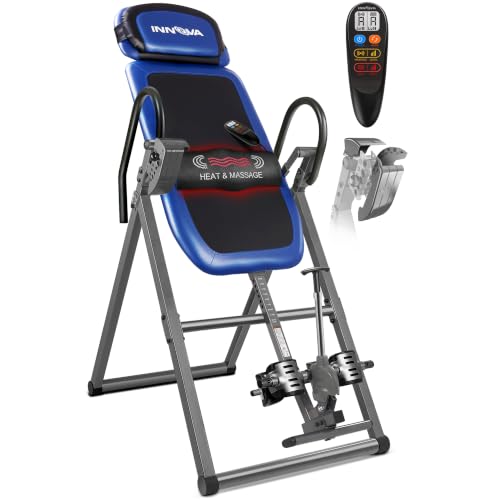
Lumbar heat and vibrationVerified
by Innova
Best for people who want a warm, vibrating pad on the lower back.
Skip it if you want heat along the whole spine: this pad sits on an adjustable lumbar band.
The cheapest way into heat and massage on this list. The pad is a lumbar band, not the full spine, which is enough if your pain sits low in the back.
- Weight limit
- 300 lb
- User height
- 4'10" to 6'6"
- Warranty
- 1 year
- Price range
- Mid-range
What we like
- Heat and vibration on a lumbar band you can reposition
- Front and rear U-shaped ankle holders
- Six-position pin with a protective cover
- Rated to 300 lb, for users 4 ft 10 in to 6 ft 6 in
Keep in mind
- Pad covers the lower back only, not the full spine
- Pin degrees not stated
- One-year limited warranty
Full specs
- Price range
- Mid-range
- Weight capacity
- 300 lb
- User height
- 4'10" to 6'6"
- Angle control
- Six-position pin with protective cover; degrees not stated
- Ankle system
- Ergonomic ankle holding system, front and rear U-shaped holders
- Heat and massage
- Heat and vibration on a lumbar band, adjustable position
- Warranty
- 1 year limited
- FDA
- Not stated
VerifiedFrom the maker's product page. Not stated means the maker publishes nothing.
We may earn a commission. It never changes which table we pick, or the order they appear in.
The Four Side by Side
Every cell below comes from the manufacturer, except the YOLEO column, which comes from its listing. Where nothing is published, the table says so.
| Spec | Innova ITX9600Budget, price tier 1 of 3Verified | YOLEO Heavy DutyBudget, price tier 1 of 3Claimed | Teeter FitSpine X3Premium, price tier 3 of 3Verified | Innova ITM4800Mid-range, price tier 2 of 3Verified |
|---|---|---|---|---|
| Weight capacity | 300 lbHighest here | Not stated | 300 lbHighest here | 300 lbHighest here |
| Maker-recommended limit | Not stated | 265 lb | Not stated | Not stated |
| User height | 4'10" to 6'6" | Not stated | 4'8" to 6'6" | 4'10" to 6'6" |
| Angle control | Pin with protective cover; the manual labels the settings 15°, 30°, 45°, 60° and 85° (the product page calls it a six-position pin) | Adjustable rear cross bar instead of a tether; degrees not stated | EZ-Angle tether marked at 20°, 40° and 60°; full inversion with secure lockout | Six-position pin with protective cover; degrees not stated |
| Warranty | 1 year limited | 2 years | 5 years (extension to 10 sold separately)Highest here | 1 year limited |
| Ankle system | Reversible ankle holders (foam rollers and U-shaped holders can trade places) | Adjustable ratchet ankle locking system with safety lock pin | Deluxe EZ-Reach ankle lock, extra-long handle, micro-adjusting closure | Ergonomic ankle holding system, front and rear U-shaped holders |
| FDA | Not stated | Not stated | 510(k) cleared (K162702), Class I device | Not stated |
| Assembly and setup | Not stated | Not stated | 85% pre-assembled, BILT app instructions (brand-wide claim) | Not stated |
| Buy | See today's price: Innova ITX9600 on Amazon (opens in a new tab) | See today's price: YOLEO Heavy Duty on Amazon (opens in a new tab) | See today's price: Teeter FitSpine X3 on Amazon (opens in a new tab) | See today's price: Innova ITM4800 on Amazon (opens in a new tab) |
Innova ITX9600- Weight capacity
- 300 lbHighest here
- Maker-recommended limit
- Not stated
- User height
- 4'10" to 6'6"
- Angle control
- Pin with protective cover; the manual labels the settings 15°, 30°, 45°, 60° and 85° (the product page calls it a six-position pin)
- Warranty
- 1 year limited
- Ankle system
- Reversible ankle holders (foam rollers and U-shaped holders can trade places)
- FDA
- Not stated
- Assembly and setup
- Not stated
YOLEO Heavy Duty- Weight capacity
- Not stated
- Maker-recommended limit
- 265 lb
- User height
- Not stated
- Angle control
- Adjustable rear cross bar instead of a tether; degrees not stated
- Warranty
- 2 years
- Ankle system
- Adjustable ratchet ankle locking system with safety lock pin
- FDA
- Not stated
- Assembly and setup
- Not stated
Teeter FitSpine X3- Weight capacity
- 300 lbHighest here
- Maker-recommended limit
- Not stated
- User height
- 4'8" to 6'6"
- Angle control
- EZ-Angle tether marked at 20°, 40° and 60°; full inversion with secure lockout
- Warranty
- 5 years (extension to 10 sold separately)Highest here
- Ankle system
- Deluxe EZ-Reach ankle lock, extra-long handle, micro-adjusting closure
- FDA
- 510(k) cleared (K162702), Class I device
- Assembly and setup
- 85% pre-assembled, BILT app instructions (brand-wide claim)
Innova ITM4800- Weight capacity
- 300 lbHighest here
- Maker-recommended limit
- Not stated
- User height
- 4'10" to 6'6"
- Angle control
- Six-position pin with protective cover; degrees not stated
- Warranty
- 1 year limited
- Ankle system
- Ergonomic ankle holding system, front and rear U-shaped holders
- FDA
- Not stated
- Assembly and setup
- Not stated
Verified from the maker's own page or manualClaimed retail listing onlyNot stated the maker publishes nothing
For every other use case, including heavier users and heat along the whole spine, see our full guide to the best inversion tables.
Using Any Inversion Table Safely
Whether you keep an old Exerpeutic or buy one of the tables above, the first sessions matter most.
Start Low, and Not Alone
Exerpeutic’s manual tells new users to “invert only 15~20 degrees to begin with,” to stay inverted only as long as they are comfortable, and to increase the angle a few degrees at a time (Exerpeutic). It also recommends that someone be with you the first few times. Both are good advice on any table.
How Long to Stay Inverted
Here the sources differ, and you should know it. The Item #5503 manual suggests using the table for five or ten minutes each morning and again each evening (Exerpeutic). The authors of the three-case report on inversion table falls recommend keeping sessions under one minute (Jung, 2021).
Neither is a clinical trial. The manual is the maker’s suggestion; the one-minute limit is those authors’ recommendation after seeing serious injuries. If you have any health condition, let your doctor set the limit.
Your questions, answered
Frequently Asked Questions
What are people saying about the Exerpeutic inversion table?
The clearest statements come from Exerpeutic itself. Its owner's manual rates the Item #5503 at 300 lb, tells new users to begin at 15 to 20 degrees, and lists conditions such as glaucoma and high blood pressure as reasons not to use it. What it does not give you in September 2026 is a new gravity table to order: the Exerpeutic you can buy is a crank-driven traction bench.
9 sources used for this guide
Each linked to the original. Citations in the text jump here.
View sources
Exerpeutic (Paradigm Health & Wellness, Inc.). Inversion Table Owner's Manual (Item #5503). manualslib.com, mirror of the manufacturer's owner's manual.
Exerpeutic (Paradigm Health & Wellness, Inc.). Exerpeutic 475SL Owner's Manual (Inversion table, 4532.2-051018). manualslib.com, mirror of the manufacturer's owner's manual.
Exerpeutic (Paradigm Health & Wellness, Inc.). Exerpeutic Traction Table Owner's Manual (4510.3-110719). manualslib.com, mirror of the manufacturer's owner's manual.
Kassay A, Soliman MAR, Jhawar BS. Recommendations for inversion table therapy. Disability and Rehabilitation 2023;45(22):3779-3782.
Wegner I, Widyahening IS, van Tulder MW et al. Traction for low-back pain with or without sciatica. Cochrane Database of Systematic Reviews 2013, CD003010.
Jung SH, Hwang JM, Kim CH. Inversion Table Fall Injury, the Phantom Menace: Three Case Reports on Cervical Spinal Cord Injury. Healthcare (Basel) 2021;9(5):492.
Innova. ITX9600 Heavy Duty Deluxe Inversion Therapy Table, Owner's Manual (version 1709AJJ). Innova Products Inc., owner's manual.
FDA. 510(k) Premarket Notification K162702: Teeter Manual Inversion Table. U.S. Food and Drug Administration, 510(k) database, decision date December 30, 2016.
Teeter. FitSpine X1 Inversion Table. teeter.com, product page.