Health guide
Red Light Therapy for Back Pain: What the Evidence Supports, and What It Doesn't
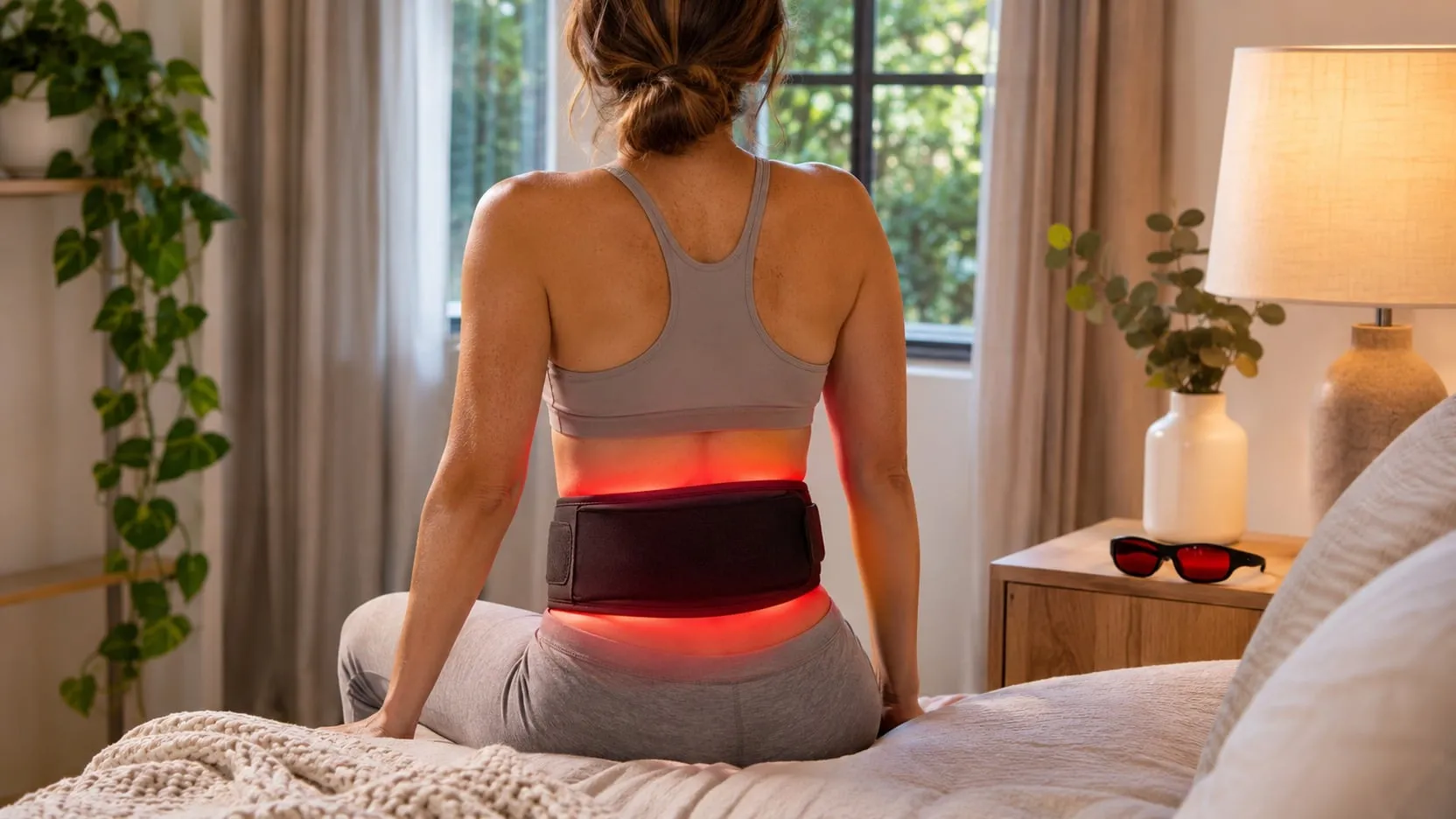
Red light therapy for back pain is sold as belts, pads and panels that glow red or emit near-infrared light, often with claims about inflammation and cellular energy. The research behind those claims is real but narrower than the marketing: most of it tested low-level lasers used by clinicians, on chronic low back pain, measured over a few weeks. This guide sorts what was tested from what is sold, explains what the main trials found, covers safety, and lists the back pain signs that need a doctor rather than a device. We did not test any device; every claim names its source.
What “Red Light Therapy” Means
Three Different Technologies
The phrase is used for three kinds of device. Low-level lasers, also called photobiomodulation lasers, deliver concentrated light to points on the skin and are mostly used in clinics. Light-emitting diode (LED) panels and belts spread lower-intensity red or near-infrared light over an area and are what most people buy for home. Infrared lamps and wraps emit longer infrared wavelengths and warm the skin; US federal rules define an infrared lamp as a medical device that emits energy at roughly 700 to 50,000 nanometers to provide topical heating, and class it as a Class II device (21 CFR 890.5500).
Why the Difference Matters
A trial result for one does not automatically carry over to another. The authors of a 2020 trial protocol on LED therapy for nurses with chronic back pain wrote that, while low-level laser had shown a pain benefit in a meta-analysis, the efficacy of LED therapy for this kind of back pain is disputed (Lin, 2020). That paper describes the planned trial, not its results, but it shows how researchers themselves separate the two.
What Is Claimed
Cleveland Clinic says red light therapy is being investigated for pain and inflammation in conditions such as knee osteoarthritis and carpal tunnel syndrome, and that most researchers find results promising but want more quality studies with larger numbers of people (Cleveland Clinic, 2021). Back pain is not on its list.
What the Back Pain Trials Found
Laser: A Short-Term Effect on Pain
A 2015 meta-analysis pooled seven placebo-controlled trials with 394 patients with chronic non-specific low back pain. Pain scores after treatment were about 13.6 points lower on a 100-point scale with low-level laser than with placebo, but there was no significant effect on disability or spinal range of motion, and the authors noted the lack of evidence on function (Huang, 2015). A 2016 meta-analysis of 15 sham-controlled trials with 1,039 participants found short-term pain reduction only in trials using at least 3 joules of laser energy per point, and graded the evidence moderate quality for a short-term benefit seen only at higher doses and in people whose back pain was more recent (Glazov, 2016).
Infrared Wraps: One Small Trial
The closest test of a wearable device is a 2006 trial of 39 people with chronic low back pain lasting more than six years. They wore battery infrared units in a waistband (800 to 1200 nm), or identical units with no power, for seven weekly sessions. Mean pain fell from 6.9 to 3 out of 10 in the infrared group and from 7.4 to 6 with the placebo, and no adverse effects were seen (Gale, 2006). It is one small trial from a single clinic, using one maker’s device, so it is a signal, not proof.
LED Panels and Belts: Little Direct Evidence
We found no completed trial of a consumer red LED belt for back pain. The LED trial protocol mentioned above describes a planned two-week program in nurses (Lin, 2020); it does not report results.
| Device | What was tested | What it found | Limits |
|---|---|---|---|
| Low-level laser (clinic) | 7 and 15 trials in two meta-analyses | Short-term pain relief; benefit tied to higher doses | No clear effect on function |
| Infrared waist wrap | One trial, 39 people | Less pain than an unpowered wrap over 7 weeks | Small, one device, one clinic |
| Red LED belt or panel | No completed back pain trial found | Unknown | Doses not comparable with laser trials |
What the Guidelines Say
American College of Physicians
The American College of Physicians’ 2017 guideline lists low-level laser therapy among the non-drug treatments that clinicians and patients should initially select for chronic low back pain, alongside exercise, yoga, tai chi, spinal manipulation and others, graded on low-quality evidence (Qaseem, 2017). The same guideline notes that most acute and subacute back pain improves over time regardless of treatment (Qaseem, 2017).
What That Does and Does Not Mean
An option on low-quality evidence is a reasonable thing to try if other first steps have not been enough. It is not an endorsement of home belts, which the guideline does not mention. Exercise appears on the same list, with moderate-quality evidence, and costs nothing (Qaseem, 2017).
Is Red Light Therapy Safe?
Eyes and Skin
Cleveland Clinic says red light therapy appears safe and is not associated with side effects when used short term and as directed, but that misuse can damage skin or unprotected eyes, that the long-term safety of the devices is not yet known, and that buyers should shield their eyes and follow all directions (Cleveland Clinic, 2021). Do not look into the light, and keep panels away from children’s eyes.
Heat and Burns
Infrared wraps and pads that warm the skin carry the same risk as any heat source used too long. A University of Utah Burn Center nurse manager says a heating pad left in one place, or one you fall asleep on, can cause a second-degree burn over a few hours (University of Utah Health, 2018). Do not wear a warming belt to sleep, and check your skin if you have reduced feeling, for example from diabetes.
Home Devices May Be Weaker
Cleveland Clinic notes that home devices may be less powerful than those used by professionals, so you may not get the results you hope for (Cleveland Clinic, 2021). Since the laser benefit appeared only above a minimum dose (Glazov, 2016), a weaker device is not a smaller version of the same treatment.
How Red Light Compares With Other Home Options
Heat
Plain heat is the cheapest thing to compare against. Our guide to the best heating pads for back pain covers what the Cochrane evidence on heat wraps found and how to use a pad safely.
TENS
A TENS unit is another home device with a long research record. Our page on the best TENS units for back pain covers what the trials found and who should not use one.
Movement and Decompression
Exercise has better evidence than any gadget on this page (Qaseem, 2017). Our guides to foam rollers for your back, decompressing your spine and inversion tables for back pain cover the options that involve moving or unloading the back.
If You Decide to Try a Red Light Device
Questions to Ask Before You Buy
Is it a laser, an LED panel or an infrared heat wrap? Does the maker publish wavelength, power and a dose per session? Is there a return window long enough to try it for several weeks? A device that states only “red and near-infrared light” with no numbers gives you nothing to compare with the trials.
Reading the Listing
Three phrases deserve a second look. “FDA registered” or “FDA listed” describes paperwork about a company or product category, not proof that a device relieves back pain. “Clinically proven” should come with a named trial of that device; if it points instead to laser studies in general, it is borrowing evidence from a different technology. And “deep tissue penetration” claims rarely come with a measured depth or dose. None of this means the device is useless, only that the listing is not evidence.
Keep a Simple Log
Write down three things once a week: your average back pain out of 10, one activity that pain limits (sitting through a film, a walk, lifting a laundry basket), and how many sessions you used the device. After three or four weeks you will have something better than memory to judge it by, and something useful to show a clinician.
How to Judge It
Give it a fair trial, note your pain and what you can do each week, and keep your other treatment going. Stop if it irritates your skin or eyes. If nothing has changed after a few weeks, the trials give no reason to expect it will.
The Takeaway
Red light therapy for back pain is not nonsense, but the evidence belongs mostly to clinic lasers: short-term pain relief in chronic low back pain, at adequate doses, without a clear effect on function. Home LED belts and panels have little direct evidence and may be weaker than the devices tested. If you try one, protect your eyes, never sleep in a warming belt, and keep doing the things with better evidence, starting with exercise. See a doctor for back pain with leg weakness, numbness or bladder changes.
Your questions, answered
Frequently Asked Questions
How long does it take for red light therapy to work for back pain?
In the trials we found, any effect was measured over weeks, not after one session: a 2006 infrared wrap trial ran seven weekly sessions, and a 2016 laser meta-analysis found benefit only in the short term. No trial tested a home LED belt for back pain on a fixed schedule, so a maker's timeline is a claim, not a result.
What is the downside of red light therapy?
The main ones are cost and uncertainty rather than danger. Cleveland Clinic says it appears safe short term when used as directed, but misuse can damage skin or unprotected eyes, long-term safety is not yet known, and home devices may be weaker than professional ones. For back pain, the strongest evidence is for clinic lasers, not home panels.
Can infrared therapy help with sciatica pain?
We found no trial of infrared or red light therapy specifically in sciatica. The closest evidence is in chronic low back pain without a focus on the leg, where one small 2006 trial of an infrared waist wrap reported less pain than an unpowered wrap. Leg pain from a nerve root has other causes, and should be assessed before you rely on a gadget.
How long to do red light for back pain?
There is no tested home dose for back pain. Follow the device's instructions, shield your eyes, and keep sessions short at first. The laser trials that showed benefit used a minimum dose per treatment point, measured in joules, which most home belts do not state in comparable terms, so you cannot match a study's dose at home.
10 sources used for this guide
Each linked to the original. Citations in the text jump here.
View sources
Qaseem A, Wilt TJ, McLean RM, Forciea MA, Clinical Guidelines Committee of the American College of Physicians. Noninvasive Treatments for Acute, Subacute, and Chronic Low Back Pain: A Clinical Practice Guideline From the American College of Physicians. Annals of Internal Medicine 2017;166(7):514-530.
Huang Z, Ma J, Chen J, Shen B, Pei F, Kraus VB. The effectiveness of low-level laser therapy for nonspecific chronic low back pain: a systematic review and meta-analysis. Arthritis Research and Therapy 2015;17:360.
Glazov G, Yelland M, Emery J. Low-level laser therapy for chronic non-specific low back pain: a meta-analysis of randomised controlled trials. Acupuncture in Medicine 2016;34(5):328-341.
Gale GD, Rothbart PJ, Li Y. Infrared therapy for chronic low back pain: a randomized, controlled trial. Pain Research and Management 2006;11(3):193-196.
Lin YP, Su YH, Chin SF, Chou YC, Chia WT. Light-emitting diode photobiomodulation therapy for non-specific low back pain in working nurses: A single-center, double-blind, prospective, randomized controlled trial (protocol). Medicine (Baltimore) 2020;99(32):e21611.
Cleveland Clinic. Red Light Therapy. my.clevelandclinic.org, last updated 1 December 2021.
US Food and Drug Administration (Code of Federal Regulations). 21 CFR 890.5500 Infrared lamp. Electronic Code of Federal Regulations, via Cornell LII.
University of Utah Health, The Scope (interview with Brad Wiggens, Burn Center). Heating Pads Can Cause Second-Degree Burns. healthcare.utah.edu, The Scope, 23 November 2018.
Bexley MSK (NHS). Lumbar Radiculopathy. msk-bexley.nhs.uk.
Qaseem A, Wilt TJ, McLean RM, Forciea MA, Clinical Guidelines Committee of the American College of Physicians, et al. Noninvasive Treatments for Acute, Subacute, and Chronic Low Back Pain: A Clinical Practice Guideline From the American College of Physicians. Annals of Internal Medicine 2017;166(7):514-530.