Health guide
Dead Hang Muscles Worked: What the Research Measured, and What It Didn't
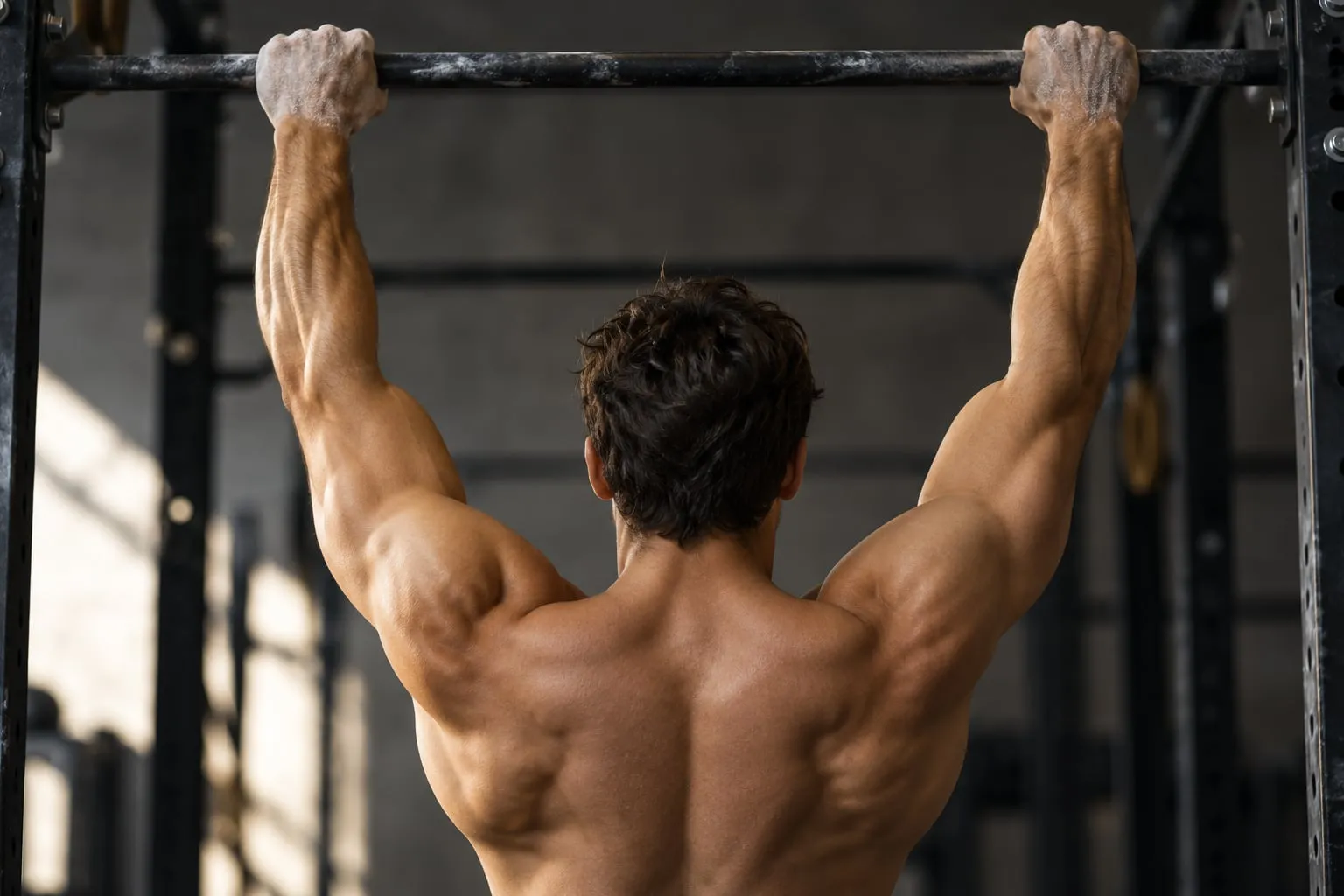
Search for dead hang muscles worked and every page gives you the same list: grip, forearms, lats, shoulders, core. The list is plausible. The problem is how little of it has been measured. The studies that put electrodes on a hanging person mostly used rock climbers hanging from a small wooden edge, and the studies that measured the lats used pull-ups, not hangs. We opened each paper below, and we say what each one can and cannot tell you. We did not test anyone ourselves.
Dead Hang Muscles Worked, at a Glance
The table sorts each muscle group by what an opened study actually measured. “Measured in a hang” means electrodes were on a hanging person. It does not mean the result carries over to a doorway bar, because the hangs were on climbing holds.
| Muscle group | What the evidence shows | Measured in a hang? |
|---|---|---|
| Finger flexors and wrist flexor (FDS, FDP, FCR) | Active in maximal finger hangs; activity changed with the grip used | Yes, on climbing holds |
| Finger extensor (EDC) | Recorded in the same hangs; lower on a sloper hold than on the other two grips | Yes, on climbing holds |
| Brachioradialis and biceps | Recorded during a hang to failure; their signals became more tightly linked as fatigue grew | Yes, on a thin edge |
| Trapezius | Recorded during a hang to failure; lower trapezius averaged 45 to 56% of a maximal test during pull-ups | Hang: yes, pull-up values only |
| Pectoralis major | Recorded during a hang to failure; averaged 44 to 57% during pull-ups | Hang: yes, pull-up values only |
| Latissimus dorsi | Averaged 117 to 130% of a maximal test during pull-ups | No hang measurement found |
| Infraspinatus | Averaged 71 to 79% during pull-ups | No hang measurement found |
| Erector spinae and external oblique | Averaged 39 to 41% and 31 to 35% during pull-ups | No hang measurement found |
The forearm rows come from a 2023 PeerJ study of 25 climbers (22 men, 3 women) who hung maximally on three grips with electrodes on four forearm muscles (Ferrer-Uris, 2023). The trapezius, biceps, brachioradialis and chest rows come from a 2026 study in which 11 male climbers hung until they failed (Exel, 2026). The rest are pull-up numbers from a 2010 study of 25 young adults (Youdas, 2010).
How to Read an EMG Percentage
Electromyography (EMG) records the electrical signal a muscle makes when it works. The Youdas team scaled each signal against a maximal voluntary isometric contraction (MVIC), a hard test contraction, so 100% means “as active as that test.” A pull-up can exceed it, which is why the lats read above 100%. These percentages describe activity, not growth: a muscle can be busy and still get no training effect from a short hold.
Grip and Forearm Muscles
If you ask which muscles a dead hang works hardest, the forearm answer is the one with the best support. Your fingers have to hold your full body weight, and nothing else in the hang can do that job for them.
What the Forearm EMG Shows
In the PeerJ study, climbers did maximal dead hangs on three grip positions called crimp, slope and sloper, while electrodes recorded the flexor digitorum profundus, flexor digitorum superficialis, flexor carpi radialis and extensor digitorum communis. The sloper grip produced more activity in the superficialis and the wrist flexor, and less in the extensor, than the other two grips (Ferrer-Uris, 2023). In plain terms, changing your grip changes which forearm muscles do the work. The limit: these were experienced climbers hanging on climbing holds at maximal effort, not beginners on a round bar. Our grip page covers hand positions for bars: see dead hang grip.
Does Hanging Make the Forearms Stronger?
For climbers, yes, with a loaded program. In a randomized trial of 35 intermediate to advanced climbers, 10 weeks of hangboard training, two 48-minute sessions a week, raised maximal finger strength more than regular climbing alone. Dead-hang duration rose 12% in the training group, but that gain did not differ significantly from the control group (Hermans, 2022). The hangs used 23 mm rungs on a hangboard, not a pull-up bar. The trial says that weighted, structured hanging trains the fingers of people who already climb. It does not tell a beginner how long to hang.
Grip Strength and Long Life: The Limit
Grip is the muscle quality with the largest outside evidence behind it. The PURE study followed 139,691 adults in 17 countries for a median of four years, and each 5 kg lower grip strength went with a 16% higher risk of death from any cause (Leong, 2015). The authors treat grip as an inexpensive way to sort people by risk. They also write that it still has to be tested whether improving strength reduces mortality (Leong, 2015). So a strong grip is a good sign, and hanging builds a strong grip, but nobody has shown that the hanging buys the years.
Shoulders, Lats and Upper Back
This is where most guides promise the most and cite the least. The shoulders must keep your arm attached to your torso while your weight pulls down on it, so something is working. The open question is how much, and in which muscles.
Passive Hang
In a passive hang you let the shoulders relax and the bar takes your weight through the arms. None of the EMG studies we read recorded the lats or the rotator cuff in this position. What exists is the hang to failure in 11 climbers: the trapezius, biceps, brachioradialis and pectoralis major were all recorded, and as the hold wore on, the signals of pairs such as trapezius and brachioradialis became more tightly coupled (Exel, 2026). That fits muscles sharing the load as the forearm tires, but the paper tested one group of male climbers on a 20 mm edge, so it cannot rank the muscles for you.
Active Hang
An active hang pulls the shoulder blades down and back before you bend the elbows. The pull-up data hint at who is involved: the lower trapezius averaged 45 to 56% of a maximal test during pull-ups, and the same study found it was significantly more active in the pull-up than in the chin-up (Youdas, 2010). That is a pull-up result. We did not find a study that compared EMG in an active hang against a passive one, so we cannot tell you the active hang works the lower trapezius harder. Our page on dead hang vs active hang covers the technique.
What the Lats Are Doing
The lats lead every pull-up list, and for good reason: they averaged 117 to 130% of a maximal test across the pull-up, chin-up and rotational pull-up in the Youdas study (Youdas, 2010). That is movement. A hang holds still, and your lats are stretched under your body weight rather than shortening to lift you. Whether they are strongly active or mostly along for the ride in a dead hang has not been measured in anything we opened, and we will not guess a number.
Does a Dead Hang Work Your Core or Lower Back?
Short answer: not shown. Guides say the core “fires to stop you swinging.” That may be true, but none of the studies we read recorded the abdominals or lower back in a plain dead hang.
What the Pull-Up Data Say
The closest numbers are from the pull-up. In the Youdas study, the erector spinae averaged 39 to 41% of a maximal test and the external oblique 31 to 35% (Youdas, 2010). Those are moderate values, lower than the lats, biceps and infraspinatus, and they come from a moving exercise. Do not carry them over to a still hang.
The Lower Back: Traction, Not a Workout
A different kind of evidence tells you what a hang does to the lower back. Surgeons in Turkey X-ray scoliosis patients hanging from a pull-up bar to apply traction from body weight, and the authors write, citing earlier work, that the spine is exposed to distraction forces of roughly 51% of body weight (Ovali, 2023). That is a load that pulls on the spine, not a measure of muscle work. If you have a back condition, read who should not use inversion-style traction and talk to your clinician before you start hanging.
Dead Hang vs Pull-Up: Which Muscles Change
A pull-up asks the same hands to hold on, then asks the back and arms to move your body. The hang keeps the first job and drops the second.
What a Pull-Up Adds
In Youdas, the pull-up and chin-up lit up the lats (117 to 130% of the maximal test), the biceps (78 to 96%) and the infraspinatus (71 to 79%), with the chin-up giving significantly more biceps and chest activity and the pull-up significantly more lower trapezius (Youdas, 2010). Those muscles had to move your body weight up. In a dead hang they hold a position, and the measured hang studies were about the forearm and the stabilizers.
Where Hanging Fits in a Pull-Up Plan
Think of the hang as grip work you can do anywhere. The fingers are one of the few places where hanging has real evidence, in the climbing trial above, and a pull-up needs strong hands before it needs anything else. What we could not verify is a trial that asked whether adding hangs alone raises pull-up reps. If your goal is more pull-ups, hang for the grip and shoulder tolerance, and add pull-up variations for the pulling. Our guide to how to do a dead hang has the progressions, and how long you should dead hang covers hold times.
How to Bias Different Muscles
Because the evidence is thin, “biasing” a muscle during a hang is a set of reasonable adjustments rather than proven recipes. Here is what the studies above justify, and where we are guessing.
Change the Grip
This one has support. In climbers, switching the hold changed which forearm muscles were most active (Ferrer-Uris, 2023). Bars let you vary width and hand position, so use that to spread the load across your forearms instead of hammering the same position. Our grip guide lays out the options.
Change the Shoulder Position
Hanging with relaxed shoulders versus pulling the shoulder blades down is the other lever. The pull-up data show the lower trapezius working, but no study has confirmed the same for an active hang, so treat it as a sensible way to practice scapular control rather than a guaranteed result. Start with short holds and stop if you feel pain in the shoulder, front of the elbow or neck.
Pick a Bar That Holds You
None of this matters if the bar fails. Check the bar’s weight limit and the door frame before you hang, and see our doorway bar guide for the models we list.
Your questions, answered
Frequently Asked Questions
Does hanging help with pull-ups?
It can help the grip side of pull-ups, but we could not verify a trial that tested hanging alone against pull-up reps. A hangboard trial in climbers raised finger strength, and the pull-up itself is a moving exercise that a hang is not. Treat hanging as grip and shoulder practice, then add pulling work on top.
What happens if I dead hang everyday?
No study we opened tested daily hanging, so nobody can give you a proven outcome. The one hanging trial we read used two sessions a week. Daily hangs are a bet on your own recovery: if your hands, elbows or shoulders feel sore the next morning, take a rest day and talk to a clinician if it lingers.
6 sources used for this guide
Each linked to the original. Citations in the text jump here.
View sources
Ferrer-Uris B, Arias D, Torrado P, Marina M, Busquets A. Exploring forearm muscle coordination and training applications of various grip positions during maximal isometric finger dead-hangs in rock climbers. PeerJ 2023;11:e15464.
Exel J, Kaufmann P, Froschauer O, Baca A, Kainz H, Mochizuki L. Upper-Body Neuromechanical Coordination Strategies During Fatiguing Sustained Dead Hangs in Climbers. European Journal of Sport Science 2026;26(6):e70197.
Youdas JW, Amundson CL, Cicero KS, Hahn JJ, Harezlak DT, Hollman JH. Surface electromyographic activation patterns and elbow joint motion during a pull-up, chin-up, or perfect-pullup rotational exercise. Journal of Strength and Conditioning Research 2010;24(12):3404-3414.
Hermans E, Saeterbakken AH, Vereide V, Nord ISO, Stien N, Andersen V. The Effects of 10 Weeks Hangboard Training on Climbing Specific Maximal Strength, Explosive Strength, and Finger Endurance. Frontiers in Sports and Active Living 2022;4:888158.
Leong DP, Teo KK, Rangarajan S, et al. Prognostic value of grip strength: findings from the Prospective Urban Rural Epidemiology (PURE) study. The Lancet 2015;386(9990):266-273.
Ovali SA, Us AK. Comparison of traction, side-bending and dead-hang radiographs in preoperative evaluation and postoperative correction prediction in adolescent idiopathic scoliosis: A retrospective analysis of a novel flexibility radiograph. Medicine (Baltimore) 2023;102(50):e36461.