Buying guide
The Best Gravity Boots, and the Risk a Table Doesn't Have
We earn from qualifying purchases made through our links. How we make money
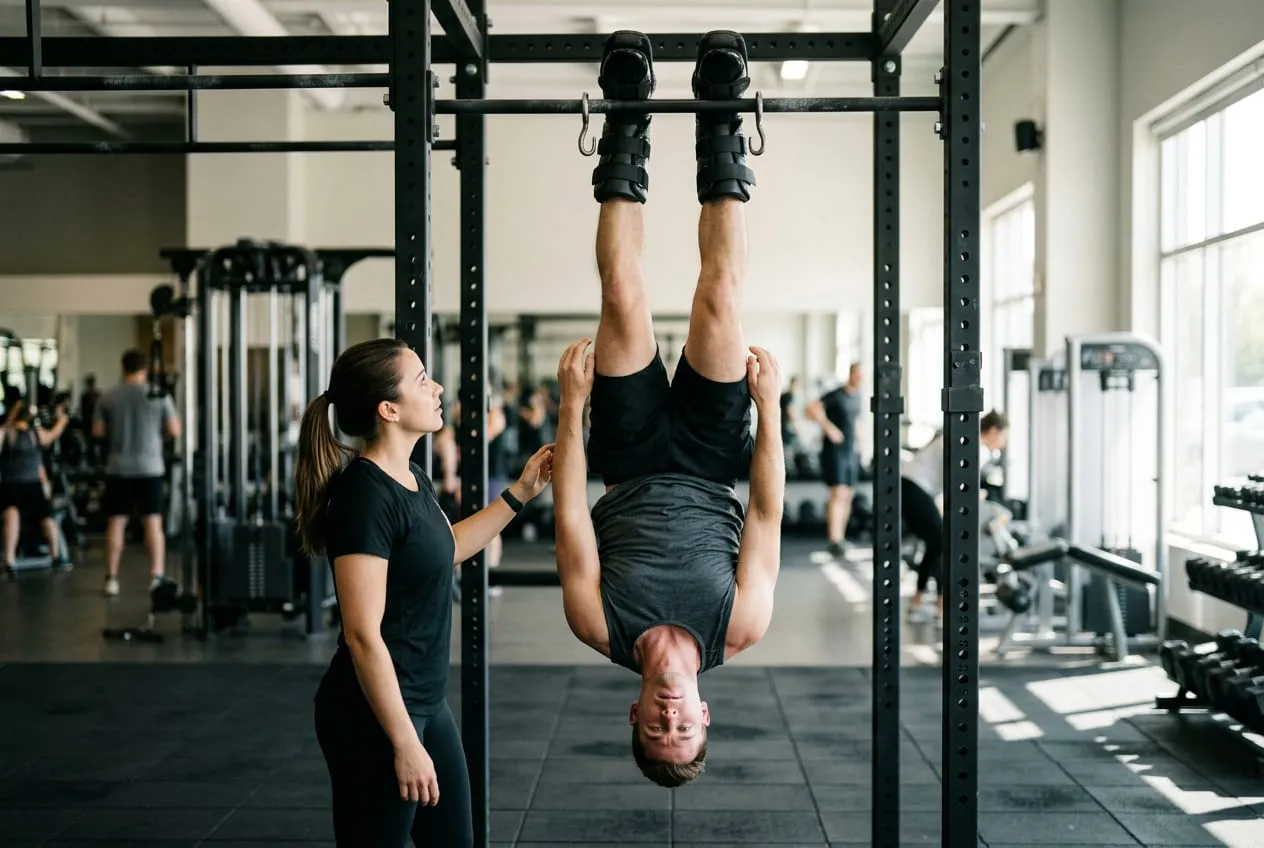

Our pick for most people
Teeter EZ-Up Gravity Boots
The best gravity boots for most people, with every spec backed by the company that makes it. Before you buy any pair, know that boots put you in full inversion with no partial angle, and that the bar or rack you hang from sets your real weight limit, not the boots.
- Rated to 300 lb, on Teeter's own spec sheet
- Five-year full warranty
- Named in an FDA 510(k) record, K162702
- Weight limit
- 300 lb
- Warranty
- 5 years
- Price range
- Budget
VerifiedSpecs from the maker's own product page

Best for the lowest spend
Choose it if you already know how your body handles full inversion and the price gap matters more to you than a warranty. Skip it if you are new to boots or want a stated warranty: its 300 lb is only on the Amazon listing.
Gravity boots, also sold as inversion boots, are the cheapest and smallest way to hang upside down at home, and also the least forgiving. We did not test these boots on people (we read every spec at its source, checked the FDA and recall records ourselves, and tied each health claim to a named study), and if you buy through our links we may earn a commission that never decides which pair we pick.
The Best Gravity Boots at a Glance
There are only a handful of real gravity boots on sale, and fewer still with a manufacturer standing behind them. That makes the choice short.
See our two picks in one table
Our Two Picks
| If you want | Our pick | Tier | The spec that decides it |
|---|---|---|---|
| The documented option | Teeter EZ-Up Gravity Boots | budget | 300 lb, 5-year warranty, FDA 510(k) record |
| The lowest spend | Sutekus Anti Gravity Inversion Boots | budget | 300 lb on the listing, no stated warranty |
Both sit in the budget tier next to any inversion table, though the Sutekus pair costs noticeably less than the Teeter. We don’t print prices, because they move from week to week.
The Specs Side by Side
Every Teeter cell comes from Teeter’s own product pages. Sutekus has no manufacturer spec sheet online, so its column comes from the Amazon listing, and where a figure is not published the table says so.
| Spec | Editor's choiceTeeter EZ-Up Gravity BootsBudget, price tier 1 of 3Verified | Sutekus Gravity BootsBudget, price tier 1 of 3Claimed |
|---|---|---|
| Weight capacity | 300 lb | 300 lb |
| Angle control | No angle control: hanging from a bar puts you fully inverted at once | No angle control: hanging from a bar puts you fully inverted at once |
| Assembly and setup | Hooks onto a sturdy bar; Teeter sells a Chin-Up Rack rated to 250 lb | Attaches to most chin-up bars |
| Warranty | 5 years fullHighest here | Not stated |
| FDA | Named in Teeter's 510(k) K162702, Class I device type | Not stated |
| Ankle system | Padded ankle cuffs with hooks, Standard and XL sizes | Strap locking system with 1.2" foam padding and chrome-plated hooks |
| Buy | See today's price: Teeter EZ-Up Gravity Boots on Amazon (opens in a new tab) | See today's price: Sutekus Gravity Boots on Amazon (opens in a new tab) |
Editor's choiceTeeter EZ-Up Gravity Boots- Weight capacity
- 300 lb
- Angle control
- No angle control: hanging from a bar puts you fully inverted at once
- Assembly and setup
- Hooks onto a sturdy bar; Teeter sells a Chin-Up Rack rated to 250 lb
- Warranty
- 5 years fullHighest here
- FDA
- Named in Teeter's 510(k) K162702, Class I device type
- Ankle system
- Padded ankle cuffs with hooks, Standard and XL sizes
Sutekus Gravity Boots- Weight capacity
- 300 lb
- Angle control
- No angle control: hanging from a bar puts you fully inverted at once
- Assembly and setup
- Attaches to most chin-up bars
- Warranty
- Not stated
- FDA
- Not stated
- Ankle system
- Strap locking system with 1.2" foam padding and chrome-plated hooks
Verified from the maker's own page or manualClaimed retail listing onlyNot stated the maker publishes nothing
The capacity row looks like a tie. It isn’t the number that limits you, as the section on bars below explains. The rows that separate the two pairs are warranty, FDA status and who stands behind the figures.
What Gravity Boots Are and How They Work
The name is misleading. You don’t walk in them, and they don’t replace your shoes.
Padded Cuffs, Hooks and a Bar
Teeter describes gravity boots as “padded cuffs that fit around your ankles and lower legs, allowing you to hang upside down from a bar or inversion rack,” connected to the bar through built-in hooks (Teeter, 2026). You strap one cuff around each ankle, get your feet up to a bar, seat both hooks over it, and lower your upper body until you hang head down. Getting down is the same in reverse, which means pulling yourself back up to the bar with your core and arms before you unhook.
What People Use Them For
Teeter markets the boots for two jobs. One is decompression: hanging lets your body weight pull on your spine instead of pressing down on it. The other is inverted exercise, such as crunches, sit-ups and leg raises done upside down (Teeter, 2026). The second use is the reason gym-goers buy them, and it is also where boots differ most from tables, since a table’s backrest gets in the way of that kind of movement.
Gravity Boots or Inversion Boots?
They are the same product. “Inversion boots,” “anti-gravity boots” and “gravity boots” all describe ankle cuffs with hooks that let you hang from a bar. Body-Solid calls its pair inversion boots, Teeter calls its pair gravity boots, and budget listings on Amazon often use every name at once. Everything on this page applies whichever label you searched for.
Gravity Boots vs. an Inversion Table: The Difference Is Control
The two devices do the same thing to your spine. Where they differ is how you get there, and that difference is the whole safety question.
A Table Lets You Stop Halfway
Teeter sells both, so its own comparison is useful. It says an inversion table “supports the body on a backrest and allows for controlled, adjustable inversion,” letting you “move gradually between angles, from partial inversion to full inversion.” Gravity boots, in the same article, “create a free-hanging setup using a compatible bar or rack, placing the body in full inversion” (Teeter, 2026).
That is the maker describing the trade-off in its own words. With a table, a beginner can spend weeks at a shallow angle. With boots, there is no shallow angle to spend time at.
Boots Start at the Angle Tables Treat as the Limit
Full inversion is not a neutral position for your body. In a 1984 study of eye pressure during inversion, five minutes of full inversion roughly doubled intraocular pressure, from 16.8 to 32.9 mmHg in healthy eyes and from 21.3 to 37.6 mmHg in eyes with glaucoma (Weinreb, 1984).
The researchers did not see damage to the visual field afterwards; the concern is the spike itself. On a table, full inversion is something you choose to reach. With boots, it is where every session starts.
Which One Suits You
Choose boots if you have inverted before, you are comfortable fully upside down, you want to do inverted exercise, and you already own a bar or rack strong enough to carry you. Choose a table if you are new to inversion, you want to start at a partial angle, you have any doubt about your ankle or grip strength, or your doctor has given you an angle limit.
For most first-time users with back pain, a table is the safer way in, and our guide to the best inversion tables compares them by use case. Boots make more sense as a second step than a first. If neither fits, our pages on the seated inversion chair and the yoga trapeze sling cover two other ways to get head-down at home.
Are Gravity Boots Safe? The Risks Without a Backrest
Nobody has published a study of injuries from gravity boots specifically. What exists is evidence from inversion tables, and the mechanism it describes applies to boots with less protection in the way.
The Fall Is the Serious Risk
A 2021 report of three cervical spinal cord injuries from inversion table falls in South Korea describes the mechanism plainly: “once the ankle power is lost or it slips, the user will land on top of their head,” and the authors add that “falls from 1 or 2 feet high are by no means negligible” (Jung, 2021).
Three cases can’t tell you how common this is, and they involved tables, not boots. But the chain of events is the same: something at the ankles gives way and the head lands first. On a table, the frame and backrest are still underneath you. On boots, nothing is.
The Ankle Lock Is Where Things Fail
The product category has a record here too. In 2010 the U.S. Consumer Product Safety Commission announced a recall of about 33,000 inversion benches from three brands after 75 reports of the ankle clamp releasing or a rotation strap breaking, including 23 injuries, some to the head and neck (CPSC, 2010).
In 2015, DICK’S Sporting Goods recalled its Fitness Gear inversion table, noting that although the manual “clearly stresses the importance of ensuring the ankle locking systems are engaged, some customers have fallen and sustained injuries” (DICK'S, 2015).
Neither recall involved gravity boots, and neither says anything about the pairs on this page. They show where the weak point sits in any device that holds you by the ankles: the closure, and whether it is fully engaged.
No Recall Is on Record for Gravity Boots
The Consumer Product Safety Commission’s recall database lists the inversion table and bench recalls, including a 2008 Stamina recall of inversion tables whose center weld could fail when inverted. It returns no recall with “gravity boots” or “inversion boots” in the title (CPSC, 2008).
That is worth knowing, and it is not a clean bill of health. The absence of a recall is not proof that boots are safe: it means no formal CPSC recall is registered under those product names, not that no one has been hurt. The risk still has to be judged on the mechanism above, and on the hooks and closures in front of you.
Your Ankles Carry Everything
On a table, your back rests on a padded bed and your ankles share the load. On boots, your ankles and lower legs carry your whole body weight for the entire session. Innova’s owner’s manual lists “weak ankles and/or feet” among the conditions that should keep you off an inversion table without a doctor’s approval (Innova). If that applies on a table, it applies more on boots.
What Teeter Tells Boot Users to Do
Teeter’s own guidance is short and sensible. Check that the bar or rack is durable, properly installed and able to hold your weight. Check that both boots are fastened and that “each hook is fully engaged before hanging.” Start with a shorter session, have someone nearby for your first few, and when you come back up, “take your time and pause halfway” (Teeter, 2026).
Add one more from the fall report above: its authors recommend keeping sessions under one minute (Jung, 2021). That advice was written for tables, and it is their recommendation, not a clinical consensus, but nothing about boots makes a longer first session wiser.
Who Should Not Use Gravity Boots
Every contraindication for an inversion table applies to gravity boots, and because boots skip the partial angles, it applies at full strength from the first second.
Teeter’s Short List for the Boots
In its gravity boots article, Teeter says the boots “are not right for everyone” and tells anyone with “high blood pressure, glaucoma, heart-related conditions, osteoporosis, are pregnant, or have a history of spinal injury or surgery” to talk with a doctor before starting (Teeter, 2026). That is a shortened version of the company’s full inversion list.
Why Full Inversion Raises the Stakes
The two effects of inversion that have been measured both rise with the angle. Two minutes upside down raised both systolic and diastolic blood pressure significantly in a small trial of healthy women aged 20 to 30, and the authors wrote that hypertensive people may need to avoid inversion (Haskvitz, 1986).
Eye pressure, as covered above, roughly doubles at full inversion. A table user with a borderline condition can choose to stay shallow. A boots user cannot.
The 1983 Study Done in Gravity Boots
The one study we found that measured people hanging in gravity boots is also one of the oldest on inversion. In a 1983 letter to The Western Journal of Medicine reporting two small studies, Klatz and colleagues hung 20 healthy volunteers (18 men and 2 women, none with heart disease or glaucoma) fully head-down in gravity boots for three minutes.
Blood pressure rose from 119/74 mmHg seated to 157/93 mmHg upside down. Pressure in the central artery of the retina went from 45/26 to 105/62 mmHg, and eye pressure from an average of 19 to 35 mmHg (Klatz et al., 1983).
In a follow-up with 12 subjects, hard exercise that pushed the pulse above 160 did not significantly raise eye pressure above resting values, while inversion did. Effort alone does not explain the spike; hanging head-down does.
Keep the limits in view: a small group of young, healthy volunteers, three minutes, no control group, published as a letter rather than a full paper. What makes it relevant here is the position. The numbers come from boots at full vertical, which is exactly where every boots session puts you, not from a table at a partial angle.
The authors also suggested that extended head-down hanging could prove dangerous for several groups, among them people with glaucoma, high blood pressure or uncompensated heart failure, people on anticoagulants or aspirin, and anyone over 55. That was their speculation, not a result of the study, but it is a reason to take the doctor’s check seriously.
An Eye Doctor’s Advice: Short Sessions and a Baseline Check
Two years later, Thomas Friberg, an ophthalmologist at the University of Texas, wrote to the same journal about the eyes. He pointed out that later data from the same research group, using oscillating inversion rather than a still hang, still showed eye pressure climbing from 17 to 33, 32 and 31 mmHg at 5, 10 and 15 minutes (Friberg, 1985).
He wrote that the risk to the eyes could probably be reduced by keeping sessions to 10 or 15 minutes, and that anyone planning to invert should first have a baseline eye pressure measurement, because raised eye pressure usually causes no symptoms. He was also clear that it was uncertain whether healthy users would suffer any permanent damage.
For a boots user, the baseline check is the practical step: an eye exam before your first hang tells you whether you start from a higher number. His 10 to 15 minutes is a ceiling for the eyes, not a starting point; for a beginner on boots, the one-minute advice from the fall report above is the better guide.
The Full List, With the Evidence
Teeter’s complete list, which it says is printed in its owner’s manual, is much longer: it runs from anticoagulant use and a history of retinal detachment to hernias, severe acid reflux, recent surgery and obesity (Teeter). We don’t repeat it all here. Our page on who should not use an inversion table goes through each item and shows which ones rest on a measurement and which on caution. Read it before your first hang, and if anything on it applies to you, get a doctor’s clearance first.
The Bar Sets Your Limit, Not the Boots
This is the part most gravity boots buyers never check.
A Bar No Thicker Than 1.25 Inches
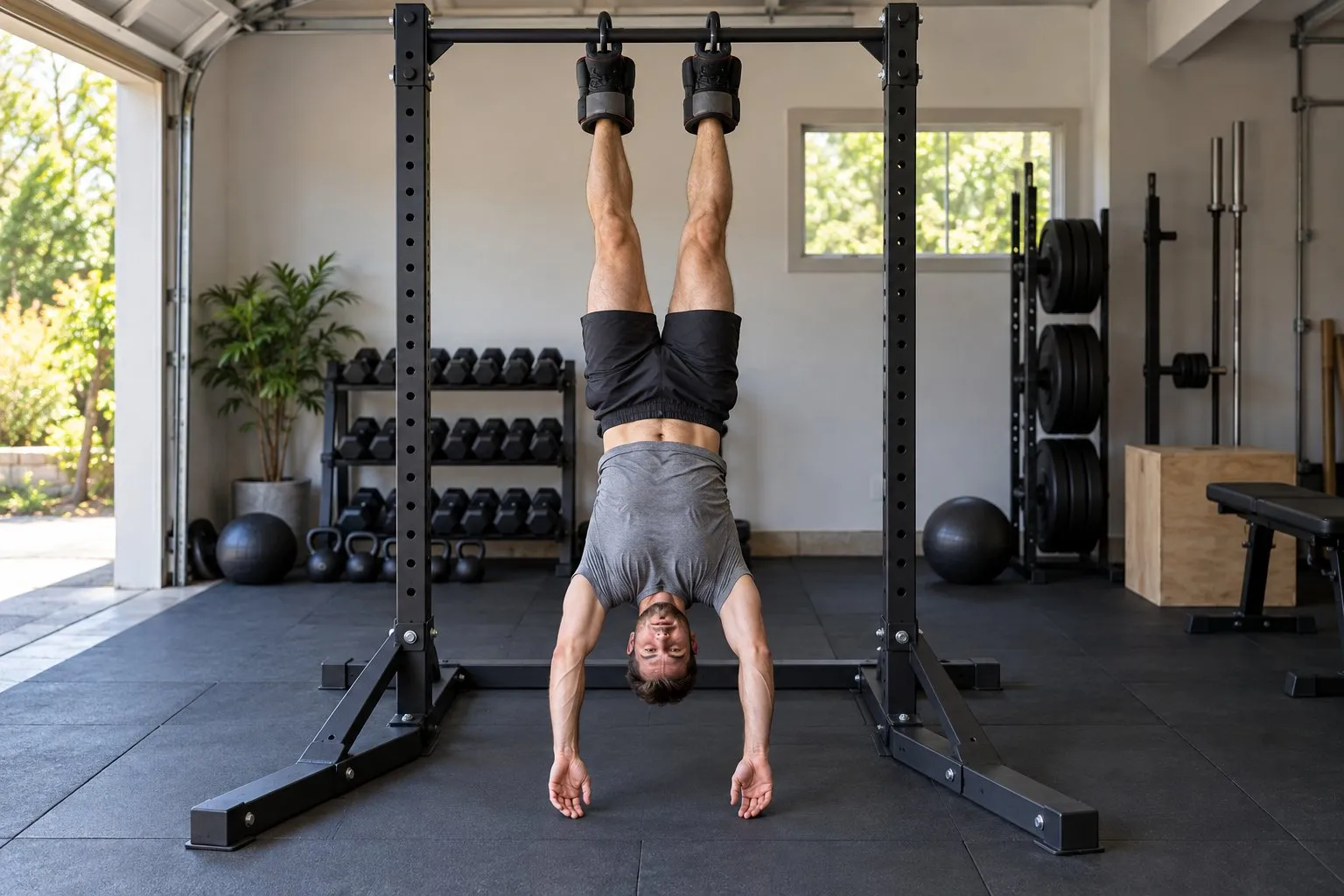
Teeter says its boots fit bars up to 1.25 inches in diameter and that the 2.5-inch hook length “allows the bar to sit deeper for a more secure attachment” (Teeter). For use on non-Teeter equipment, it adds: “Ensure a secure, durable platform before attempting inversion” (Teeter). In practice that means a bar that does not flex, rotate or shift under your full weight, mounted into something solid. A thick bar lets the hooks sit shallower, and a bar that moves is the start of the fall described above.
Teeter’s Own Chin-Up Rack Is Rated to 250 lb
Here is the detail that changes the math. Teeter rates the gravity boots themselves to 300 lb, but the doorway Chin-Up Rack it sells for using them at home is rated to 250 lb (Teeter).
The same logic applies to any bar: a pull-up bar, a power rack or a joist-mounted pipe has its own limit, and if its maker does not publish one, you don’t know it. If you weigh more than 250 lb, check the bar before the boots. If you are heavier than 300 lb, no gravity boots we found are rated for you, and a table built for your weight is the better route; our guide to the inversion table with a 400 lb capacity covers those.
Using the Boots on a Teeter Table
If you already own a Teeter table, the boots can hang from it. Teeter lists them as compatible with the FitSpine X1, EP-560, EP-860 and NXT-S, and with its own inversion racks and bars (Teeter). The FitSpine X3 and LX9 are not named on that page. That is not a statement that they are incompatible, only that Teeter does not list them there, so ask Teeter before you try it on either.
Best Gravity Boots Overall: Teeter EZ-Up Gravity Boots
This is the pair to buy if you want every spec backed by the company that makes it.
Five-year full warrantyVerified
by TEETER
Best for buyers who want every spec backed by the company that makes it.
Skip it if you weigh more than 250 lb and plan to hang from Teeter's own Chin-Up Rack, which is rated to 250 lb.
The only gravity boots with a full manufacturer spec sheet, a five-year warranty and an FDA record behind them. Fewer buyers have reviewed them than the budget pair, but every number here is Teeter's own.
- Weight limit
- 300 lb
- Warranty
- 5 years
- Price range
- Budget
What we like
- Five-year full warranty
- Named in Teeter's FDA 510(k) record, K162702
- Standard and XL sizes; XL is 1 in wider and 1.5 in taller
- Rated to 300 lb, on Teeter's own spec sheet
Keep in mind
- No angle control: you go straight to full inversion
- Teeter's own Chin-Up Rack is rated to only 250 lb
- Bar must be no more than 1.25 in across
- XL size comes without the calf loops
Full specs
- Price range
- Budget
- Weight capacity
- 300 lb
- User height
- Not stated
- Angle control
- No angle control: hanging from a bar puts you fully inverted at once
- Ankle system
- Padded ankle cuffs with hooks, Standard and XL sizes
- Heat and massage
- None
- Warranty
- 5 years full
- FDA
- Named in Teeter's 510(k) K162702, Class I device type
VerifiedFrom the maker's product page. Not stated means the maker publishes nothing.
We may earn a commission. It never changes which table we pick, or the order they appear in.
Why the Teeter Pair
Teeter is the only gravity boots maker we found that publishes a complete spec sheet. It rates the boots to 300 lb and closes them with “dual-lock ratchet buckles” over thick foam liners. The shell is DuPont Hytrel reinforced with a 40% glass and nylon alloy, finished with 2.5-inch non-skid hooks meant “to help reduce movement along the bar while inverted” (Teeter, 2026).
The Standard pair also comes with calf loops, which Teeter says create “a slight bend in the knees to reduce the load on the knee joints and tops of the feet,” and an EZ-Up strap in the box (Teeter). The warranty is a five-year full warranty, the same term Teeter gives its tables.
Standard or XL
Size depends on your calf, not your shoe. Standard fits calves under 16 inches in circumference; XL is for 16 inches and up (Teeter). Teeter’s product page adds that XL is 1 inch larger in diameter and 1.5 inches taller, and that it does not include the calf loops (Teeter).
Measure the widest part of your calf before ordering. A cuff that is too loose is a safety problem, not a comfort one.
The FDA Record, and What It Means
The FDA cleared a group of Teeter devices through the 510(k) process under number K162702, decided December 30, 2016, with a finding of “substantially equivalent.” The device list on that record names “Teeter Gravity Boots” alongside the Teeter Manual Inversion Table (FDA, 2016). The device type, non-powered traction apparatus, is Class I, the FDA’s lowest-risk class (FDA).
Be clear about what that is. A 510(k) clearance means the FDA agreed the device is substantially equivalent to one already on the market; it is not a finding that the boots treat back pain.
It still sets Teeter apart: an article on how inversion therapy is regulated, published in Disability and Rehabilitation in 2023, explains that the FDA only regulates devices whose makers claim a medical use, and most makers of these products do not (Kassay, 2023). Teeter chose to be reviewed. None of the budget boots we found state any FDA status.
Returns and Stock
Bought directly from Teeter, products in original condition can be returned within 90 days of delivery for the full item price; returns that show obvious use get up to 50% (Teeter). That applies to teeter.com only. On Amazon, Amazon’s return policy applies.
Stock on this pair has been thin, and the card above shows the current state. If it is unavailable when you check, the specs above still hold.
Best Budget Gravity Boots: Sutekus Anti Gravity Inversion Boots
If you have used gravity boots before and want the lowest spend, this is the pair we would look at, with the gaps spelled out.
Listed to 300 lbClaimed
by Sutekus
Best for people who have used gravity boots before and want the lowest spend.
Skip it if you are new to boots, near the top of the weight range, or want a company that documents its product and stands behind it with a warranty.
The cheapest pair here with a long record of buyers, at roughly a third of Teeter's price. There is no manufacturer spec sheet, no stated warranty and no FDA record: every figure comes from the listing.
- Weight limit
- 300 lb
- Price range
- Budget
What we like
- Listed at 300 lb, the same figure as Teeter's boots
- Strap lock with 1.2 in foam padding
- Chrome-plated hooks that attach to most chin-up bars
Keep in mind
- No manufacturer spec sheet, only the Amazon listing
- No stated warranty and no FDA record
- No angle control: you go straight to full inversion
Full specs
- Price range
- Budget
- Weight capacity
- 300 lb
- User height
- Not stated
- Angle control
- No angle control: hanging from a bar puts you fully inverted at once
- Ankle system
- Strap locking system with 1.2" foam padding and chrome-plated hooks
- Heat and massage
- None
- Warranty
- Not stated
- FDA
- Not stated
ClaimedFrom the retail listing; no maker spec sheet
We may earn a commission. It never changes which table we pick, or the order they appear in.
What the Listing Says
The Sutekus listing claims a 300 lb capacity, a strap locking system with 1.2-inch foam padding, and chrome-plated hooks, and says the boots attach to most chin-up bars. It is sold as a budget pair for ab crunches, sit-ups and hanging, which is how most buyers use it.
What You Give Up
Three things, all of them about documentation. First, there is no manufacturer spec sheet: every figure above comes from the Amazon listing, so we can repeat it but can’t verify it the way we verified Teeter’s. Second, no warranty is stated. Third, there is no FDA record. None of that makes the boots unsafe, but it means that if something fails, you have less to fall back on.
The closure matters too. Teeter’s ratchet buckles lock in steps; a strap closure depends on you pulling it tight and checking it every time. Whatever pair you buy, the checks in the safety section above are not optional.
Sutekus or Teeter?
Pick the Sutekus if you already know how your body handles full inversion and the price gap matters more to you than a warranty. Pick the Teeter if you are new to boots, you are near the top of the weight range, or you want a company that documents its product and stands behind it for five years.
Inversion Boots We Looked at but Didn’t Pick
A few names come up whenever people search for gravity boots. Here is why they are not on the list.
See the boots we looked at but didn't pick
Body-Solid GIB2R Inversion Boots
Body-Solid is a real equipment maker with its own product page for the GIB2R. It describes a “heavy-duty single-action locking mechanism,” a “built-in safety lever” and extra pads for different users, and says the boots need a horizontal bar such as a power rack or pull-up bar (Body-Solid). What the page does not publish anywhere is a maximum user weight or a calf size range, so on those two points the answer is “Not stated.”
The boots were also out of stock on Body-Solid’s own site when we checked, and we have no listing we can link to. With no weight rating and nothing to buy, we can’t recommend them, but if they return with a published capacity, they would be worth a second look.
Ironman “Gravity” Models Are Tables, Not Boots
If you searched for Ironman gravity boots, you probably found the Gravity 2000, 4000 or 5000. Those are inversion tables; “Gravity” is the model name, not the product type. The Gravity 4000 owner’s manual, for example, gives it a 350 lb maximum capacity as a table (Ironman manual, via ManualsLib). We found no hanging boots sold under the Ironman name.
Other Budget Listings
Amazon carries several other budget pairs sold only through their listings, with no maker site behind them. Until we can check their specs and buyer record the way we checked the two picks, they stay off the list.
What Gravity Boots Can and Can’t Do for Your Back
It is worth being honest about the upside before you hang from a bar for it.
Traction, Not a Proven Treatment
Hanging from boots is a form of traction: your body weight pulls on the spine. The best summary of traction for back pain is a Cochrane review published in 2013 that pooled 32 trials with 2,762 people and found traction, alone or with other treatments, had “little or no impact” on pain, function or return to work (Wegner, 2013). That review covers traction in general, not inversion, and some smaller inversion studies are more encouraging. Our page on inversion table benefits sets out what the research does and doesn’t support.
No Study on the Boots Themselves
We found no trial of gravity boots for back pain and no study of injuries caused by them. The 1983 Klatz letter measured blood pressure and eye pressure in boots over three minutes, not back pain; the rest of what this page says about their effects comes from studies of inversion on other devices, which are the closest match. When you read that gravity boots “decompress the spine” or “relieve back pain,” that is the maker’s description, not a measured result. If you notice side effects such as headaches, eye pressure or worse back pain, stop and read our guide to inversion table side effects, which applies to boots as well.
The Honest Verdict
Gravity boots are a good tool for someone who already inverts, wants inverted exercise, and owns a solid bar rated above their weight. They are a poor first step for someone with back pain who has never been upside down. For that person, a table with a partial angle is the better buy, and the boots can come later.
Your questions, answered
Frequently Asked Questions
What are the best gravity boots?
For most buyers, the Teeter EZ-Up Gravity Boots, because Teeter is the only maker in this category that publishes a full spec sheet, a 300 lb rating, a five-year warranty and an FDA record naming the boots. If you want to spend less, the Sutekus pair lists the same 300 lb, but only on its Amazon listing, with no stated warranty.
Are there any risks to using gravity boots?
Yes, and they are the risks of inversion with less margin. You hang fully upside down from the first second, so blood pressure and eye pressure rise as they do at full tilt on a table. The serious documented danger is a fall onto the head if an ankle lock, a hook or your ankle strength gives way, with no backrest to slow it.
What are the differences between gravity boots and an inversion table?
The main difference is control over the angle. A table holds you on a backrest and lets you tilt back a little, stop, and go further when ready. Boots hook onto a bar and leave you hanging at full inversion straight away. Boots take less space and suit inverted exercises; a table suits beginners and anyone who needs a partial angle.
How long should you hang with gravity boots?
Start with well under a minute. Teeter tells new users to begin with a shorter session without giving a number. The authors of a report on three spinal cord injuries after inversion table falls advise under one minute per session, while a 1985 ophthalmologist's letter put 10 to 15 minutes as a ceiling for eye safety. With boots, which offer no partial angle, begin at the short end.
Do gravity boots actually work?
They do what they promise mechanically: your body weight pulls on your spine while you hang. Whether that relieves back pain is less certain. A Cochrane team that pooled 32 trials of traction found little or no effect on low-back pain, and nobody has published a trial of gravity boots specifically. Some people feel relief; the evidence does not guarantee it.
What is the purpose of gravity boots?
Gravity boots let you hang upside down by your ankles from a bar. Teeter sells them for two jobs: spinal decompression, meaning a stretch from your own body weight, and inverted exercise such as crunches, sit-ups and leg raises. They are the smallest way to invert at home, provided you already own a bar strong enough to hold you.
20 sources used for this guide
Each linked to the original. Citations in the text jump here.
View sources
Teeter. Gravity Boots: What They Are, How They Work, and How to Get Started. teeter.com/blog/gravity-boots-inversion-at-home/, 17/04/2026.
Teeter (Stl International, Inc.). Gravity Boots & Doorway Inversion Systems (ficha de produto). teeter.com/product/gravity-boots/.
Teeter (Stl International, Inc.). Gravity Boots with Adapter Kit (ficha de produto). teeter.com/product/gravity-boots-adapter-kit/.
Weinreb RN, Cook J, Friberg TR. Effect of inverted body position on intraocular pressure. American Journal of Ophthalmology 1984;98(6):784-787.
Jung SH, Hwang JM, Kim CH. Inversion Table Fall Injury, the Phantom Menace: Three Case Reports on Cervical Spinal Cord Injury. Healthcare (Basel) 2021;9(5):492.
CPSC. ICON Health & Fitness Recalls Inversion Benches Due to Fall Hazard. U.S. Consumer Product Safety Commission, cpsc.gov, recall 10-210, April 28, 2010.
DICK'S Sporting Goods. DICK'S Sporting Goods Voluntarily Recalls Fitness Gear Inversion Table. company recall notice via PR Newswire, January 8, 2015.
CPSC. Inversion Therapy Tables Recalled by Stamina Products Due to Fall Hazard. U.S. Consumer Product Safety Commission, recall 08538, January 16, 2008.
Innova. ITX9600 Heavy Duty Deluxe Inversion Therapy Table, Owner's Manual (version 1709AJJ). Innova Products Inc., owner's manual.
Haskvitz EM, Hanten WP. Blood pressure response to inversion traction. Physical Therapy 1986;66(9):1361-1364.
Klatz RM, Goldman RM, Tarr RS, Pinchuk BG. Gravity inversion therapy. The Western Journal of Medicine 1983;139(4):538-540.
Friberg TR. Ocular effects of gravity inversion. The Western Journal of Medicine 1985;143(4):530-531.
Teeter. Are there health issues that would prevent me from inverting?. teeter.com, Support Center (the same list appears in the owner's manual).
FDA. 510(k) Premarket Notification K162702: Teeter Manual Inversion Table. U.S. Food and Drug Administration, 510(k) database, decision date December 30, 2016.
FDA. Device classification, product code HST: Apparatus, Traction, Non-Powered. U.S. Food and Drug Administration, device classification database (openFDA), 21 CFR 888.5850.
Kassay A, Soliman MAR, Jhawar BS. Recommendations for inversion table therapy. Disability and Rehabilitation 2023;45(22):3779-3782.
Teeter. Return Policy. teeter.com, Return Policy.
Body-Solid, Inc. Body-Solid Tools GIB2R Inversion Boots (ficha de produto). bodysolid.com/inversion-boots.
Ironman Fitness (Paradigm Health & Wellness Inc.). Ironman Fitness Gravity 4000 Owner's Manual. Owner's manual, hosted on ManualsLib.
Wegner I, Widyahening IS, van Tulder MW et al. Traction for low-back pain with or without sciatica. Cochrane Database of Systematic Reviews 2013, CD003010.