Health guide
Scapular Pull-Ups: Form, Benefits and a Plan Toward Full Pull-Ups
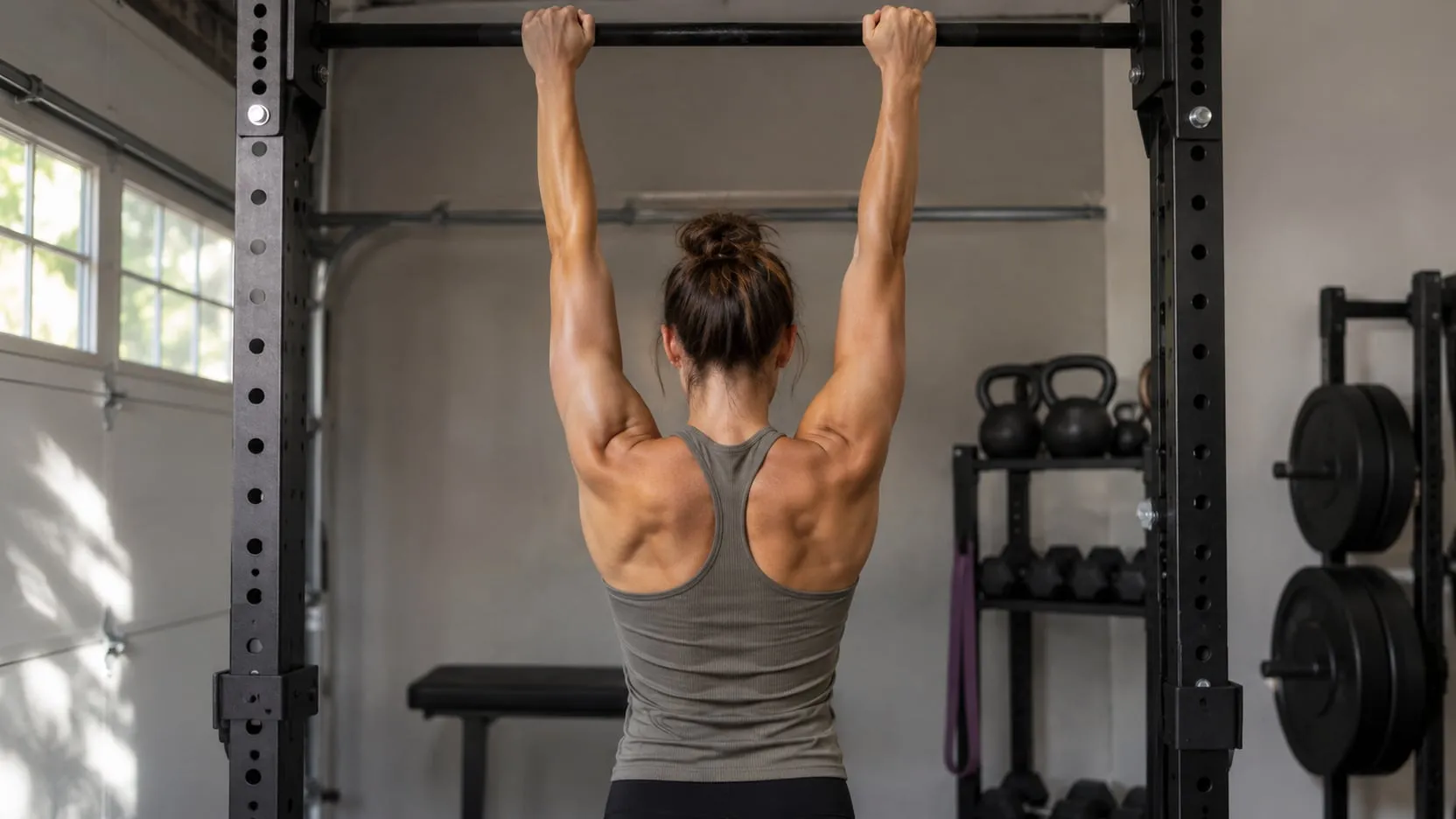
Scapular pull-ups are one of the most useful and least glamorous moves you can do on a bar. Your arms stay straight, your body barely moves, and nobody films them. Yet they train the first part of every pull-up and teach your shoulders to sit in a stable position while you hang. This guide covers how to do scapular pull-ups, what they train, how many to do, easier and harder versions, and who should be careful. We have not tested anyone; every claim about muscles or safety names its source, and we say when the research is about pull-ups in general rather than this drill.
What a Scapular Pull-Up Is
Your shoulder blades (scapulae) slide on the back of your rib cage. When you hang loosely from a bar, they ride up toward your ears. When you start a pull-up, the first thing that happens, before your elbows bend, is that they move down and slightly together. A scapular pull-up isolates that first part.
Dead Hang, Active Hang, Scapular Pull-Up
| Feature | Dead hang | Active hang | Scapular pull-up |
|---|---|---|---|
| Shoulder blades | Relaxed, up near the ears | Held down and back | Moved down and back, then released |
| Elbows | Straight | Straight | Straight |
| Body | Still | Still | Rises an inch or two, then lowers |
| Main job | Grip and a relaxed stretch | Shoulder position | Shoulder blade strength and control |
The active hang is the held position; the scapular pull-up is the repeated movement into it. Our page on dead hang versus active hang compares the two holds in more detail.
Depression and Retraction
Two movements combine here. Depression draws the shoulder blades down away from your ears. Retraction squeezes them back toward the spine. ACE’s pulling instructions put the two together: “Depress and retract your scapulae (pull shoulders back and down) and attempt to hold this position throughout the exercise” (American). In a scapular pull-up the down part is the main movement and the back part is a small squeeze.
How to Do Scapular Pull-Ups
Step by Step
- Hang from the bar with an overhand grip about shoulder width apart and your thumbs wrapped around the bar.
- Let yourself settle into a dead hang, arms straight, shoulders allowed to rise.
- Brace your stomach lightly and keep your legs still.
- Without bending your elbows, pull your shoulder blades down and slightly together. Your body should rise an inch or two and your neck should look longer.
- Hold for one to two seconds.
- Slowly let the shoulder blades rise back to the dead hang. That is one rep.
Form Checks
- Elbows straight. If they bend, it has become a partial pull-up and the arms are doing the work.
- No shrug. At the top, your shoulders should be further from your ears, not closer.
- No swing. If your legs start to pendulum, pause in a still hang.
- Slow lowering. Let the blades rise under control. Dropping into the bottom jolts the shoulder.
Grip Choice
Use a shoulder-width overhand grip to start. In a study of 11 regular pull-up performers that tracked the shoulder blade, the authors linked wide and reverse grips with movement patterns they associate with higher impingement risk (Prinold, 2016). In a separate study of 19 strength-trained men, activation across palms-toward, palms-away, neutral and rope pull-ups was similar overall (Dickie, 2017). So the grip that feels best on your shoulder is a fair choice, and a moderate width is the safe default.
What Scapular Pull-Ups Train
The Muscles That Move the Shoulder Blades
The movement is driven by the muscles that pull the shoulder blades down and together, chiefly the lower and middle trapezius, with help from the lats. We found no EMG study of the scapular pull-up itself (our Europe PMC search returned nothing on the drill). The nearest data are for full pull-ups: in a study of 25 adults, the lower trapezius was significantly more active in the pull-up than in the chin-up, while the chin-up worked the chest and biceps more (Youdas, 2010). It is reasonable to expect the down-and-back phase to rely on the same lower trapezius, but that is an inference, not a measurement.
Why Control Matters for the Shoulder
When your arms are overhead, the space at the top of the shoulder narrows. The 2016 tracking study found that high arm elevation during pull-ups reduced the sub-acromial space and raised pressure there (Prinold, 2016). Learning to hold the shoulder blades in a set position is the practical response: it is the position ACE asks you to keep throughout a pull (American), and the scapular pull-up is the drill that rehearses it.
Sets, Reps and Where to Put Them
How Many
No study has set a dose for scapular pull-ups. General strength guidance from the American College of Sports Medicine’s 2026 position stand found strength improved with training at least two days a week (Currier, 2026). A practical plan:
| Goal | Sets x reps | Hold at the top | Sessions a week |
|---|---|---|---|
| Learn the movement | 2 x 6 to 8 | 1 second | 2 to 3 |
| Build control | 3 x 8 to 12 | 2 seconds | 2 to 3 |
| Warm-up before pull-ups | 1 to 2 x 6 | 1 second | Every pulling session |
This is our suggestion, built on the ACSM frequency finding, not a tested program.
Where They Fit in a Workout
Put scapular pull-ups early, after a short warm-up, while your shoulders are fresh. They also pair well with the hanging leg raise, where the same set shoulder position keeps you stable while your legs move.
Common Scapular Pull-Up Mistakes
Because the movement is so small, it is easy to do something that looks similar and trains something else. These are the four errors worth checking in a mirror or a phone video.
Bending the Elbows
The most common fault. Once the elbows bend, the biceps and lats take over and the drill turns into a short, weak pull-up. Lock your elbows straight and accept that the range is only an inch or two.
Shrugging Instead of Depressing
Some people lift their shoulders toward their ears at the top, which is the opposite movement. A good check is your neck: at the top of a correct rep it looks longer, not shorter.
Arching the Lower Back
Pushing the chest out and arching the back can fake the rise. Keep your ribs down and a light brace, so the movement comes from the shoulder blades.
Rushing the Reps
Bouncing quickly between the top and the bottom uses momentum. A one to two second hold at the top and a slow release make each rep count.
Easier and Harder Versions
Easier: Feet-Assisted
Set a box under the bar and keep your toes on it, taking some of your weight. The movement is the same; the load is smaller.
Easier: Band-Assisted
Loop a resistance band over the bar and put a knee or foot in it. The band helps most at the bottom, which is where beginners struggle.
Harder: Longer Holds and Slower Lowering
Hold the top for three to five seconds, and take three seconds to lower. This builds endurance in the position.
Harder: Scapular Pull-Up Into a Pull-Up
Do the scapular pull-up, hold, then continue into a full pull-up without losing the shoulder position. Lower to the active hang, then relax to the dead hang. This is the bridge to clean pull-ups.
From Scapular Pull-Ups to Your First Full Pull-Up
- A 20 to 30 second dead hang. Our dead hang exercise guide covers form.
- A 10 to 20 second active hang.
- Three sets of 8 to 12 scapular pull-ups.
- Slow negatives: jump or step to the top position and lower over three to five seconds.
- Band-assisted or feet-assisted pull-ups. The 2016 tracking study authors suggest weight-assisted front pull-ups could suit weaker people, though they say this needs more study (Prinold, 2016).
- Your first full pull-up, started with a scapular pull-up.
Each step should be clean before the next. If you train at home, the bar matters too: our guide to doorway pull-up bars covers fit and limits.
Who Should Be Careful
Shoulder Pain
If lifting your arms overhead hurts, a hang is not the place to start. Try the floor version with a band, and ask a clinician or physical therapist before hanging. Stop for sharp pain, pinching at the top of the shoulder, or pain, tingling or numbness that runs down the arm.
A Recent Injury or Dislocation
Hanging loads the shoulder in a stretched position. After a dislocation, a rotator cuff injury or shoulder surgery, get clearance first.
Grip and Elbows
If your grip fails before your shoulders, use a feet-assisted version rather than hanging on with a death grip. Elbow pain during hangs is another reason to reduce the load and take a few days off.
The Takeaway
Scapular pull-ups are small, slow and worth doing. Hang, pull the shoulder blades down and slightly back with straight arms, hold, and lower under control. Do a few sets two or three times a week, use them as a warm-up before pull-ups, and treat them as the bridge from hanging to pulling. The research on this exact drill is missing, but the shoulder position it trains is the one every pulling guide asks you to hold.
Your questions, answered
Frequently Asked Questions
What to do instead of scapular pull ups?
If hanging is not possible yet, practice the same shoulder movement with your feet on the floor: hold a bar or a band overhead and draw your shoulder blades down without bending the elbows. A lat pulldown machine done with straight arms works too. Scapular push-ups train the opposite pairing, pushing the blades apart, and suit a warm-up.
What are scapular retractions?
A scapular retraction means squeezing your shoulder blades back toward your spine. In a scapular pull-up it comes with depression, drawing the blades down away from your ears, which is the pairing ACE describes as pulling the shoulders back and down. Rowing exercises train retraction on its own, with your body upright or leaning back.
Do pull-ups build shoulder strength?
They build strength in the muscles that move and steady the shoulder blade and upper arm, mainly the lats, the trapezius and the muscles of the rotator cuff, plus the biceps. They are not a shoulder press, so the front of the shoulder gets less work. Good form matters, because a high arm position also narrows space in the joint.
Does hanging help with pull-ups?
Yes, as a first step. A dead hang builds the grip endurance a pull-up needs, and an active hang or scapular pull-up adds the shoulder blade control that starts every rep. Hanging alone won't teach you to pull your chin over the bar, so pair it with rows, negatives or assisted pull-ups as you progress.
5 sources used for this guide
Each linked to the original. Citations in the text jump here.
View sources
American Council on Exercise. Chin-ups (Exercise Library). acefitness.org, exercise library entry 190.
Youdas JW, Amundson CL, Cicero KS, Hahn JJ, Harezlak DT, Hollman JH. Surface electromyographic activation patterns and elbow joint motion during a pull-up, chin-up, or perfect-pullup rotational exercise. Journal of Strength and Conditioning Research 2010;24(12):3404-3414.
Prinold JA, Bull AM. Scapula kinematics of pull-up techniques: Avoiding impingement risk with training changes. Journal of Science and Medicine in Sport 2016;19(8):629-635.
Currier BS, D'Souza AC, Singh MAF, et al. American College of Sports Medicine Position Stand. Resistance Training Prescription for Muscle Function, Hypertrophy, and Physical Performance in Healthy Adults: An Overview of Reviews. Medicine & Science in Sports & Exercise 2026;58(4):851-872.
Dickie JA, Faulkner JA, Barnes MJ, Lark SD. Electromyographic analysis of muscle activation during pull-up variations. Journal of Electromyography and Kinesiology 2017;32:30-36.